



Who Should Read This?
- eCommerce businesses preparing for Christmas trading
- Retailers expecting a rise in online orders over Black Friday and Christmas
- Marketing and digital teams responsible for website performance
- Businesses looking to improve online sales without simply spending more on advertising
Why It’s Worth Reading
- Christmas can bring a major increase in website traffic, but that does not automatically mean more sales
- Slow pages, poor mobile experiences and complicated checkouts can quickly cost you customers
- Small improvements to product pages, delivery information and checkout can make a noticeable difference
- Preparing early gives you time to fix problems before your busiest trading days
What You’ll Learn
- What to check before Christmas traffic increases
- How to make your website easier to shop
- Why speed, mobile performance and checkout matter
- How stock, delivery and website data can affect Christmas sales
Why Christmas eCommerce Matters
Christmas remains one of the biggest opportunities in the retail calendar, and more of that spending continues to happen online.
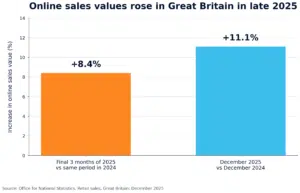
According to the Office for National Statistics, the amount spent online in Great Britain was 8.4% higher in the final three months of 2025 than during the same period in 2024. In December alone, online sales values were 11.1% higher than December 2024.
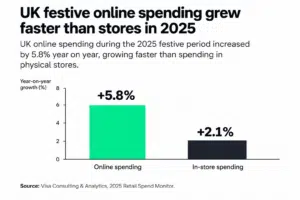
Visa also reported that UK online spending during the 2025 festive period increased by 5.8% year on year, growing faster than spending in physical stores.
These numbers show strong opportunities for eCommerce stores to get ahead, however, increased traffic only helps if your website makes it easy for people to buy.
Christmas shoppers are often short on time. If pages are slow, products are difficult to find or delivery information is unclear, there is usually another retailer only a click away.
Make Sure Your Website Can Handle the Rush
A successful Christmas campaign can send considerably more visitors to your website than usual. That is great, provided the site can cope.
Before peak trading starts, check the pages that matter most. For example:
- Homepage
- Product and category pages
- Site search
- Basket
- Checkout
Large images, unnecessary plugins and poorly optimised code can all slow a website down. It is also worth testing how the site performs when lots of customers are using it at once. This is often called load testing, which means simulating high visitor numbers before they happen for real.
Finding a problem during testing is much better than discovering it in the middle of your biggest Christmas campaign.
💡 Mobile performance matters just as much.
Customers could be browsing from the sofa, opening an email on their commute or clicking an advert on social media. Go through your whole buying journey on a phone.
Can you find a product easily? Use the filters? Add something to your basket? Enter your details? Complete payment without unnecessary steps?
A website being technically “mobile-friendly” is not enough. It should actually be easy to shop from.
Help Customers Find and Buy the Right Product
Christmas shoppers often behave differently from your everyday customers.
Some know exactly what they want. Others may be buying for someone with interests they know very little about. Your website should help both.
Christmas gift collections can make browsing easier. Depending on your business, that might include:
- Gifts under £25
- Gifts under £50
- Stocking fillers
- Bestsellers
- Gifts for beginners
- Last-minute gifts
The important thing is to organise products around how customers actually shop, rather than expecting them to understand your internal product categories.
Website search and filters also become more important at Christmas. Try searching your own site using the words a customer would use, rather than your exact product terminology.
Do the right products appear?
If customers regularly search for something and get no useful results, that could point to a gap in your navigation, product naming or search setup.
Once they reach a product page, make the next decision easy too. Customers should quickly be able to understand:
- What the product is
- What is included
- Whether it is in stock
- When it will arrive
- Whether it can be returned
Clear product information reduces doubt and gives people more confidence to buy.
Make Delivery and Stock Clear
As Christmas gets closer, delivery becomes one of the biggest factors in a buying decision.
A customer may love the product, but if they are not sure it will arrive before Christmas Day, they may simply go somewhere else. Make your Christmas delivery information easy to find.
Customers should know:
- Delivery costs
- Expected delivery times
- Your final Christmas order date
- Whether express delivery is available
- Whether Click & Collect is available
As the deadline gets closer, make that information more prominent.
Something as simple as:
“Order by 2pm on 20 December for Christmas delivery”
can remove uncertainty and help customers make a decision.
Stock information needs to be accurate too. If somebody places an order and then finds out two days later that the product was actually unavailable, you are likely to create frustration at exactly the wrong time of year.
If you sell through several channels, connecting your stock systems can help keep availability accurate.
Review Your Checkout Experience
By this point, the customer has already decided they want the product. Do not make them work unnecessarily hard to complete the purchase.
Check:
- Can customers check out as a guest?
- Are delivery charges clear?
- Is the checkout easy to use on mobile?
- Do discount codes work properly?
- Are payment options straightforward?
Every extra step creates another opportunity for somebody to leave.
Test Your Christmas Campaigns Properly
Christmas usually means more promotions, more emails, more paid advertising and more landing pages. Before anything goes live, test the complete customer journey.
Click through from the email or advert → Check the landing page → Add the promoted product to the basket → Apply the discount code → Complete the checkout.
You should be making sure that:
- Promotions start and finish at the right time
- Discount codes work
- Sale prices display correctly
- Links point to the right pages
- Products being promoted are actually available
It is also important that your teams are working from the same plan.
Marketing, eCommerce, development, fulfilment and customer service should all know which campaigns are running, what products are being promoted and what the delivery deadlines are.
A lot of peak-season problems can be avoided simply by making sure everyone has the same information.
Use Your Data to Improve as You Go
Don’t wait until January to decide whether Christmas went well. Keep an eye on how customers are behaving while campaigns are running.
For example:
Lots of people reaching product pages but not adding anything to their basket?
Review your product information, price and delivery messaging.
Lots of baskets but not many completed orders?
Look at the checkout.
Plenty of advertising traffic but very few sales?
Check whether the campaign and landing page match what customers were expecting.
Useful measures include:
- Online sales
- Conversion rate
- Basket abandonment
- Average order value
- Bestselling products
- Mobile performance
Focus on the information that helps you make useful decisions for your business.
Final Thoughts
Getting your eCommerce website ready for Christmas is not about adding festive graphics and putting a sale banner on the homepage, it is about making buying as easy as possible.
Customers should be able to find the right product, understand what they are buying, know when it will arrive and complete their order without unnecessary frustration.
Start early, test the important parts of the journey and use your data to understand where customers are struggling. Because when Christmas traffic arrives, you want your team focused on making the most of the opportunity, not fixing problems that could have been found weeks earlier.
At CDA, we help businesses improve eCommerce websites and digital experiences using strategy, data and technology. If you want to understand where your eCommerce website could be performing better before the Christmas rush, get in touch with the team today.

