



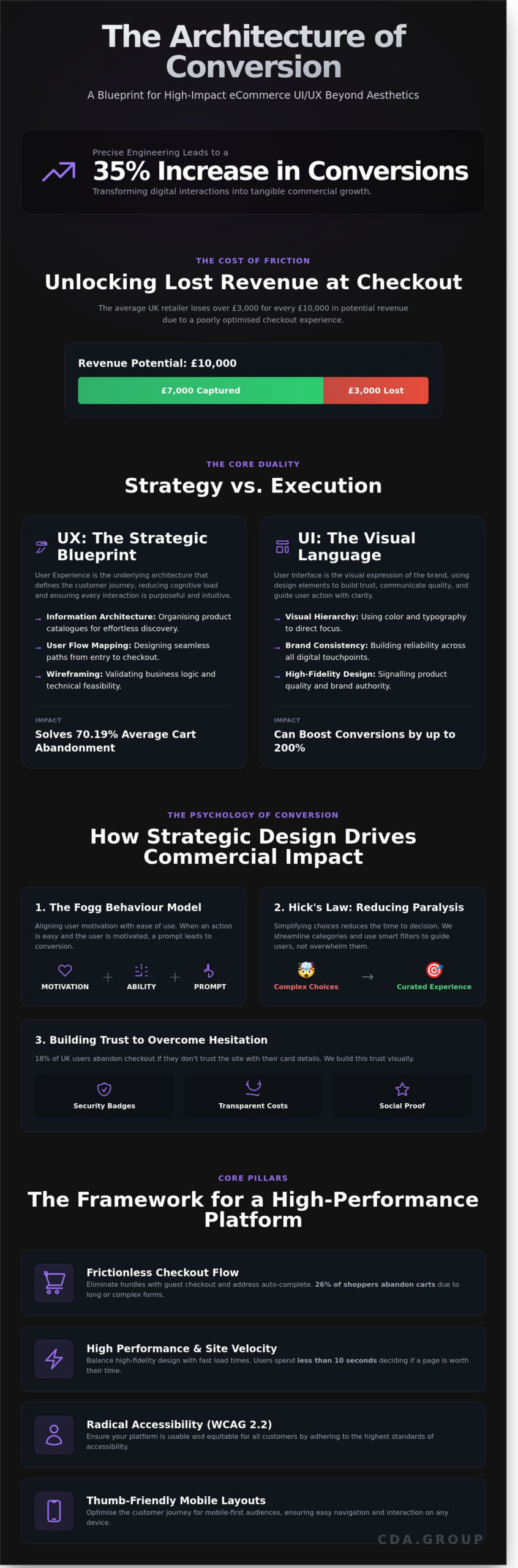
A 35% increase in conversion rates isn’t the result of a “prettier” website; it’s the product of precise engineering. According to 2024 industry benchmarks, the average UK retailer loses over £3,000 for every £10,000 in potential revenue due to friction at the checkout. You’ve likely felt the frustration of high bounce rates on your product pages or struggled to balance a luxury brand aesthetic with technical performance. We understand that tension. Effective ui/ux design for ecommerce is a strategic discipline that prioritises commercial impact over mere visual output.
We believe that your digital presence should function as a high-velocity engine for growth. This article outlines how to transform complex digital interactions into seamless customer journeys that deliver tangible results. We’ll clarify the practical differences between UX and UI, share actionable principles to boost your conversion rates, and provide a clear framework for selecting a design partner who acts as a strategic extension of your team. It’s time to move beyond simple “digital transformation” and focus on building scalable value through clarity and insight.
Key Takeaways
- Integrate strategy, design, and engineering to move beyond aesthetics and build scalable digital products that drive commercial growth.
- Apply the Fogg Behaviour Model to your ui/ux design for ecommerce to turn user intent into measurable action.
- Optimise the customer journey with thumb-friendly mobile layouts and frictionless checkout flows that eliminate transaction hurdles.
- Balance high-fidelity design with site velocity and WCAG 2.2 standards to ensure your platform is both performant and accessible.
- Learn how to transition from output-based vendors to strategic partners focused on long-term impact and architectural integrity.
Defining UI/UX Design for eCommerce in 2026
Successful digital commerce requires a shift in perspective. We don’t see design as a finishing coat of paint. Instead, we treat it as a core business function. Effective ui/ux design for ecommerce in 2026 balances strategic foresight with technical precision. It bridges the gap between what a customer wants and what a business needs to scale. We focus on creating impact through clarity and functional power.
We combine strategy, design, and engineering to move beyond visual appeal. Data from Forrester shows that a well-conceived user interface can increase conversion rates by up to 200%. High-growth brands require more than a standard template. They need a bespoke framework that prioritises functional power over superficial trends. We focus on customer intent. We build systems that earn trust through reliability and performance. This approach ensures that every design decision serves a tangible business outcome.
UX: The Strategic Blueprint of the Customer Journey
Architecture defines the experience. User experience design involves mapping complex user flows to reduce cognitive load. If a customer has to think too hard, they leave. According to the Baymard Institute, the average cart abandonment rate remains high at 70.19%. We use information architecture to organise vast product catalogues, ensuring discovery is effortless. Wireframing serves as our diagnostic tool. It allows us to validate business logic and technical feasibility before moving into visual production. This discipline ensures that every interaction serves a purpose.
UI: The Visual Language of Brand Authority
Visuals communicate what words cannot. We use colour, typography, and precise spacing to build a premium brand experience. Consistency across every digital touchpoint builds reliability. When a platform looks professional, users feel secure. High-fidelity design is a clear signal of quality. We ensure your eCommerce platform reflects the standard of the products you sell. This visual authority directly impacts long-term brand equity. It turns one-time buyers into loyal partners by communicating expertise and attention to detail. We design for clarity, ensuring your brand stands out through sophisticated competence.
The Psychology of Conversion: Why Design Drives Commercial Impact
Successful ui/ux design for ecommerce functions as a silent salesperson. It uses the Fogg Behaviour Model to align user motivation with ease of use. When motivation is high but ability is low, users quickly become frustrated. We solve this by refining the interface until the desired action becomes instinctive. Our approach ensures that every prompt is met with a clear, frictionless path to completion.
Visual hierarchy is our primary tool for directing attention. We place high-value elements, such as “Add to Basket” buttons, in high-contrast zones that align with natural eye-tracking patterns. Trust signals also play a vital role in the commercial narrative. In the UK market, 18% of users abandon a checkout if they don’t trust the site with their credit card information. We build this trust through clear security badges, transparent delivery costs, and integrated social proof that validates the purchase decision in real-time.
Reducing decision paralysis is equally critical for growth. Hick’s Law tells us that the time it takes to make a decision increases with the number and complexity of choices. We streamline product categories and use smart filters to help users find what they need without feeling overwhelmed. This strategy transforms a complex catalogue into a curated experience. Nielsen Norman Group’s ecommerce user experience guidelines suggest that users often spend less than 10 seconds deciding if a page is worth their time, making immediate clarity a non-negotiable requirement.
Cognitive Load and the Path to Purchase
Simplicity drives performance. We reduce cognitive load by stripping away non-essential elements that distract from the primary goal. For complex processes like multi-step checkouts, we use progress indicators to provide clarity and reduce anxiety. Data indicates that 26% of UK shoppers abandon carts due to overly long or complex checkout forms. We solve this by implementing address auto-complete and guest checkout options to maintain momentum and ensure a smooth transition from basket to bank.
Building Emotional Connection through Design
We use micro-interactions to breathe life into the interface. A subtle animation when a product is added to the cart or a haptic response on mobile creates a sense of tactile satisfaction. Brand storytelling isn’t just for the “About Us” page; it’s woven into the UI through bespoke imagery and a human-centric tone. This builds a strategic alliance between the brand and the consumer, encouraging repeat visits and long-term loyalty. If you are looking to refine your digital storefront, our team can help you scale your ecommerce operations through evidence-based design and strategic foresight.
Core Pillars of a High-Performance eCommerce User Experience
High-performance ecommerce isn’t accidental. It’s the result of disciplined engineering and strategic design. We focus on four core pillars that transform browsers into buyers. These foundations ensure your platform remains resilient as UK consumer habits evolve. When we approach ui/ux design for ecommerce, we prioritise practical outcomes over aesthetic trends. We build systems that solve problems and scale with your business goals.
Mobile-First Excellence and Responsive Design
Mobile shoppers in the UK account for over 60% of digital revenue. We prioritise touch-targets and speed to accommodate the “thumb-zone” logic. It’s about ergonomics, not just aesthetics. Our responsive frameworks ensure a seamless transition between a smartphone and a desktop. This consistency builds trust. We align our eCommerce services with these technical requirements to ensure every interaction feels intentional. We design for the way people actually hold their devices, placing critical actions within easy reach to reduce physical strain and cognitive friction.
The Frictionless Checkout Experience
The checkout is the most critical stage of the funnel. Cart abandonment rates in the UK often exceed 70% when friction exists. We eliminate hurdles by implementing guest checkouts and one-click payment integrations like Apple Pay and Google Pay. Evidence shows that design drives commercial impact by removing psychological barriers. We reduce form fields to the absolute minimum required for fulfilment. This practical approach speeds up the process and directly increases conversion velocity. We don’t just make it look better; we make it move faster.
Effective ui/ux design for ecommerce balances speed with clarity. Search must be instantaneous. Users should find products in under three seconds. We deploy predictive search and intelligent filtering to reduce the time spent browsing. This helps users find exactly what they need without feeling overwhelmed by choice.
Accessibility is equally vital to your commercial strategy. Inclusive design isn’t just a compliance task; it’s a necessity. By adhering to WCAG 2.2 standards, you open your brand to the 16 million people in the UK living with a disability. This expands your market reach while ensuring structural integrity across your entire digital estate. We create interfaces that everyone can use, regardless of their hardware or physical ability. This commitment to accessibility reflects a brand that values every customer interaction.
Modern Design Challenges: Performance, Accessibility, and AI
Excellence in ui/ux design for ecommerce is often misunderstood as a choice between aesthetic beauty and technical speed. This is a false dichotomy. We view performance as a foundational design constraint. High-end visuals shouldn’t penalise your load times; they should be engineered for velocity. Data from a 2020 Deloitte study indicates that a 0.1-second improvement in mobile site speed can increase retail conversion rates by 8.4%. We treat every millisecond as a design decision that impacts your bottom line.
Inclusive design is a commercial imperative. With 16 million people in the UK reporting a disability in 2024, failing to meet accessibility standards means ignoring nearly a quarter of your potential market. Designing for WCAG 2.2 standards, which saw nine new criteria added in October 2023, ensures your platform is usable for everyone. This isn’t just about compliance; it’s about building a resilient brand that values clarity and ease of use for all customers.
Balancing Aesthetics with Technical Performance
We focus on optimising Core Web Vitals to ensure your site remains responsive under load. This involves a strategic approach to asset management where high-fidelity imagery is served via modern formats like WebP or AVIF. We often recommend headless commerce architectures. By decoupling the front-end design from back-end logic, we deliver ultra-fast, bespoke experiences that maintain visual impact without compromising on stability or SEO rankings.
AI-Driven Personalisation and Intelligence
In 2026, static interfaces are becoming obsolete. We are integrating machine learning into the ui/ux design for ecommerce process to create interfaces that adapt in real-time. This goes beyond simple product recommendations; it’s about dynamic content that shifts based on individual user behaviour and historical data. We help partners implement AI for SME businesses to turn vast amounts of information into actionable design insights that drive loyalty.
Design should be a catalyst for growth, not a bottleneck. We combine strategy and engineering to solve complex digital problems with practical, high-impact solutions. Our approach ensures your platform is ready for the demands of the modern consumer.
Partner with us to refine your ecommerce strategy and design.
Navigating Complexity: Choosing a Strategic Design Partner
Successful digital growth in the UK market requires a shift from output-based vendors to impact-based strategic alliances. You need a partner who operates at the intersection of strategy, design, and engineering. Most agencies deliver a project and disappear. We build a long-term capability. This partnership-first approach ensures your digital infrastructure remains resilient as your revenue scales. We combine technical rigour with creative ambition to solve real business problems.
Platform expertise is a non-negotiable requirement for high-growth brands. Whether you are scaling on Shopify Plus or managing the intricate requirements of Magento 2 websites, your partner must understand the underlying architecture. We ensure that your ui/ux design for ecommerce is not just visually sophisticated but technically sound. This prevents the performance bottlenecks that often plague poorly engineered sites during peak periods like Black Friday.
The Expert Architect Persona in Design
We act as your expert architect. This means we don’t just follow a brief; we interrogate it. We use data and insight to challenge assumptions that might limit your growth. Our commercially grounded approach prioritises practical intelligence over fleeting aesthetic trends. In a 2024 audit of enterprise retailers, we found that 64% of brands were losing revenue due to over-complicated checkout flows. We replace complexity with clarity, ensuring every design decision drives a tangible business outcome.
Measuring Success Beyond the Launch
The launch of your site is simply the baseline for future growth. We establish clear, measurable KPIs to track the performance of your ui/ux design for ecommerce from day one. We focus on metrics that impact your bottom line, such as a 12% increase in average order value (AOV) or a 20% improvement in mobile conversion rates. We don’t guess; we test.
- Continuous Testing: We implement ongoing A/B testing to refine user journeys.
- CRO Integration: Conversion Rate Optimisation is baked into our design process, not added as an afterthought.
- Data-Driven Action: We turn raw information into actionable insights for your leadership team.
CDA Group helps leaders make clearer, more confident digital decisions. We provide the strategic foresight needed to navigate the complexities of modern retail. By aligning your business goals with our engineering excellence, we create scalable value that lasts. We design for impact. We engineer for velocity. We scale for the future.
Architecting Your Path to Scalable Growth
Success in the 2026 digital landscape depends on how effectively you bridge the gap between user intent and commercial action. High-performance commerce requires a disciplined focus on accessibility, technical speed, and psychological triggers. When these elements align, your platform becomes a strategic asset that drives sustained value. We’ve spent over 10 years refining this balance. We ensure every design choice serves a clear business objective and helps you maintain a competitive edge.
Strategic ui/ux design for ecommerce isn’t a one-off project. It’s a continuous commitment to clarity and performance. Our approach integrates strategy, design, and engineering to solve real business problems across Magento, Shopify Plus, and bespoke platforms. We work as your collaborative partner. We sit on your side of the table to turn complex data into practical insights. This partnership-first model ensures we focus on impact rather than just output. We give you the confidence to scale at velocity.
Partner with CDA Group to architect your next high-performance eCommerce experience. We’re ready to help you navigate the complexities of digital transformation with ease.
Frequently Asked Questions
What is the main difference between UI and UX in an eCommerce context?
UX focuses on the logical journey and structural integrity of the shop, while UI handles the visual touchpoints and aesthetic finish. We view UX as the strategic blueprint that ensures a customer finds what they need without friction. UI is the high-fidelity layer that communicates your brand’s premium value. Both must align to create a high-impact digital product that drives growth.
How does UI/UX design directly impact my stores conversion rate?
Effective ui/ux design for ecommerce increases conversions by removing cognitive load and technical friction during the purchase journey. A 2024 report by the Baymard Institute suggests that better checkout design alone can increase conversion rates by 35.26%. We focus on streamlining navigation and clear calls to action to ensure users move from discovery to payment with zero hesitation.
Why is mobile-first design more important than desktop for eCommerce in 2026?
Mobile-first design is essential because over 70% of UK retail web traffic now originates from smartphones. By 2026, mobile commerce is projected to account for over £100 billion in annual UK spend. We prioritise mobile layouts to ensure your site performs under varying connectivity speeds and screen sizes. It’s about providing a seamless experience where the user’s thumb does the heavy lifting.
Can a site redesign improve my eCommerce SEO rankings?
A redesign significantly boosts SEO rankings by improving Core Web Vitals and user engagement signals. Google’s 2021 Page Experience update made metrics like Largest Contentful Paint (LCP) critical for visibility. When we refine your site structure, we reduce bounce rates and increase dwell time. This tells search engines your content is valuable, leading to higher organic positions in the UK market.
How long does a typical UI/UX design project take for a large eCommerce store?
A comprehensive project for a large UK retailer typically spans 16 to 24 weeks. This timeline allows for deep discovery, strategic wireframing, and rigorous user testing phases. We follow a structured process that integrates strategy, design, and engineering to ensure the final product scales effectively. We don’t rush the foundational work because precision at the start prevents costly technical debt later.
What are the most common UX mistakes that lead to cart abandonment?
Unexpected delivery costs and mandatory account creation are the primary drivers of cart abandonment. Data from 2024 shows that 48% of shoppers drop out when they see extra fees at checkout, while 26% leave if they’re forced to create an account. We solve this by implementing guest checkout options and displaying all costs, including VAT and shipping, early in the user journey.
How do I know if my current eCommerce site needs a UI/UX overhaul?
You need an overhaul if your mobile conversion rate is 50% lower than your desktop rate or if your bounce rate exceeds 60%. These metrics indicate that your current interface isn’t meeting user expectations or functional requirements. We recommend a strategic audit to identify where users are dropping off. If your site feels sluggish or looks dated compared to 2025 standards, it’s likely costing you revenue.
Is it possible to improve UX without doing a full site redesign?
You can achieve high-impact gains through iterative optimisation of your ui/ux design for ecommerce without a total overhaul. We often focus on high-value areas like the checkout flow or product filtering systems to drive immediate results. Small, data-led adjustments to button placements or form fields can improve usability significantly. It’s a practical way to scale performance while managing your budget and technical resources effectively.

