



Who Should Read This?
- UK business owners considering whether to hire internally or outsource their marketing
- eCommerce brands that need support with website management, paid ads, SEO, content and customer journeys
- SMEs looking to grow without increasing payroll costs
- Marketing managers who need additional specialist support
- Businesses feeling the impact of rising employer National Insurance, salaries and recruitment costs
Why It’s Worth Reading
- The cost of hiring in the UK has increased, particularly following changes to employer National Insurance
- Digital marketing and eCommerce now require multiple specialist skills, not just one generalist
- Outsourcing can give businesses access to a wider team without the cost of building one internally
- A good agency can bring strategy, execution, reporting and optimisation together
- For many growing businesses, outsourcing offers more flexibility, speed and value than internal recruitment
What You’ll Learn
- How much it can really cost to build an internal marketing and eCommerce team
- Why National Insurance changes have made employment more expensive for UK businesses
- What skills are typically needed to manage digital marketing properly
- How outsourcing compares with hiring a full in-house team
- When outsourcing makes the most commercial sense
Why More UK Businesses Are Rethinking In-House Marketing
For many businesses, growth creates a familiar challenge.
You need better marketing. You need your website to perform. You need your eCommerce store managed properly. You need SEO, paid ads, content, social media, email marketing, analytics, reporting, design updates, conversion improvements and ongoing strategy.
The question is: do you hire a full internal team, or do you outsource?
A few years ago, hiring internally may have felt like the natural next step. But in today’s UK business climate, that decision is more complicated.
Employment costs have risen. Employer National Insurance has increased. Salary expectations remain significant across digital, marketing and eCommerce roles. Recruitment takes time. Retention is not guaranteed. And the skills needed to manage modern digital growth are too broad for one person to cover well.
That is why many UK SMEs and eCommerce businesses are turning to outsourced digital marketing and eCommerce management.
Not because internal teams do not work. They absolutely can. But because building the right internal team is expensive, time-consuming and difficult to scale.
Outsourcing gives businesses access to a team of specialists without the fixed cost and risk of employing every role directly.
The Cost of Hiring Internally Has Increased
From April 2025, UK employer National Insurance became more expensive. The employer rate increased to 15%, and the threshold at which employers start paying National Insurance was reduced to £5,000 per year.
In simple terms, employing people now costs more.
That matters because salaries are only one part of the real cost of hiring. Employers also need to account for:
- Employer National Insurance
- Workplace pension contributions
- Recruitment fees or internal hiring time
- Training and onboarding
- Software, equipment and licences
- Management time
- Holiday, sickness and cover
- Performance reviews and HR administration
- The risk of turnover if the hire does not work out
When you are hiring one person, these costs can be manageable. When you are hiring a full digital marketing and eCommerce team, however, they become substantial.
Digital Marketing Is No Longer a One-Person Job
One of the biggest mistakes businesses make is expecting one internal hire to manage everything.
A Digital Marketing Manager may be able to coordinate activity, but they are unlikely to be an expert in every area required for growth.
A strong digital and eCommerce operation often needs expertise across:
- Digital strategy
- SEO
- Paid search
- Paid social
- Organic social media
- Email marketing
- Content writing
- eCommerce merchandising
- UX and conversion rate optimisation
- Website updates
- Analytics and reporting
- Graphic design
- Campaign planning
- Customer journey optimisation
That is a lot to ask from one person.
Even a highly capable hire will have strengths and weaknesses. They may be excellent at strategy but weaker on technical SEO. They may understand paid ads but lack design skills. They may be strong on content but less experienced in eCommerce conversion.
This is where outsourcing becomes powerful.
Instead of hiring one generalist and expecting them to cover every discipline, you can access a team with different specialists working together.
Internal Team vs Outsourced Support: A Visual Cost Comparison
The table below shows an illustrative example of what it can cost to build a small internal digital marketing and eCommerce team in the UK.
These figures are based on typical 2026 London salary benchmarks and include estimated employer National Insurance and minimum workplace pension contributions. They do not include recruitment fees, bonuses, software, equipment, training or management time.
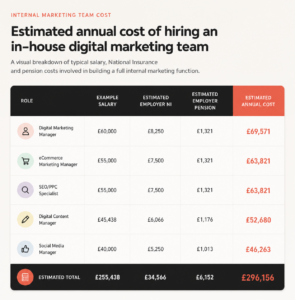
And that is before you add the wider costs of employment.
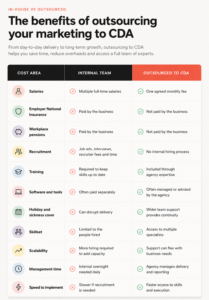
The difference is clear.
Hiring internally can make sense for larger organisations with the budget, structure and workload to support a full team.
But for many SMEs and growing eCommerce businesses, outsourcing gives access to senior marketing thinking and hands-on delivery without committing to a large permanent payroll.
The Hidden Costs of Building an Internal Team
The table above shows direct employment costs, but the true cost of hiring internally can be higher.
Recruitment Takes Time
Finding good digital talent is not always straightforward. You need to write the job description, advertise the role, review applications, interview candidates, negotiate salary, manage notice periods and onboard the new hire.
That process can take months.
During that time, marketing activity may slow down, campaigns may be delayed and opportunities may be missed.
One Hire Rarely Solves the Whole Problem
A business might hire a Marketing Manager expecting them to handle everything from strategy to social media to website updates.
In reality, that person may still need freelance designers, developers, copywriters, PPC support or technical SEO advice.
That means the business ends up paying for an internal salary and external support.
Skills Can Become Outdated Quickly
Digital marketing changes constantly.
Google updates its algorithm. Paid ad platforms change campaign structures. AI search evolves. Social media trends shift. eCommerce platforms release new features. Tracking, privacy and analytics requirements continue to develop.
An internal team needs ongoing training to stay current. A specialised agency will be staying up to date on changes anyway.
Turnover Creates Risk
When a key internal hire leaves, knowledge can leave with them.
Campaign history, website understanding, reporting processes, supplier relationships and strategic context may all be disrupted.
With outsourced support, delivery is less dependent on one individual. A good agency builds processes, documentation and continuity around the client relationship.
The Benefits of Outsourcing Digital Marketing and eCommerce Management
1. Access to a Full Team of Specialists
Outsourcing gives you access to a broader skillset than most businesses could afford to hire internally.
Instead of relying on one or two employees, you can benefit from specialists across SEO, paid media, content, design, web, social media, email marketing and eCommerce.
That joined-up expertise is particularly valuable for businesses that need both strategy and execution.
2. Lower Fixed Employment Costs
When you outsource, you do not pay employer National Insurance, workplace pension contributions, sick pay, holiday pay, recruitment costs or employee benefits for the agency team.
You pay for the service.
That makes budgeting clearer and often more manageable, especially for SMEs that need marketing support but do not want to commit to several permanent hires.
3. Greater Flexibility
Business needs change.
You may need more support during a product launch, seasonal campaign, website project or peak eCommerce period. At other times, you may need a lighter level of ongoing management.
An internal team is harder to scale up or down.
An outsourced partnership can be more flexible, allowing you to adjust priorities as the business changes.
4. Faster Delivery
Hiring can be slow. Outsourcing can give you access to expertise much faster.
If your website needs fixing, your paid ads need improving or your SEO strategy needs attention, waiting three months to recruit someone may not be realistic.
An agency can step in, assess the situation and start making improvements quickly.
5. Better Strategic Oversight
A strong agency does not just “do tasks”. It looks at the bigger picture.
That means reviewing how your website, marketing channels, customer journey, content, paid activity and reporting work together.
For eCommerce businesses, this is especially important. Traffic is only valuable if the website converts. Paid ads are only effective if the landing page works. Email marketing only performs if customer data is managed well. SEO only delivers value if the content matches real search intent.
6. Access to Wider Experience
An internal hire may have experience from a handful of previous roles. An agency works across multiple clients, sectors and campaigns.
That gives them broader insight into what is working, what is changing and what businesses need to avoid.
This experience can help you move faster and reduce costly trial and error.
7. More Reliable Continuity
When one employee is off sick, on annual leave or leaving the business, work can slow down.
With an agency, there is usually a wider team behind the account. That means campaigns, reporting and day-to-day management are less likely to stop because one person is unavailable.
Why Outsourcing Works Particularly Well for eCommerce Businesses
eCommerce is operationally demanding.
It is not enough to simply drive traffic to a website. You need to manage the whole customer journey, from discovery to purchase and repeat order.
That can include:
- Product page optimisation
- Category page structure
- Website merchandising
- SEO content
- Paid shopping campaigns
- Email flows
- Abandoned basket activity
- Conversion rate optimisation
- Analytics and tracking
- Seasonal campaign planning
- Landing page creation
- UX improvements
- Promotional strategy
For many eCommerce businesses, these tasks sit across marketing, sales, operations and customer service.
Outsourcing eCommerce management can help bring structure and momentum to that process. Instead of activity being reactive, it becomes planned, measured and optimised.
Outsourcing Does Not Mean Losing Control
Some businesses worry that outsourcing means handing over control.
In reality, the right agency relationship should give you more clarity, not less.
A good outsourced partner should provide:
- A clear strategy
- Defined priorities
- Regular communication
- Transparent reporting
- Agreed deliverables
- Practical recommendations
- A clear understanding of your commercial goals
You still make the business decisions. The agency provides the expertise, resource and execution to help you move faster.
The best partnerships feel like an extension of your team.
When Does Hiring Internally Make Sense?
Outsourcing is not always the answer.
Hiring internally can make sense when:
- You have enough ongoing work for full-time roles
- You have the budget to build a proper team
- You already have senior marketing leadership in place
- You need someone embedded in the business every day
- You want to own certain roles permanently
However, even businesses with internal teams often benefit from agency support.
For example, an in-house Marketing Manager may still need outsourced support for paid ads, SEO, website development, content production or campaign strategy.
The decision is not always internal vs external. Often, the best model is internal leadership supported by external specialists.
Why Outsourcing Is a Smart Growth Move for SMEs
For UK SMEs, the appeal of outsourcing is simple.
You get access to the skills you need without taking on the cost and risk of a full internal team.
That means you can:
- Keep overheads under control
- Improve marketing output
- Access specialist expertise
- Move faster
- Scale support as needed
- Reduce recruitment pressure
- Focus internal time on running the business
In a market where employment costs are rising, that flexibility is valuable.
Final Thoughts: Build the Capability, Not Necessarily the Payroll
Digital marketing and eCommerce management are essential for growth, but that does not mean every business needs to hire a full internal team.
With employer National Insurance increases, pension obligations and rising salary expectations, the real cost of building an internal team can quickly approach hundreds of thousands of pounds per year.
Outsourcing offers a more flexible and cost-effective alternative.
It gives businesses access to strategy, specialists, delivery and reporting without the fixed overheads of permanent employment.
For many growing UK businesses, the smartest question is no longer:
“Who do we need to hire?”
It is:
“What expertise do we need access to, and what is the most efficient way to get it?”
At CDA, we help businesses manage and grow their digital presence through joined-up support across digital marketing, eCommerce, web, SEO, paid media, content and social media.
Whether you need a complete outsourced marketing function or specialist support alongside your internal team, CDA can help you build momentum without building unnecessary overheads.

