



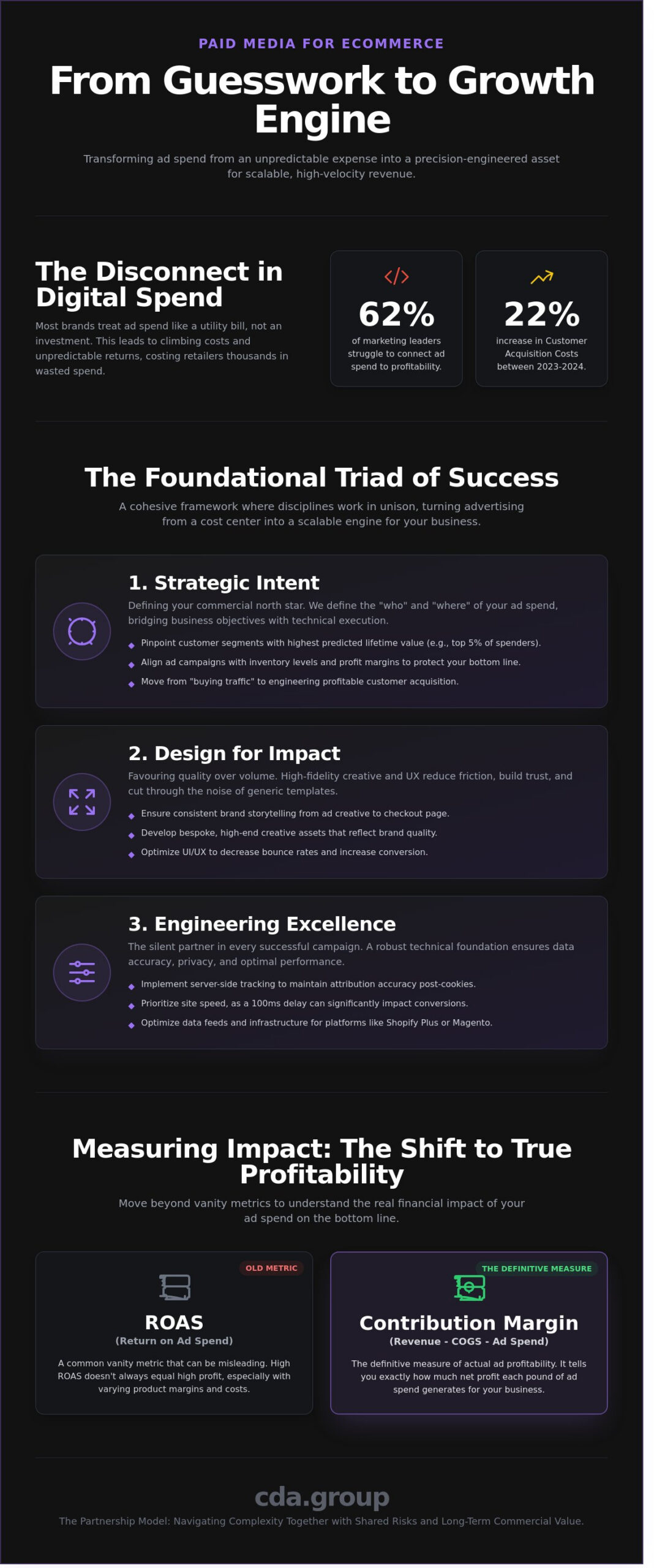
By 2026, UK retail eCommerce ad spend is projected to exceed £12.5 billion, yet a 2024 industry survey reveals that 62% of marketing leaders still struggle to connect their ad performance directly to bottom-line profitability. Most brands treat their digital spend as a recurring utility bill rather than a precision-engineered asset. We understand the frustration of watching customer acquisition costs climb by 22% between 2023 and 2024 while your ROAS remains stubbornly unpredictable. It’s a common friction point when technical execution doesn’t align with commercial strategy; we’ve seen this disconnect cost growing retailers thousands in wasted spend.
You deserve a clearer path to scale that doesn’t rely on guesswork or generic templates. This guide demonstrates how to transform paid media for ecommerce into a scalable growth engine by merging engineering excellence with strategic foresight. We’ll examine how a foundational triad of strategy, design, and engineering creates the data clarity needed to turn every £1 of spend into predictable, high-velocity revenue.
Key Takeaways
- Transition from unpredictable spending to a scalable growth engine by treating paid media for ecommerce as a technical, strategic investment.
- Build high-performance campaigns using the foundational triad of strategy, design, and engineering to ensure every pound spent drives a measurable result.
- Move beyond vanity metrics like ROAS to focus on contribution margin as the definitive measure of your actual ad profitability.
- Optimise your data feeds and tracking infrastructure to match the specific technical requirements of platforms like Shopify Plus or Magento.
- Adopt a partnership-first model that replaces traditional agency relationships with shared risks and a focus on long-term commercial value.
What is Paid Media for eCommerce in 2026?
Paid media for ecommerce is the strategic allocation of capital across search, social, and display channels to generate a predictable, scalable return. It’s the engine of modern retail growth. In 2026, relying solely on organic reach is a high-risk strategy. With organic visibility on platforms like Meta often dipping below 2% for brand pages, paid channels provide the necessary velocity to reach new audiences. A foundational understanding of What is Paid Media for eCommerce in 2026? requires looking past simple ad placements toward a model of engineered acquisition.
We distinguish between “buying traffic” and “engineering profitable customer acquisition.” Buying traffic is a commodity service that often leads to high bounce rates and wasted spend. Engineering acquisition involves using first-party data and AI-driven bidding to find customers with high lifetime value. It’s a shift from tactical spending to high-fidelity financial modelling. We focus on how every £1 spent contributes to your bottom line, navigating a privacy-first world where traditional tracking has been replaced by sophisticated modelling and server-side tagging.
The Core Channels of Modern eCommerce Advertising
Success in the UK market depends on a diversified channel mix. Google Shopping and Performance Max (PMax) remain the backbone of search-based intent, capturing users at the moment of high-purchase probability. Paid social platforms, specifically Meta and TikTok, drive discovery through sophisticated creative behaviour and algorithmic targeting. We’re also seeing the rapid ascent of Retail Media Networks. Advertising directly on marketplaces or supermarket platforms allows brands to influence the point of sale, often resulting in more efficient conversion rates due to closed-loop data.
Moving from Tactical Ad Spend to Strategic Investment
A “set and forget” mentality leads to budget wastage and stagnant performance. We operate as Expert Architects, ensuring your paid media for ecommerce efforts aren’t siloed. We align ad spend with your inventory levels, profit margins, and long-term business goals. By connecting your paid media for ecommerce strategy to the broader digital marketing ecosystem, we turn raw data into actionable insight. This partnership approach ensures we aren’t just hitting platform-specific metrics, but driving the metrics that matter to your board: net profit and sustainable growth.
The Triad of Success: Strategy, Design, and Engineering
High-performance advertising requires more than just a generous budget. It demands a cohesive framework where different disciplines work in unison to drive growth. We use the CDA Group foundational triad: Strategy, Design, and Engineering. This framework ensures every pound spent on paid media for ecommerce drives measurable value rather than just vanity metrics. By integrating these three pillars, we transform advertising from a cost centre into a scalable engine for your business.
Strategic Intent: Defining Your Commercial North Star
Strategy defines the “who” and “where” of your ad spend. We use data intelligence to pinpoint customer segments with the highest predicted lifetime value, such as your top 5% of repeat spenders. We align every campaign with your specific inventory levels and profit margins to protect your bottom line. If a product line is overstocked but carries a low margin, our strategy adjusts the bidding logic accordingly. A foundational e-commerce marketing guide highlights that paid advertising only thrives when supported by a strong brand identity and clear commercial goals. Strategic intent is the bridge between business objectives and technical execution.
Design for Impact: Favouring Quality over Volume
Quality always beats volume in a saturated market. High-end UI/UX design is essential for maintaining the momentum generated by an initial ad click. When brand storytelling is consistent across every touchpoint, from the social media creative to the checkout page, trust increases and bounce rates fall. By 2026, bespoke creative assets will be the only way to cut through the noise of generic, AI-generated templates. We create high-fidelity visuals that reflect the premium nature of your brand while reducing the friction of the buying journey.
Engineering Excellence: The Technical Side of Paid Media
Engineering is the silent partner in every successful campaign. With the end of third-party cookies, we implement server-side tracking to maintain attribution accuracy and data privacy. We also prioritise site speed; even a 100-millisecond delay in page load can result in a 7% reduction in conversions. It’s vital that your ecommerce development supports advanced tracking scripts and API integrations without bloating the source code. This technical precision ensures your paid media for ecommerce data is clean, actionable, and ready for scaling.
Platform-Specific Considerations for Paid Media
Adopting a platform-agnostic strategy is a common weakness in digital growth. Each eCommerce engine possesses unique data structures that dictate how effectively your marketing spend translates into revenue. We’ve found that generic tracking setups can lead to a 15% discrepancy in reported versus actual conversions. Successful paid media for ecommerce requires a technical architecture that aligns your ad platforms with your specific backend capabilities. API-led integrations are essential here; they ensure real-time inventory syncing so you never waste budget promoting out-of-stock items. When evaluating your technical foundation, conducting a comprehensive ecommerce platform comparison ensures your infrastructure can support high-velocity paid media campaigns without performance bottlenecks.
Paid Media for Magento and Adobe Commerce
Large-scale product catalogues in Magento require sophisticated feed management to remain performant in Google Merchant Centre. We specialise in configuring magento 2 websites to handle complex B2B pricing structures within dynamic ads, ensuring customers see the correct rates based on their account tier. Multi-storefront tracking presents significant technical hurdles. We solve this by implementing server-side tagging to maintain data integrity across different regions and currencies, providing a single source of truth for your global spend.
Scaling Shopify Plus with Performance Marketing
Shopify Plus users gain a distinct advantage through Shopify Audiences, which can reduce customer acquisition costs by up to 20% by leveraging aggregated commerce data. We enhance this by integrating AI for sme businesses to predict customer lifetime value (LTV) with high precision. This data allows for more aggressive bidding on high-intent segments. For brands prioritising speed, moving to a headless architecture often results in a 35% increase in ad-to-land conversion rates by eliminating the latency found in traditional liquid themes. However, while paid media drives immediate traffic, sustainable growth requires a foundation of organic visibility. Working with a Shopify SEO agency ensures your store captures high-intent search traffic without ongoing ad spend, creating a balanced acquisition strategy that reduces long-term customer acquisition costs.
B2B Paid Media: Beyond the Transaction
B2B eCommerce requires a shift from direct sales to b2b lead generation. Decision-makers rarely convert on a single visit. Forbes notes in their comprehensive guide to e-commerce marketing that successful strategies must account for multiple touchpoints across the funnel. We target professional networks and use intent data to identify buyers early in the process. We then nurture these 6 to 12-month sales cycles through strategic retargeting, delivering technical whitepapers and case studies that build the necessary trust to close high-value contracts.
- Data Integrity: Server-side tracking prevents data loss from browser privacy updates.
- Feed Optimisation: Custom attributes in your product feed improve ad relevance scores.
- Strategic Velocity: Real-time API syncing ensures your ad creative reflects current stock levels.
Measuring Impact: Beyond ROAS to Contribution Margin
Return on Ad Spend (ROAS) often masks the reality of business health. While a 5:1 ROAS looks impressive on a spreadsheet, it remains a vanity metric if it doesn’t account for VAT, cost of goods sold (COGS), and logistics. If your gross margin is 30% and your ROAS is 4:1, you’re effectively trading £1 for £1 after platform fees and fulfilment. We focus on contribution margin. This is the actual profit remaining after all variable costs are deducted from the revenue generated by paid media for ecommerce. It’s the only figure that dictates your ability to scale.
Profitability requires looking deeper than the immediate transaction. Data from 2024 retail benchmarks suggests that for every £1 spent on search ads, UK brands see an average 18% uplift in direct and organic traffic. This “Halo Effect” means your ads are working even when they don’t get the final click. High-growth brands also factor in Customer Lifetime Value (LTV). If your Customer Acquisition Cost (CAC) is £45 but the average customer spends £210 over 12 months, a break-even first sale is a strategic win, not a failure. We help you build bidding models that reflect this long-term value.
Turning Information into Insight
Data only becomes valuable when it informs smarter decision-making. We use data intelligence to identify “hero products” that drive high contribution margins rather than just high volume. Effective attribution modelling is vital here; it moves beyond “last-click” bias to show how social awareness ads support search conversions. Adopting a robust omnichannel retail strategy ensures that every click is valued based on its total impact across all digital and physical touchpoints.
The Role of CRO in Ad Performance
Sending paid traffic to a generic homepage is a fast way to deplete your budget. High-performance paid media for ecommerce relies on landing page relevance. When a user clicks an ad for a specific SKU, they expect to land on that product page or a curated collection. This alignment increases your Quality Score, which directly lowers your Cost Per Click (CPC). If your conversion rate is stagnant, it’s often a sign to select an ecommerce marketing consultant who prioritises Conversion Rate Optimisation (CRO) as much as ad spend.
We combine strategy and engineering to ensure your ad spend drives genuine growth. Explore how we align digital marketing with your commercial goals.
The Partnership Model: Navigating Complexity Together
Traditional agency relationships often fail because incentives are misaligned. Many agencies focus on vanity metrics like impressions or clicks, while the business owner focuses on net profit. This gap creates friction and stalls growth. We choose a different path. A partnership-first approach means we sit on your side of the table, sharing both the risks and the rewards of your paid media for ecommerce strategy.
CDA Group integrates directly with your internal team to drive velocity. We don’t just send monthly reports; we remove the technical and strategic barriers that slow you down. This collaborative model ensures that every pound spent is an investment in measurable growth. Paid media is not a “set and forget” task. It’s a journey of continuous refinement and strategic clarity. We help you move past the noise to focus on what actually scales your business.
A Strategic Alliance for High-Growth Brands
High-growth brands in the UK need more than short-term campaign bursts. They require a foundation that supports long-term scalability. We combine strategy, design, and engineering to solve real business problems. This triad allows us to look beyond the ad platform and examine the entire user journey. Our quiet confidence comes from practical results, not marketing hype. We prioritise impact over output, ensuring your digital products and ad spend work in perfect harmony.
Next Steps: From Insight to Action
Success begins with clarity. Start by auditing your current performance for technical debt. In 2024, data from UK retail studies showed that 62% of brands struggled with fragmented tracking. Preparing your infrastructure for a scalable paid media for ecommerce strategy in 2026 requires clean data and robust engineering. We invite you to a strategic consultation to explore your growth potential. We’ll help you turn information into insight and insight into action, ensuring your brand is ready to lead in a competitive market.
Engineering Your Competitive Edge for 2026
Success in the 2026 retail landscape requires a shift from superficial metrics to structural integrity. It’s about engineering a system where strategy, design, and engineering converge to drive contribution margin rather than just top-line revenue. High-growth UK organisations are already moving away from isolated tactics, choosing instead to integrate their technical infrastructure across Shopify Plus and Adobe Commerce with clear commercial goals. When we manage paid media for ecommerce, we don’t just look at clicks; we focus on the net profitability of every acquisition to ensure your spend translates into scalable value.
We believe that data only becomes valuable when it informs smarter decision-making. By prioritising a partnership-first approach, we sit on your side of the table to navigate the complexities of modern digital trade. Our focus remains on practical, effective outcomes that deliver measurable impact to your business. We’ve helped brands scale by turning complex technical challenges into streamlined growth engines through intellectual rigour and engineering excellence. This collaborative model ensures that your digital products are built for velocity and long-term stability.
Book a Strategic Consultation with CDA Group to discuss how we can align your digital strategy with your 2026 growth targets. Let’s build something impactful together.
Frequently Asked Questions
How much should an eCommerce brand spend on paid media?
Most UK eCommerce brands allocate between 12% and 18% of their total revenue to paid media for ecommerce to maintain steady growth. For businesses entering the market in 2025, a minimum monthly test budget of £3,500 is often required to gather statistically significant data. We calculate spend based on your specific margins and customer acquisition cost targets. This ensures every pound spent contributes to a measurable return.
Is Google Ads or Meta Ads better for eCommerce in 2026?
The choice depends on whether your product satisfies existing demand or creates it through visual discovery. In 2026, Google Ads often captures high-intent shoppers through Performance Max, while Meta Ads excels at building brand desire. Data from 2024 shows that brands using a 60/40 split between search and social see 22% better efficiency. We recommend an integrated approach that leverages the specific strengths of both platforms to maximise reach.
How long does it take to see results from a new paid media strategy?
You’ll likely see initial traffic within 48 hours, but a strategy takes 90 days to reach peak efficiency. This period allows platform algorithms to move through the initial learning phase and permits us to refine creative assets based on real performance data. By the end of the first quarter, we usually identify the 20% of campaigns generating 80% of your revenue. Patience in this phase leads to more stable long-term scaling.
What is the difference between PPC and paid media for eCommerce?
PPC refers specifically to the pay-per-click pricing model, whereas paid media for ecommerce encompasses all paid placement opportunities including display, social, and video. While PPC focuses on the cost of the individual click, a paid media strategy looks at the entire customer journey. We focus on the broader impact of your media spend. This includes building brand equity alongside immediate conversion goals to ensure sustainable growth.
Can I run paid media effectively on a smaller budget?
You can achieve results on a smaller budget by narrowing your focus to high-intent long-tail keywords or specific geographic regions. We often suggest starting with a test and learn budget of £1,500 per month for specific product categories. This prevents budget dilution across too many campaigns. Focusing your resources on a single platform initially often yields a higher impact than spreading spend too thin across multiple channels.
How does site speed affect my paid media performance?
Site speed directly influences your Quality Score and conversion rate. Research indicates that a one-second delay in mobile load times can decrease conversion rates by up to 20%. If your site takes longer than 2.5 seconds to load, you’re effectively paying for clicks that never see your content. We prioritise technical performance to ensure your ad spend isn’t wasted on a poor user experience that drives shoppers away.
What technical tracking is essential for eCommerce ads today?
Server-side tracking and the Meta Conversions API (CAPI) are now mandatory for accurate reporting. Since the 2021 privacy updates, browser-based cookies miss roughly 30% of conversion data. Implementing a robust first-party data strategy ensures your campaigns optimise against real sales rather than incomplete signals. We help you build a technical foundation that maintains data integrity in a privacy-first environment, allowing for smarter decision-making.
Why is my ROAS dropping even though my traffic is increasing?
A dropping ROAS alongside rising traffic usually signals a decline in traffic quality or a friction point in the checkout process. This often happens when broad targeting settings bring in users who aren’t ready to buy yet. We analyse your add to basket rates and checkout abandonment to find where value is lost. Improving your conversion rate by just 0.5% can often restore your ROAS to profitable levels without increasing spend.

