



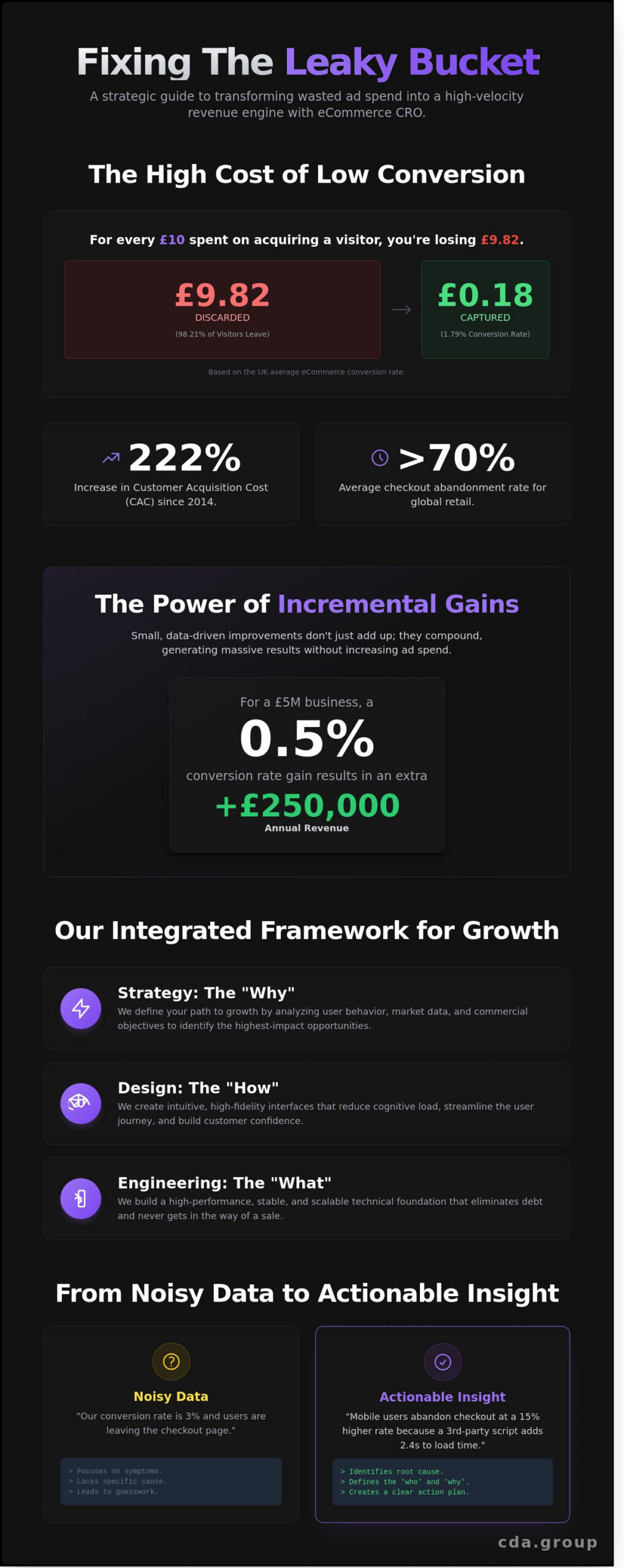
If you’re spending £10 to acquire a single visitor but your site converts at the UK average of 1.79%, you’re effectively discarding £9.82 of every marketing pound spent. It’s a common frustration for high-growth brands where customer acquisition costs have risen by 222% since 2014. You likely agree that increasing traffic is a hollow strategy if your digital store is leaking value at every stage of the funnel. We’ll help you fix this by applying strategic cro techniques ecommerce to transform user data into a measurable revenue engine.
This guide provides a framework to integrate technical performance with psychological conversion triggers. You’ll learn how to improve your revenue per visitor and increase average order value through a repeatable, data-driven process. We move from identifying strategic needs to presenting high-fidelity solutions. We eliminate technical debt. We drive high-velocity growth for 2026.
Key Takeaways
- Understand how aligning user intent with business goals serves as a strategic lever to reduce Customer Acquisition Cost (CAC) in 2026.
- Learn to distinguish between noisy data and actionable insights using a structured framework to identify and resolve high-impact friction points.
- Deploy technical cro techniques ecommerce leaders use to optimise site velocity, ensuring every 100ms of performance translates into tangible revenue.
- Apply psychological principles like cognitive ease and social proof to streamline the buying process and build lasting confidence with your customers.
- Build a sustainable culture of experimentation that turns strategic hypotheses into a continuous cycle of testing, learning, and scaling.
Understanding eCommerce CRO as a Strategic Growth Lever
Effective Conversion rate optimization (CRO) is no longer about changing button colours or testing headlines in isolation. It represents the strategic alignment of user intent with specific commercial objectives. In the UK eCommerce landscape of 2026, where digital ad spend has risen by 12% annually since 2023, the focus has shifted. We prioritise the better utilisation of your existing audience rather than chasing expensive new traffic. This approach directly lowers your Customer Acquisition Cost (CAC) by extracting more value from every pound spent on marketing.
In 2026, the cost of visibility on major search and social platforms has reached a point of diminishing returns for many UK brands. Research from industry analysts suggests that organic reach for retail brands has dropped to less than 2% on average. This makes CRO the most effective lever for sustainable growth. By refining cro techniques ecommerce teams can stop the “leaky bucket” syndrome. We help you capture the demand you’ve already paid for, ensuring your marketing budget works harder.
Our methodology integrates Strategy, Design, and Engineering into a single, high-velocity workflow. Strategy defines the “why” by analysing data and user behaviour. Design creates the “how” through intuitive interfaces that reduce cognitive load. Engineering provides the “what” by building high-performance, stable environments that never get in the way of a sale. We don’t just provide a service; we offer a strategic alliance that focuses on impact over mere output. This ensures your eCommerce platform remains a scalable asset rather than a technical burden.
The Commercial Impact of Incremental Gains
Small changes generate massive results over time. A 1% improvement at each stage of your checkout funnel doesn’t just add up; it compounds. For a mid-market retailer turning over £5 million, a marginal gain of 0.5% in conversion can result in an extra £250,000 in annual revenue without increasing ad spend. We focus on “Conversion Velocity,” the speed at which we identify, test, and deploy these improvements. This disciplined approach increases long-term brand value and significantly boosts customer lifetime value (CLV) by creating a frictionless shopping experience that encourages repeat business.
Moving Beyond Surface-Level Metrics
The standard conversion rate often hides the truth of your site’s performance. A 3% conversion rate might look healthy, but it tells you nothing about the 97% of users who left. We look at micro-conversions such as add-to-carts, newsletter signups, and gallery views. These indicators show us exactly where friction exists in the user journey. Success is defined by your specific business model and platform requirements. A high-end bespoke furniture brand requires a different measurement framework than a high-volume FMCG site. We help you define what success looks like for your specific goals, turning raw data into actionable intelligence.
The Data-Driven Framework for Identifying Conversion Gaps
Effective CRO isn’t about guessing. It’s about distilling clarity from noise. Many brands drown in metrics that don’t drive growth, focusing on vanity numbers instead of actionable insights. We believe a “Partnership First” approach requires shared access to data truths. This means moving beyond surface-level traffic numbers to find the specific friction points that stall your revenue. When we align strategy with engineering, we turn raw information into a roadmap for high-velocity growth.
A strategic framework distinguishes between “noisy” data and strategic insights. Noisy data tells you that users are leaving; strategic insight tells you they are leaving because a specific third-party script is delaying the checkout load time by 2.4 seconds. We focus on the latter. By using data-driven CRO strategies, we identify exactly where the value is leaking from your funnel. This disciplined methodology ensures that every design change or engineering sprint is backed by evidence rather than intuition.
Quantitative Analysis: Mapping the User Journey
We use GA4 and platform-specific analytics to pin down where users exit. A 2024 analysis of global retail trends shows the average checkout abandonment rate remains high, often exceeding 70%. We look for anomalies in your specific funnel. If mobile users drop off at a rate 15% higher than desktop users, it indicates a technical friction point rather than a lack of intent. We use AI for SME businesses to predict these churn patterns before they become systemic failures. These cro techniques ecommerce professionals use allow us to see patterns in huge datasets that human analysis might miss. We map the entire journey to ensure the path to purchase is frictionless and logical.
Qualitative Insight: Seeing Through the Users’ Eyes
Quantitative data shows the “what,” but qualitative insight reveals the “why.” We use heatmaps and session recordings to observe how customers actually interact with your site. A user might ignore a primary call-to-action because it’s obscured by a promotional banner on certain screen sizes. Our “Expert Architect” audits provide a rigorous review of existing eCommerce services to identify these subtle barriers. We don’t just provide a static report. We build a continuous feedback loop where user testing informs our engineering priorities. This collaborative approach ensures we solve real business problems with precision. If you want to see how these insights can scale your operations, explore our strategic approach to eCommerce growth.
Core eCommerce CRO Techniques: Optimising the Technical Foundation
Technical integrity isn’t a secondary concern. It’s the bedrock of every successful conversion strategy. We’ve found that before applying psychological and UX techniques to influence buyer behaviour, the underlying infrastructure must be flawless. If a site fails at the point of interaction, even the most persuasive copy won’t save the sale. We treat technical health as the prerequisite for any growth experiment.
Site velocity remains the most critical lever for cro techniques ecommerce. By 2026, user expectations have tightened significantly. Industry data indicates that every 100ms of latency results in a 1.2% decrease in conversion rates for high-traffic UK retailers. We view speed not as a metric, but as a direct revenue driver. Technical debt often acts as an invisible anchor. Bloated legacy code and outdated plugins prevent teams from testing new features, effectively stalling growth and limiting agility.
Mobile-first architecture must move beyond “responsive” design. It’s about “thumb-zone” optimisation and adaptive loading. We build for the 82% of UK consumers who now complete purchases via mobile devices, ensuring the experience feels native and frictionless. This requires a shift from simply resizing desktop elements to engineering mobile-specific interactions that reduce cognitive load.
Platform-Specific Technical Excellence
Choosing the right architecture defines your ceiling for growth. We partner with brands to optimise Magento 2 websites, ensuring they handle complex B2B logic and high-volume B2C transactions without performance degradation. For businesses seeking rapid agility, we scale WooCommerce websites by stripping away generic code and building lean, efficient environments. Bespoke engineering always outperforms generic templates because it’s built for your specific customer journey, not a general average.
Site Speed and Performance Engineering
Core Web Vitals are no longer just SEO signals; they’re conversion benchmarks. We focus on the critical rendering path to ensure your shop is interactive within 1.5 seconds on a standard 4G connection. Utilising custom web application development for eCommerce allows us to remove the bloatware that plagues standard platforms. By moving towards headless architecture and server-side optimisations, we ensure your site remains resilient during peak traffic events like Black Friday, where downtime can cost an enterprise upwards of £5,000 per minute.
Psychological and UX Techniques to Influence Buyer Behaviour
We design for cognitive ease to reduce the mental load on your customers. High-velocity growth requires a path of least resistance. We eliminate friction by simplifying navigation and removing unnecessary decision points. Data from 2024 indicates that 42% of users feel overwhelmed by excessive choices. We solve this by curating navigation to prevent choice paralysis, ensuring users find what they need without fatigue. Trust signals like verified reviews and clear security badges build the confidence required to move from browsing to buying. These elements act as silent partners in the sales process, providing the quiet assurance that your brand is reliable and professional.
Product Page Optimisation: The Moment of Truth
Effective product pages focus on outcome-driven value rather than just listing technical specifications. We craft descriptions that speak to the user’s needs and aspirations. High-fidelity imagery and video content are essential for building desire. 73% of UK consumers are more likely to purchase after watching a product video. We implement cross-sell and up-sell logic that complements the user journey. This approach adds value to the basket without creating a distraction or breaking the flow of the session. It’s about strategic placement that feels like a recommendation, not a sales pitch.
Streamlining the Checkout Experience
A friction-free checkout is a technical necessity for conversion velocity. We implement a five-step process to ensure a seamless transition to purchase: guest checkout options, address autocomplete via postcode lookup, real-time form validation, transparent shipping costs, and mobile-optimised payments. Removing hidden fees is vital. 48% of cart abandonments occur because of unexpected extra costs at the final stage. We integrate one-click solutions like Apple Pay and Google Pay to cater to the mobile-first market. This reduces the time to purchase and ensures the final transaction is handled with precision.
Leveraging AI for Strategic Personalisation
AI transforms generic data into actionable insight. We use dynamic recommendations based on real-time behaviour to ensure every user sees products relevant to their intent. Intelligent filtering helps users find products in seconds, not minutes. This creates a powerful synergy where digital marketing attracts high-intent traffic and cro techniques ecommerce specialists convert that traffic into revenue. We help you build a loop where data informs design and design drives performance. This partnership between strategy and technology ensures your store remains competitive in a crowded market. For brands looking to move beyond basic automation, AI in eCommerce strategic implementations provide the structural integration needed to drive measurable business impact.
We build high-performance digital stores that scale. Partner with us to optimise your eCommerce experience.
Navigating Complexity: Implementing a Continuous Optimisation Cycle
Conversion rate optimisation is a marathon of strategic iterations. It’s not a one-off project. High-growth brands treat it as a core business discipline. They move away from subjective opinions and toward data-led certainty. This shift requires a rigorous culture of experimentation. We follow a clear loop: hypothesis, test, learn, and scale. Every change starts with a specific question. We don’t guess. We validate.
Precision is vital. We prioritise statistical significance to avoid the “false positive” trap. A 5% lift in checkout completion might look impressive over three days, but without a 95% confidence interval, it’s often just noise. We ensure your data is robust enough to support heavy investment. This discipline protects your margins. It ensures that cro techniques ecommerce teams deploy actually move the needle on your bottom line.
Prioritising the Experiment Pipeline
Resources are finite. We use the PIE framework to focus on what matters. We score every idea based on Potential, Importance, and Ease. This allows us to balance quick wins with long-term structural improvements. If a change has high potential but low ease, we plan it into the roadmap. If it’s a simple fix with high impact, we deploy it immediately. Every test must link to a tangible business outcome, such as reducing cart abandonment by 12% or increasing average order value by £15. We focus on the numbers that drive growth.
Scaling Impact Through Partnership
Effective CRO doesn’t exist in a vacuum. It must integrate into your broader eCommerce development roadmap. We act as the Expert Architect. We don’t just provide reports. We provide clarity. We sit on your side of the table to help you navigate technical complexity. Our role is to turn raw information into strategic insight. We then turn that insight into measurable action. This collaborative approach helps leaders make clearer, more confident growth decisions.
We focus on impact over output. We build systems that scale. We design experiences that convert. We engineer value that lasts. By aligning your technical roadmap with your conversion goals, we ensure every pound spent on development yields a measurable return. We help you move from reacting to the market to leading it with quiet confidence.
Driving Commercial Velocity through Strategic Refinement
Achieving high-velocity growth in 2026 demands more than just aesthetic updates. It requires a disciplined approach to engineering and a commitment to data-driven decision making. By focusing on the technical foundation and psychological triggers discussed, you’ll create a resilient platform ready for scale. The most effective cro techniques ecommerce teams use today are those that prioritise long-term value over short-term wins. It’s about turning raw information into strategic insight and then into decisive action.
We understand the complexities of high-growth retail. Our team provides deep expertise in Magento, Shopify Plus, and bespoke engineering to ensure your technology supports your ambition. We value impact over mere output, acting as a strategic partner to help you navigate the evolving commercial landscape. We’ll work with you to identify gaps, refine experiences, and build a roadmap for sustainable success. This collaborative approach ensures your eCommerce platform remains a powerful asset in a competitive market.
The path to a more efficient, high-converting store is built on partnership and precision. Partner with CDA Group to scale your eCommerce impact and let’s unlock your next phase of growth together.
Frequently Asked Questions
What is a good conversion rate for an eCommerce store in 2026?
A strong benchmark for UK eCommerce in 2026 sits between 3.5% and 4.5%. While the IRP Commerce index recorded an average of 1.76% in late 2023, top-tier brands now focus on sector-specific targets. Luxury fashion brands often target 1.5% while health and beauty retailers aim for 5% or higher. We track these metrics to ensure your growth aligns with current industry performance standards.
How long does it take to see results from CRO techniques?
You’ll typically observe measurable shifts in user behaviour within 14 to 30 days of implementation. Achieving statistical significance for major revenue impact usually requires a full 90 day cycle. This timeframe allows for data collection across different traffic patterns. It ensures that the cro techniques ecommerce teams deploy are based on stable trends rather than temporary spikes in traffic.
Will CRO techniques affect my SEO rankings?
Effective CRO strengthens your SEO by improving Core Web Vitals and reducing bounce rates. Google’s 2024 algorithm updates reward sites that demonstrate high engagement and clear user journeys. We ensure every design change maintains your technical SEO integrity. Faster load times and clearer navigation satisfy both your customers and search engine crawlers, creating a virtuous cycle of visibility and conversion.
Do I need a high volume of traffic to start A/B testing?
You need at least 1,000 monthly conversions to run statistically valid A/B tests on checkout flows. If your traffic is lower, we pivot to qualitative methods like heatmaps or user testing with 5 to 10 participants. These insights provide immediate clarity without needing massive datasets. We focus on high impact changes that move the needle for smaller, high value audiences.
What is the difference between UX design and CRO?
UX design focuses on the overall usability and feel of the site, while CRO focuses on specific business outcomes. Think of UX as the architecture and CRO as the performance engineering. We combine both to ensure your site isn’t just easy to use but actively drives revenue. Strategy, design, and engineering must work together to turn visitors into loyal customers. For brands seeking to align their design strategy with commercial objectives, our comprehensive approach to UI/UX design for eCommerce provides the framework needed to transform complex digital interactions into seamless customer journeys that deliver measurable results.
How much should I invest in CRO compared to my ad spend?
Allocate 10% to 20% of your total marketing budget to CRO and site performance. Most UK brands overspend on acquisition while neglecting the destination. If you spend £10,000 on ads but your site doesn’t convert, you’re wasting capital. Reinvesting a portion of that spend into cro techniques ecommerce ensures your paid traffic yields a higher return on investment.
Can AI completely automate my eCommerce CRO process?
AI handles data processing and pattern recognition but it can’t replace strategic human oversight. In 2026, tools like predictive analytics identify friction points in seconds. However, we use these insights to build bespoke solutions that reflect your brand’s unique identity. AI provides the raw data; we provide the strategy and creative execution required to make it work for your specific audience.
Building a strong brand identity is a holistic effort, extending from the digital experience to how your team represents the brand. Companies like Brandme specialize in creating personalized apparel that reinforces this identity for businesses and agencies.
What are the most common CRO mistakes eCommerce brands make?
The biggest mistake is changing site elements based on gut feelings rather than 1st party data. Another error is ignoring mobile users, who accounted for 70% of UK eCommerce traffic in 2024. Many brands also stop testing after one successful experiment. Continuous growth requires a disciplined approach to testing, learning, and scaling your digital product to meet evolving consumer expectations.
