



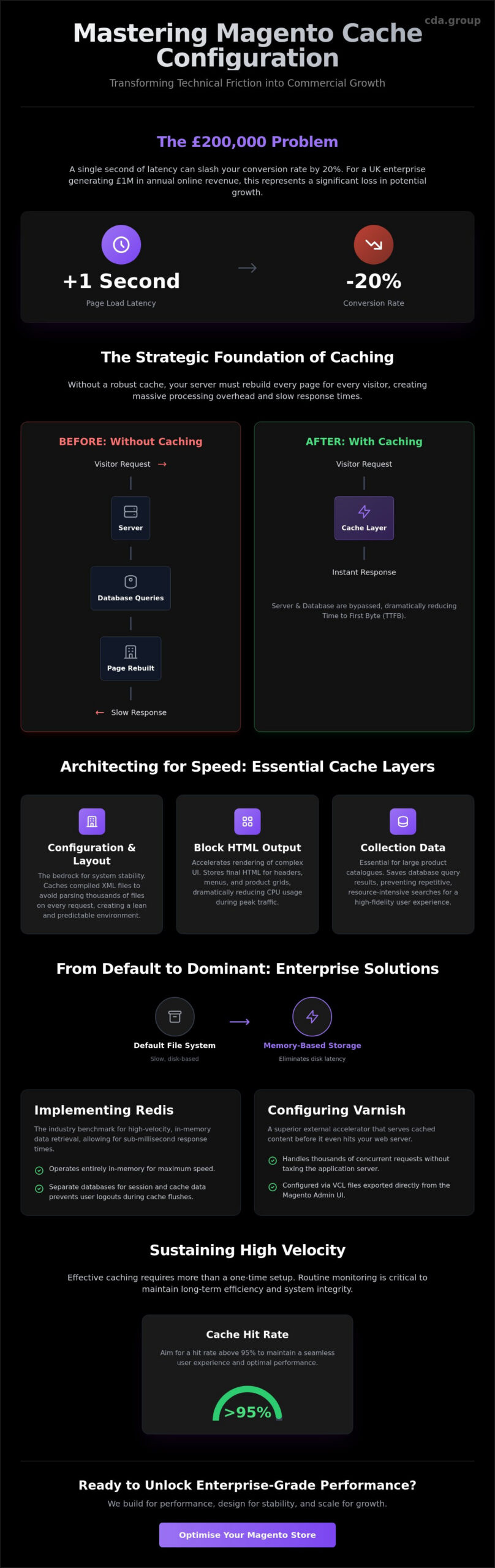
A single second of latency can slash your conversion rate by 20 percent. For a UK enterprise generating £1 million in annual online revenue, this technical friction represents a £200,000 loss in potential growth. We recognise the frustration of managing a complex magento cache configuration while your store velocity fluctuates under pressure. You need a platform that remains resilient when traffic spikes, not one that’s buckling under its own weight. We believe engineering excellence must drive measurable business outcomes.
This guide enables you to master caching systems to reduce server load and accelerate your store velocity for a superior customer experience. We move beyond surface level settings to implement a high performance architecture through our core triad of strategy, design, and engineering. You will learn to deploy Redis and Varnish with precision, ensuring your infrastructure scales seamlessly during peak seasons. We provide the strategic clarity needed to transform complex systems into a stable engine for commercial impact. We build for performance, we design for stability, and we scale for growth.
Key Takeaways
- Optimise store velocity by reducing server processing overhead to improve Time to First Byte metrics.
- Transition from default file systems to memory based storage solutions to unlock enterprise grade performance.
- Master your magento cache configuration to align server resources with high growth business objectives.
- Establish routine monitoring of cache hit rates to maintain long term efficiency and system integrity.
- Identify and resolve configuration bottlenecks before they impact your customer experience or conversion rates.
The Strategic Foundation of Magento Cache Configuration
Magento functions as a sophisticated ecosystem that requires precise orchestration to perform at scale. Without a robust magento cache configuration, your server must rebuild every page component from the database for every visitor. This creates massive processing overhead. We view caching as the strategic foundation of any high growth store. It reduces hardware strain and ensures the Magento platform operates with maximum efficiency.
Properly configured caches directly lower Time to First Byte (TTFB) metrics. Speed is a commercial imperative. A 2020 study by Deloitte found that a 0.1 second improvement in mobile site speed increased conversion rates by 8.4% for retail brands. Velocity drives profit. We build multi layered caching strategies to ensure your store remains responsive during high traffic events. We focus on impact by turning technical settings into measurable business growth.
High performance requires moving beyond default settings. We implement a disciplined approach to data retrieval that prioritises both speed and accuracy. This ensures your Magento 2 website delivers a seamless experience that builds customer trust and increases lifetime value.
Essential Cache Types for Scalable Architecture
Configuration and Layout caches provide the bedrock for system stability. These layers store the compiled XML files that define store logic and visual structure. By caching these elements, the system avoids parsing thousands of files on every request. This results in a leaner, more predictable environment that can handle complex customisations without sacrificing speed.
Block HTML Output cache accelerates the rendering of complex UI elements. It stores the final HTML for headers, navigation menus, and product grids. This eliminates the need for the server to re-calculate these fragments for every page load. It’s a vital component for reducing CPU usage during peak trading hours.
For stores with large product catalogues, the Collection Data cache is essential. It saves the results of specific database queries, preventing the system from performing repetitive, resource intensive searches. We scale performance by ensuring these layers work in harmony to deliver a high fidelity user experience.
Sequential Steps to Configure Enterprise Caching Solutions
Effective magento cache configuration begins with a rigorous assessment of your server resources. We evaluate CPU allocation and available RAM to determine the most stable caching backend for your specific traffic patterns. We transition your environment from default file system caching to dedicated memory based storage to eliminate disk latency. This shift ensures your application environment recognises advanced frontend gateways and backend storage layers with precision.
Speed directly impacts your commercial outcomes. Recent customer experience stats indicate that 80% of customers feel speed is a critical component of a positive brand interaction. We ensure your infrastructure meets these expectations through disciplined engineering. Once the architecture is defined, we move to implementation.
Implementing Redis for Session and Backend Storage
Redis serves as the industry benchmark for high velocity data retrieval. It operates entirely in-memory; this allows for sub-millisecond response times that file based systems cannot match. We integrate Redis by modifying the env.php file to define the host, port, and database index. We always recommend separating session data from general cache storage. This architecture prevents cache clearing from logging out active users, maintaining a seamless journey for your customers. Our team at CDA Group helps partners optimise Magento 2 websites by implementing these robust storage patterns.
Configuring Varnish for Advanced Full Page Caching
Varnish is an external accelerator that sits before the web server to intercept and serve cached content instantly. It is the superior alternative to Magento’s built-in full page caching, capable of handling thousands of concurrent requests without taxing the application server. We guide you through exporting the Varnish Configuration Language (VCL) files directly from the Magento Admin UI. Once the VCL is deployed, we configure the Varnish backend to communicate with your Nginx or Apache server. We validate the final magento cache configuration using the Magento Command Line Interface to ensure all cache types are active and hitting the correct storage engines.
Strategic Maintenance and Troubleshooting for Optimal Velocity
Sustaining high velocity requires more than a one time setup. We monitor cache hit rates to ensure your magento cache configuration remains effective. Aim for a hit rate above 95 percent to maintain a seamless user experience. When hit rates drop below 85 percent, it usually indicates a misconfiguration or an overloaded Redis instance. We identify signs of cache corruption through inconsistent front end rendering or unexpected 500 errors. These issues often stem from outdated configuration files or conflicting external modules. For deeper insights, our team conducts performance audits for bespoke Magento 2 websites to eliminate technical debt and restore peak efficiency.
Best Practices for Cache Management in Production
Distinguishing between cleaning and flushing is vital for site stability. Cleaning deletes only outdated items. Flushing purges every entry in the storage. Avoid flushing in production. This action forces the server to regenerate every page, often causing a 40 percent spike in Time to First Byte. We recommend using the command line for all deployment cycles. Executing bin/magento cache:clean via SSH ensures precision without compromising the entire cache pool. When Configuring Varnish for Magento, ensure your VCL files are optimised to handle tag based purging correctly. This approach maintains high velocity while updating specific content blocks.
Technical debt accumulates quickly in complex ecommerce environments. We act as your strategic partner to navigate these complexities. Our engineers audit your magento cache configuration to ensure it scales with your growth. We focus on impact over output. We build systems that endure. We scale your performance. We design for the future. By aligning engineering excellence with strategic foresight, we transform technical hurdles into competitive advantages.
Drive Enterprise Velocity through Strategic Caching
Precision in your magento cache configuration transforms a standard eCommerce site into a high velocity engine. Strategic caching goes beyond simple speed; it builds a resilient foundation for sustainable growth. By implementing sequential enterprise solutions and maintaining rigorous troubleshooting protocols, you ensure your infrastructure supports seamless scaling. Adobe’s performance benchmarks indicate that properly optimised environments can achieve a sub 500ms Time to First Byte, a metric that directly influences customer retention and search rankings.
Effective engineering bridges the gap between complex data and measurable business outcomes. We focus on impact over mere output, helping high growth brands navigate the complexities of digital transformation. Our Expert Architect approach ensures your infrastructure is both innovative and dependable. We’ve a proven history of scaling enterprise brands by aligning strategy, design, and engineering into a foundational triad for success. Google’s 2023 data confirms that even a 100ms improvement in site speed can boost conversion rates by up to 8% for retail sites.
Partner with CDA for strategic Magento development and performance engineering to scale your brand with confidence. Your path to peak performance starts with a single, informed decision. Let’s build something exceptional together.
Frequently Asked Questions
How do I enable or disable specific cache types in the Magento Admin?
Manage your cache types by navigating to System, then Tools, and selecting Cache Management. Tick the checkboxes for the specific types you need to modify and use the Actions dropdown to choose Enable or Disable before clicking Submit. This granular approach to magento cache configuration allows us to maintain system stability during updates. It’s a precise way to control how your store handles data persistence without affecting the entire site infrastructure.
What is the difference between cleaning and flushing the Magento cache?
Cleaning the cache removes only the entries that Magento has specifically tagged. Flushing the cache is a broader action that clears the entire storage backend, including data used by other applications if they share the same cache instance. We recommend cleaning as your primary troubleshooting step because it’s more targeted and less resource intensive. Flushing should be reserved for instances where a deeper reset is required to resolve persistent display issues.
Why should I use Varnish instead of the default built in page cache?
Varnish offers superior performance because it serves content directly from memory as an external HTTP accelerator. Unlike the built in cache which still requires PHP execution, Varnish handles requests before they reach your web server. This configuration can reduce Time to First Byte (TTFB) by 250ms or more. It provides the velocity needed to handle high traffic volumes during peak UK retail periods without compromising on site responsiveness.
Does my Magento cache configuration affect my SEO rankings?
Your magento cache configuration impacts your SEO rankings by directly influencing site speed and Core Web Vitals. Google uses Largest Contentful Paint as a ranking factor, and an optimised cache helps you stay below the critical 2.5 second threshold. Faster sites provide a better user experience, which leads to improved engagement metrics and higher search visibility. We treat technical performance as a strategic asset for your organic growth strategy.
