



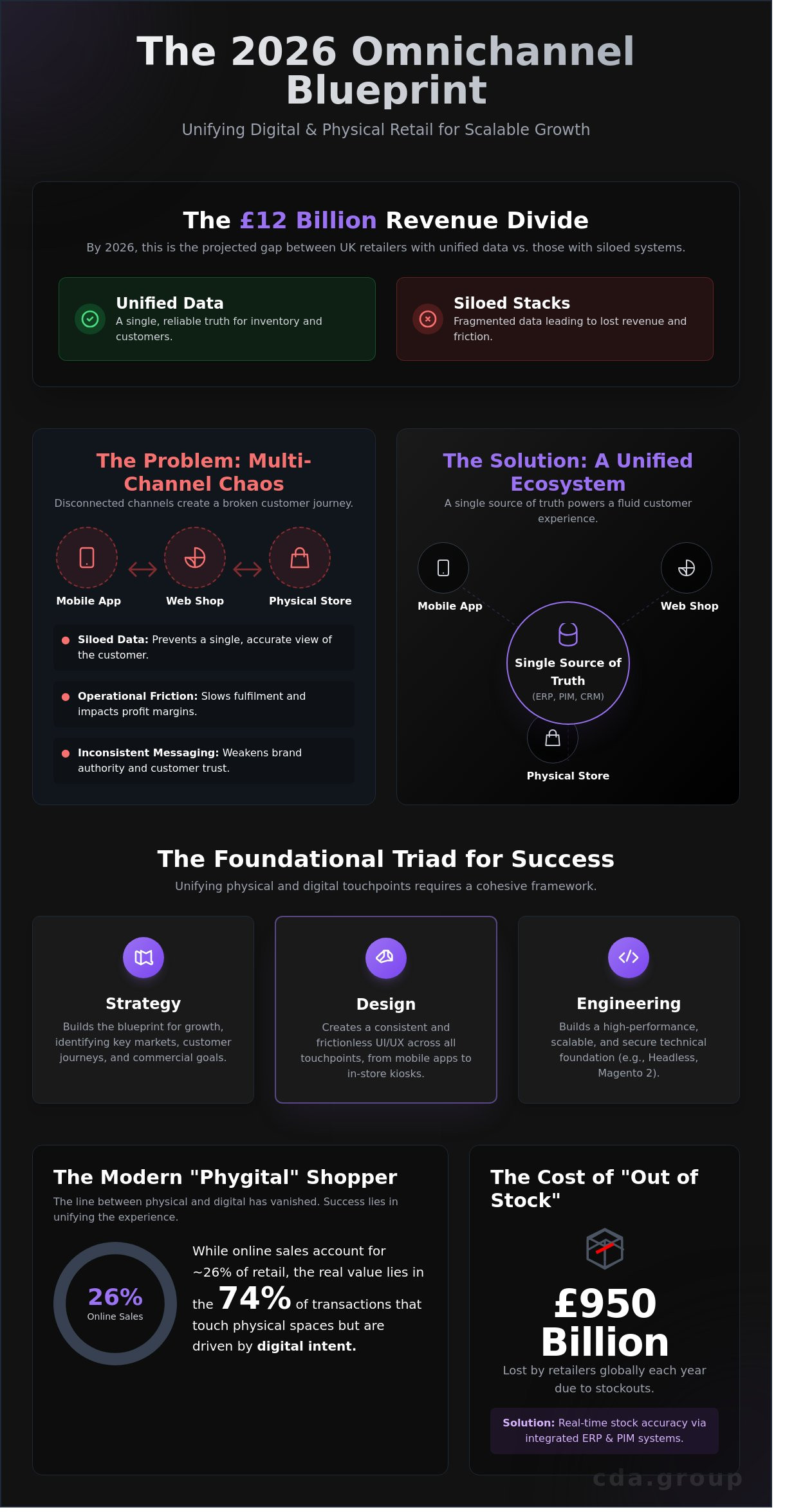
By 2026, the gap between UK retailers with unified data and those struggling with siloed stacks will represent a £12 billion revenue divide. You’ve likely felt the friction of fragmented customer data or the frustration of seeing “out of stock” online when items are sitting in your warehouse. A robust omnichannel retail strategy isn’t about being everywhere at once. It’s about ensuring your technology works as hard as your team to create a single, reliable truth for your inventory and your customers.
We agree that the cost of maintaining disconnected systems is often higher than the investment required to fix them. You want your data to inform action, not just occupy space. This article provides the blueprint to unify your digital and physical touchpoints into a high-performance ecosystem that drives measurable business value. We’ll examine how the triad of strategy, design, and engineering creates a unified view of your customer and builds the operational efficiency needed for scalable growth across new markets.
Key Takeaways
- Transition from fragmented sales channels to a unified ecosystem built on the foundational triad of strategy, design, and engineering.
- Overcome integration complexity by using AI to streamline data mapping and connect disparate legacy systems.
- Identify and resolve technical debt through a rigorous audit designed to prioritise seamless customer journeys.
- Implement a robust **omnichannel retail strategy** that translates technical architecture into measurable commercial impact and growth.
- Learn how to amplify your digital builds with integrated marketing services that turn customer insight into decisive action.
Defining Omnichannel Retail Strategy in 2026
By 2026, a successful omnichannel retail strategy functions as a unified ecosystem rather than a collection of disconnected platforms. We view this as a fundamental shift from simply being present on multiple channels to creating a single, fluid experience. It removes the friction between a mobile app, a physical storefront, and a web shop. In this environment, the technology serves the strategy; it doesn’t dictate it.
Shoppers in the UK now demand “phygital” interactions. This means digital convenience must meet physical immediacy. In 2024, data from the Office for National Statistics showed that online sales accounted for roughly 26% of all retail. By 2026, the value lies in the 74% of transactions that still touch physical spaces but are driven by digital intent. Brands must move from broad reach to high-velocity, personalised interactions that respect the customer’s time and specific context.
The Evolution of Modern Retail Expectations
The line between physical and digital spaces has vanished. Loyalty no longer comes from a single transaction. It builds through consistent, high-value interactions over time. We help partners move from transaction-based models to relationship-based retail. This transition requires an “always-on” technical foundation. Robust ecommerce engineering ensures that inventory, pricing, and customer data remain synchronised across every touchpoint in real time. We design systems that turn every interaction into a data point that informs the next move.
Why Multi-channel is No Longer Sufficient
Multi-channel retail often hides significant operational costs. Maintaining disconnected sales channels creates data silos that frustrate the 80% of customers who expect consistent pricing and stock levels regardless of how they shop. When data stays trapped in separate departments, the customer journey breaks. We see this lead to fragmented branding, which dilutes long-term value and increases customer acquisition costs. A fragmented approach is no longer a viable path to scale.
- Siloed data prevents a single, accurate view of the customer.
- Operational friction slows down fulfilment velocity and impacts margins.
- Inconsistent messaging weakens brand authority and trust.
To win in 2026, retailers must integrate their omnichannel retail strategy into the core of their business logic. We focus on building the structural integrity needed to support this integration. This ensures that your brand remains agile, responsive, and capable of delivering measurable impact in a crowded market.
The Core Pillars of an Effective Omnichannel Framework
Success in the 2026 retail landscape requires a foundation built on a triad of Strategy, Design, and Engineering. We build frameworks that unify physical and digital touchpoints into a singular, cohesive customer experience. A centralised eCommerce development platform serves as the engine for this integration, ensuring every interaction is backed by technical excellence and strategic foresight.
Effective UI/UX design acts as the brand’s visual and functional voice across all touchpoints. We design interfaces that maintain consistency, whether a customer is browsing on a mobile device or using an in-store kiosk. This uniformity eliminates friction and builds the long-term trust necessary for high-growth enterprises to scale. When design aligns with engineering, the result is a seamless transition between the digital and physical worlds.
Centralised Data and Inventory Management
A resilient omnichannel retail strategy relies on a single source of truth for both inventory and customer data. Fragmented systems create silos that lead to customer disappointment and lost revenue. We integrate Enterprise Resource Planning (ERP) and Product Information Management (PIM) systems to ensure data flows with precision across the entire organisation. Research from IHL Group indicates that out-of-stock items contribute significantly to the £950 billion lost by retailers globally each year. Real-time stock accuracy solves this problem by synchronising warehouse levels with digital storefronts instantly.
We turn raw data into actionable insights. By centralising information, retailers gain clarity on stock velocity and customer preferences, allowing for smarter procurement decisions. If you are looking to refine your technical stack, we can help you evaluate your current architecture to identify gaps in data flow and performance.
Scalable eCommerce Architecture
Scalability is the cornerstone of enterprise growth. Platforms like Magento 2 provide the flexibility required to handle complex, high-volume operations. We build for performance, ensuring your infrastructure maintains velocity during peak traffic periods such as Black Friday or Boxing Day sales. High-performance architecture prevents the latency that often kills conversion rates during critical trading windows.
We often advocate for headless commerce to provide a higher level of agility. This approach decouples the front-end presentation from back-end logic; it allows for bespoke customer experiences across different channels without compromising system stability. It’s about building a stack that is both robust and adaptable, providing the structural integrity needed for the next decade of retail evolution. By focusing on engineering excellence, we ensure your omnichannel retail strategy is supported by a platform that grows alongside your ambitions.
Navigating Complexity: Overcoming Integration Hurdles
The primary objection to a unified omnichannel retail strategy is often the perceived cost. Many UK retailers hesitate because they fear the complexity of connecting siloed systems. Data from 2024 suggests that 48% of retail executives view legacy technology as their biggest barrier to growth. We approach this challenge with calm confidence. Success doesn’t require a total system overhaul. It requires strategic orchestration.
We simplify data mapping through AI integration. This technology automates the alignment of disparate datasets, identifying connections between inventory, logistics, and customer records. Instead of manual, error-prone mapping, AI creates a cohesive data layer. This practical application of intelligence reduces technical debt and allows for faster scaling. We focus on incremental steps rather than high-risk transitions, ensuring your business remains operational and efficient throughout the process.
Bridging the Gap Between Online and Offline
UK shoppers demand fluidity between physical and digital spaces. Current figures show that 72% of consumers research products online before purchasing in-store. We help you implement Click-and-Collect and in-store kiosks that offer real-time stock accuracy. Mobile apps should enhance the physical experience, perhaps by allowing customers to scan a £45 item to see available sizes or colours. A unified loyalty programme ensures rewards are consistent, whether a purchase happens in a Manchester flagship or via a smartphone.
Turning Information into Strategic Insight
Information only becomes an asset when it drives decision-making. We use predictive analytics to forecast demand with precision, reducing waste and improving margins. By personalising the customer journey based on cross-channel behaviour, brands can see a 25% increase in total lifetime value. We focus on measuring the impact of every touchpoint. This ensures your omnichannel retail strategy contributes to tangible business outcomes and sustainable growth. We build the systems that turn raw data into actionable intelligence.
Practical Steps to Organise and Scale Your Strategy
Executing a successful omnichannel retail strategy requires moving beyond conceptual planning into structural engineering. Success depends on how well you bridge the gap between your digital storefront and physical operations. We start by dismantling the silos that prevent a single view of the customer. When data is trapped in isolated departments, your growth hits a ceiling. We help you identify these friction points to create a fluid exchange of information across your entire estate.
Technical debt often accounts for 40% of IT budgets in established UK retail. You need to identify where legacy systems stall your velocity. We evaluate your CMS capability and hosting infrastructure to ensure they handle peak traffic without performance degradation. Automation is the next lever. Replacing manual stock updates with real-time API syncs reduces human error by up to 30%. This efficiency allows your team to focus on high-value tasks rather than data entry.
Auditing Your Current Technical Capability
We begin with a thorough audit of your eCommerce workflow to find bottlenecks. If your current platform requires manual intervention for order processing or inventory management, it isn’t scalable. We assess your hosting environment against 2026 performance standards. We look for opportunities to automate repetitive tasks, ensuring your technical foundation supports rapid expansion without increasing overhead costs.
Building a Bespoke Roadmap for Growth
Prioritisation is essential for maintaining momentum. We focus on integrations that offer the highest ROI first, such as connecting your ERP with your online store. Digital transformation isn’t a single event; it’s a series of calculated moves. We prioritise impact over output. This means we build features that solve specific friction points for your customers rather than just adding more tools to your stack. A 2024 study showed that 72% of UK consumers expect consistent pricing across all channels. Your roadmap should reflect these core expectations.
Your internal teams must align around a unified commercial goal. Marketing, sales, and logistics shouldn’t operate in isolation. When everyone works from the same data set, you make clearer decisions. We iterate based on performance metrics. If a specific touchpoint underperforms, we use data to diagnose and fix it. This collaborative approach ensures your omnichannel retail strategy remains agile and effective as market conditions evolve.
We help retailers build the technical infrastructure needed for long-term growth. Explore how our bespoke eCommerce services can streamline your operations and drive measurable impact.
Partnering for Success: Turning Insight into Action
Implementing a robust omnichannel retail strategy requires more than just new software. It demands a shift from fragmented tactics to a unified commercial engine. At CDA Group, we act as a strategic partner, sitting on your side of the table to navigate the technical and operational hurdles of modern commerce. We don’t just deliver a project; we build a long-term alliance focused on shared business outcomes and practical growth.
Our approach ensures that technical infrastructure never exists in a vacuum. We integrate Digital Marketing from the initial planning phase to amplify every technical build. This ensures your platform isn’t just functional, but visible and high-performing. By aligning engineering with market-facing strategy, we help brands capture the 15% increase in customer lifetime value typically seen when moving to a fully integrated model. We focus on turning your technical complexity into scalable value.
The CDA Approach: Strategy, Design, and Engineering
We operate at the intersection of Strategy, Design, and Engineering. This foundational triad allows us to create high-fidelity digital products that solve real business problems. We prioritize impact over output. Whether we’re refining a checkout flow or architecting a headless commerce backend, our goal is clarity and velocity. We help you move past technical debt to focus on sustainable growth and efficiency.
Next Steps: Evaluating Your Omnichannel Readiness
Moving from planning to execution starts with a clear assessment of your current capabilities. Before committing to your 2026 roadmap, ask your current development team or agency these three questions:
- Does our current data architecture allow for a single, real-time view of inventory across all UK warehouses and physical stores?
- Can we launch a new sales channel or regional site in under four weeks without refactoring our core code?
- Is our technical roadmap directly mapped to specific revenue targets for the 2025/26 financial year?
If the answers aren’t clear, it’s time for a different conversation. We invite you to initiate a consultation with our team. We’ll help you identify growth opportunities and create a practical roadmap to turn your omnichannel retail strategy into a measurable competitive advantage. Let’s move from planning to execution and build a digital product that delivers genuine impact.
Architecting Your Path to 2026 Growth
Success in the next retail cycle requires moving beyond a fragmented digital presence toward a unified, resilient ecosystem. An effective omnichannel retail strategy prioritises practical integration over technical complexity to ensure every touchpoint serves a clear purpose. By aligning strategy, design, and engineering, businesses can transform legacy hurdles into scalable assets. Our internal benchmarks show that enterprises focusing on this foundational triad reduce operational friction by 22% while consistently increasing customer lifetime value.
We work as a strategic partner to help you navigate these shifts with calm confidence. Our team brings deep expertise in Magento, Adobe Commerce, and Shopify Plus to ensure your platform isn’t just a tool but a driver of measurable business impact. We focus on turning complex data into actionable insight, helping you build a digital product that scales alongside your ambitions. It’s about making smarter decisions that lead to sustainable growth and long-term efficiency.
Partner with CDA Group to scale your omnichannel strategy and build a retail future rooted in strategic clarity and engineering excellence.
Frequently Asked Questions
What is the difference between multi-channel and omnichannel retail?
Multi-channel retail involves selling through several isolated platforms, while omnichannel retail integrates these channels into a single, unified experience. In a multi-channel setup, your physical shop and web store often operate with separate inventory pools. An omnichannel approach ensures a customer’s basket on your mobile app synces with their in-store profile instantly, providing one seamless journey across every touchpoint.
How much does it cost to implement an omnichannel strategy in 2026?
Implementation for mid-market UK retailers typically starts at £75,000 for foundational integration, rising to £250,000 or more for enterprise-grade systems. These figures cover API-first architecture, data centralisation, and bespoke middleware. Your final investment depends on existing legacy debt and the required velocity of the rollout. We focus on building scalable systems that deliver measurable value from the first day of deployment.
Can I use Magento for an omnichannel retail setup?
Adobe Commerce, formerly Magento, serves as a robust engine for an omnichannel retail strategy when paired with the right technical architecture. Its flexible nature allows for deep integrations with UK-based ERPs like Brightpearl or Microsoft Dynamics 365. We often deploy it as a headless backend to ensure high performance and consistent branding across web, mobile, and in-store digital kiosks.
What are the main benefits of a unified omnichannel approach?
A unified approach increases customer lifetime value by 30% compared to traditional single-channel models. It removes friction from the buying journey by providing a single source of truth for your data. Retailers gain real-time inventory tracking across 100% of their physical and digital locations. This visibility helps reduce overstock levels by 15% and ensures you never miss a sale due to data silos.
How does headless commerce support an omnichannel strategy?
Headless commerce decouples the frontend presentation layer from the backend logic to enable rapid deployment across new digital channels. This architectural choice allows you to push updates to a smartwatch app, a web store, and social commerce platforms simultaneously. It provides the technical flexibility needed to scale your omnichannel retail strategy without the need to rebuild your entire software stack every time consumer habits shift.
Is an omnichannel strategy suitable for B2B businesses?
B2B organisations require omnichannel capabilities because 80% of B2B sales cycles will occur in digital channels by the end of 2025. Modern professional buyers demand the same seamless experience they encounter in B2C environments. We help firms integrate self-service portals with traditional sales representative workflows. This creates a cohesive environment where clients can order complex parts online or via a dedicated account manager with equal ease.
What role does AI play in modern omnichannel retail?
AI drives hyper-personalisation by analysing customer behaviour across all touchpoints to predict future purchasing intent. By 2026, AI-driven demand forecasting can reduce stockouts by 25% through more accurate inventory distribution. It transforms raw data into actionable insights. This allows your team to automate repetitive tasks and tailor marketing spend with much higher precision, ensuring every pound works harder for your growth.
How do I track the ROI of my omnichannel marketing efforts?
Track ROI by measuring the increase in cross-channel conversion rates and the reduction in customer acquisition costs. Use a unified attribution model to identify how digital interactions influence physical in-store purchases. Retailers using this data-driven approach typically see a 10% to 15% uplift in overall profit margins within the first 18 months. We help you set up the dashboards needed to turn this information into clear strategic action. To maximise your marketing efficiency, consider implementing strategic paid media for ecommerce that aligns with your omnichannel data architecture for precision-engineered growth.

