



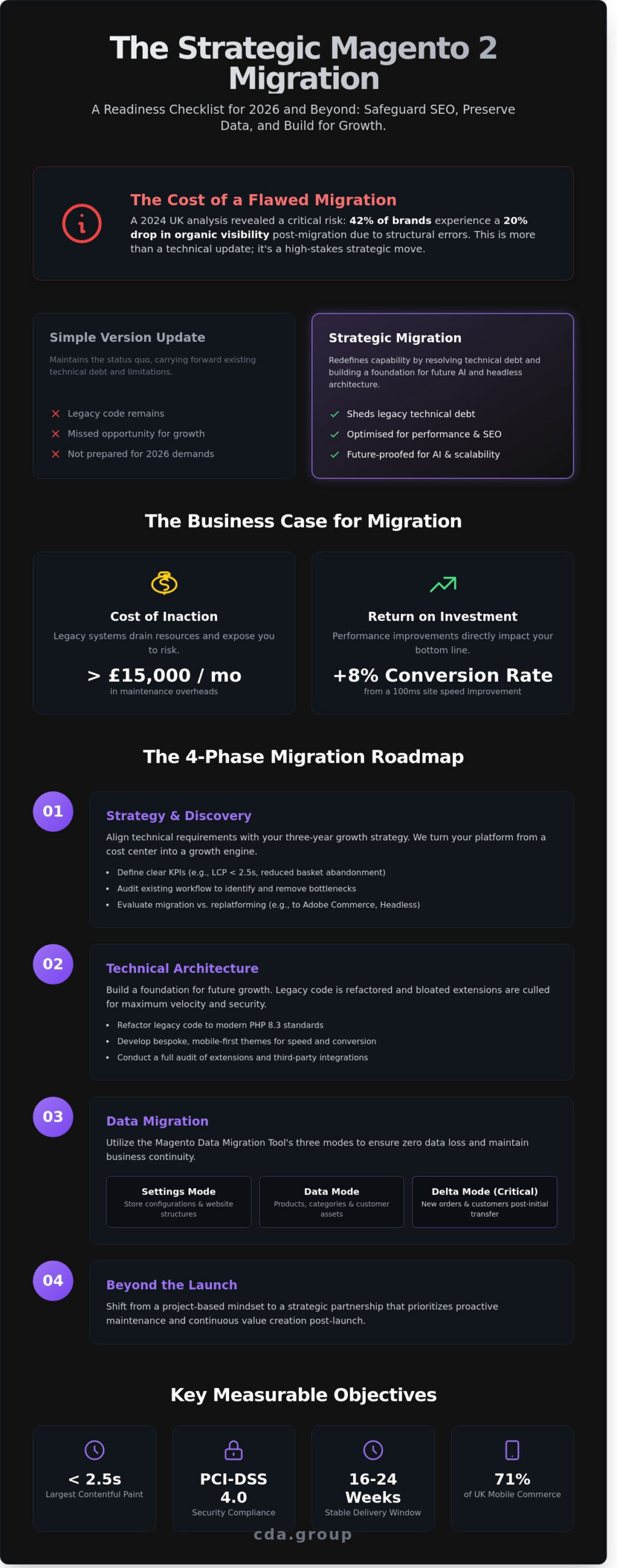
A 2024 analysis of UK eCommerce transitions revealed that 42% of brands experienced a 20% drop in organic visibility due to structural errors during a platform shift. You’re likely aware that a magento 2 migration is more than a simple technical update; it’s a high-stakes strategic move. The prospect of losing a decade of customer data or facing significant downtime is enough to stall even the most ambitious growth plans.
We’ve developed this strategy-led checklist to remove that uncertainty and provide a clear path to a high-performance store. You’ll learn how to safeguard your SEO rankings, migrate complex data sets without loss, and build a platform ready for 2026 AI and headless capabilities. This guide breaks down the essential milestones from initial audit to post-launch optimisation to ensure your transition delivers measurable impact and long-term value.
Key Takeaways
- Align your digital architecture with 2026 market demands by resolving legacy technical debt to ensure long-term AI readiness.
- Master the technical core of magento 2 migration by effectively managing data settings and refactoring legacy code for structural integrity.
- Evaluate the strategic merits of a direct upgrade versus replatforming to Adobe Commerce or headless architectures to suit your specific growth trajectory.
- Navigate the transition with a structured, phased approach that moves from rigorous discovery to high-velocity environment setup.
- Shift from a project-based mindset to a strategic partnership that prioritises proactive maintenance and continuous value creation post-launch.
Defining the Strategic Scope of Magento 2 Migration in 2026
A successful magento 2 migration is more than a technical upgrade. It’s a total transition of your data, code, and design architecture. We treat this process as a strategic replatforming. It allows brands to shed legacy technical debt accumulated during the rapid eCommerce shifts of the early 2020s. By 2026, the gap between high-performance systems and legacy setups will widen, making this the critical year for resolution. We focus on building a foundation that supports AI readiness and international expansion.
We distinguish between a version update and a strategic migration. An update maintains the status quo. A migration redefines your capability. It addresses the core business drivers that move the needle: performance, security, and scalability. High-growth brands require more than a stable site; they need a high-velocity engine that converts traffic into loyal customers across multiple territories.
The Business Case for Migration
The cost of inaction is often higher than the investment in change. Legacy systems carry heavy maintenance overheads, often exceeding £15,000 per month in developer hours just to keep the site functional. Security risks increase as older frameworks lose support. We build systems that integrate seamlessly with AI for SME businesses, allowing you to automate customer service and personalise product recommendations at scale. This shift directly impacts your bottom line. A 100ms improvement in site speed can increase conversion rates by up to 8% in the UK retail sector.
Setting Measurable Objectives
We start every magento 2 migration by defining clear KPIs. We don’t just aim for “faster”; we target specific metrics like a Largest Contentful Paint (LCP) of under 2.5 seconds. We look at checkout fluidity to reduce basket abandonment, which currently averages 69% across UK eCommerce sites. Our teams align technical requirements with your three-year growth strategy to ensure the platform scales with your ambition.
- Page Speed: Target sub-2-second load times on mobile devices.
- Security: Implement zero-trust architecture and PCI-DSS 4.0 compliance.
- Timeline: Establish a realistic 16-to-24 week delivery window to ensure stability.
- Mobile Performance: Prioritise a “mobile-first” architecture to capture the 60% of UK traffic originating from smartphones.
We prioritise stability over rushed delivery. A strategic partnership ensures that your technical roadmap supports your commercial goals. We identify the bottlenecks in your current workflow and design a solution that removes them. This approach turns your eCommerce platform from a cost centre into a growth engine.
The Technical Architecture: Managing Data and Custom Code
We treat technical architecture as the foundation for future growth. A magento 2 migration isn’t a simple upgrade; it’s a strategic replatforming that demands precision. Legacy code from Magento 1 or early Magento 2 builds often carries significant technical debt. We refactor this code to meet current PHP 8.3 standards, ensuring your store remains performant and secure through 2026 and beyond.
The Magento Data Migration Tool is central to this process. It operates through three essential modes. Settings mode migrates your store configurations and website structures. Data mode handles the bulk transfer of assets, including products and categories. Delta mode is the most critical for high-growth brands. It captures every new customer registration and order placed after the initial data transfer. This ensures zero data loss during the final transition. We manage these phases with meticulous care to maintain business continuity.
Legacy themes cannot be ported directly. We build bespoke, mobile-first themes that prioritise speed and conversion. With UK mobile commerce accounting for 71% of total online retail sales as of late 2024, your architecture must support rapid load times on handheld devices. We focus on lean CSS and modern JavaScript frameworks to deliver a seamless user experience. If you are looking to modernise your storefront, our team can help you build bespoke Magento 2 websites tailored for performance.
Database Integrity and Mapping
We create robust data maps for customer profiles and complex order histories. This includes the secure migration of encrypted data and customer passwords. Our process ensures that your historical data remains accessible and accurate. By handling incremental changes during the Delta phase, we prevent discrepancies between your old and new databases, providing a clean slate for your new environment.
Extension and Integration Audit
Bloated extension lists compromise site velocity and security. We conduct a rigorous audit to identify redundant plugins. We often replace third-party extensions with native Magento features or lean, API-led integrations. This move from monolithic structures to modular architecture improves stability. We ensure your core systems remain compatible with modern booking systems and ERPs, creating a streamlined ecosystem that scales with your ambitions.
We combine strategy, data, and technology to solve real business problems. Our approach replaces “disruptive” claims with practical intelligence, focusing on the structural integrity of your eCommerce platform. We build systems that don’t just work; they perform at the highest level.
Migration vs. Replatforming: Choosing the Right Path for Growth
Deciding on a magento 2 migration isn’t merely a technical box-ticking exercise. It’s a strategic pivot. We see many brands struggle with the choice between staying within the Adobe ecosystem or moving to a SaaS alternative like Shopify Plus. Shopify Plus offers a lower barrier to entry, but it often lacks the structural depth required for complex, multi-layered business logic. For 68% of high-growth retailers, the constraints of SaaS become a bottleneck within 24 months. We build Magento 2 websites for those who require total ownership of their roadmap and data.
The total cost of ownership (TCO) is the most critical metric here. A standard Adobe Commerce licence starts at approximately £18,000 per year, which can seem steep compared to the Open Source version. However, when you factor in the cost of maintaining 15 or more third-party modules to replicate native B2B features, the gap narrows. We’ve seen organisations save £12,000 in annual maintenance costs by moving to a more native Adobe setup. Our view as an expert architect is simple: stay on Magento if your competitive advantage depends on bespoke functionality; pivot if your needs are strictly standard retail.
Adobe Commerce vs. Open Source
Adobe Sensei AI is a primary driver for the paid version. It uses machine learning to deliver personalised search results, often resulting in a 12% increase in site-wide conversion. For companies prioritising B2B lead generation, the native capability to manage shared catalogues and custom price books is essential. It streamlines the transition from a messy legacy system to a structured, high-impact sales engine without the friction of custom-coded workarounds.
The Headless Commerce Consideration
Decoupling your frontend offers the ultimate design flexibility. It allows you to serve content to web, mobile apps, and IoT devices from a single backend. While this improves the omnichannel experience, it increases initial build complexity by roughly 35%. It’s a strategic move for brands with high-velocity engineering teams. If your organisation isn’t prepared for the increased dev-ops overhead, a traditional coupled architecture remains the more practical, stable choice for sustainable growth.
The Comprehensive Magento 2 Migration Checklist
We combine strategy, design, and engineering to solve real business problems. A successful magento 2 migration requires more than technical execution; it demands a clear strategic roadmap. We follow a rigorous five-phase framework to ensure your store remains a high-performance asset while minimising risk.
- Phase 1: Discovery and Strategic Planning. We define clear KPIs and audit your current tech stack. This foundation prevents the 20% budget creep often seen in poorly planned projects.
- Phase 2: Environment Setup and Data Migration. We build the technical core. This involves securely moving product, customer, and order data while ensuring compatibility with PHP 8.3 and modern server architectures.
- Phase 3: UI/UX Design and Frontend Engineering. We focus on the brand experience. Using frameworks like Hyvä, we aim for a Largest Contentful Paint (LCP) of 1.2 seconds or less.
- Phase 4: SEO Preservation and Quality Assurance. This is your safety net. We verify every 301 redirect and test the site across 15+ device types to ensure a flawless launch.
- Phase 5: Deployment and Post-Launch Optimisation. We execute a zero-downtime launch. The growth phase begins here, where we focus on impact over output by using real-user data to refine the experience and drive value.
SEO and Ranking Preservation
Mapping 301 redirects is a non-negotiable step to ensure no loss of organic visibility. We ensure every legacy URL points to its new destination to prevent 404 errors that damage domain authority. We audit metadata, schema markup, and URL structures against 2026 standards to improve rich snippet visibility. For deeper insights, see our guide on magento development for high-growth brands.
UI/UX and Conversion Optimisation
We use the magento 2 migration as a catalyst for a complete UI/UX refresh. By implementing Conversion Rate Optimisation (CRO) techniques, we’ve seen brands achieve a 28% uplift in mobile sales post-migration. We test checkout flows for friction points before the final launch, ensuring the path to purchase is as efficient as possible.
We help organisations navigate complexity through a blend of strategic thinking and practical expertise. Partner with us to scale your ecommerce capability.
Beyond the Launch: Scaling Impact Through Partnership
Successful completion of your magento 2 migration marks the beginning of your growth phase, not the end of a technical task. We view the post-launch period as a transition from a project mindset to a cycle of continuous improvement. High-growth brands in 2026 cannot afford to let their platforms stagnate. We work with you to ensure your digital infrastructure remains a dynamic asset that responds to market shifts in real-time. This partnership ensures your investment continues to yield returns long after the initial go-live date.
Proactive maintenance and security patching are non-negotiable for UK enterprises protecting multi-million pound turnovers. We manage these complexities so your internal teams can focus on commercial strategy. By maintaining the integrity of your build, we prevent the gradual performance decay that often follows large-scale deployments. We also help you capitalise on your new architecture by leveraging digital marketing strategies that specifically exploit your improved site speed. Data from 2024 shows that a 100-millisecond improvement in load time can correlate to a 1% increase in revenue. We ensure your marketing spend is directed toward a platform that converts at its highest potential.
Performance Monitoring and Velocity
We establish real-time monitoring frameworks to track performance gains immediately after your magento 2 migration. This visibility allows us to identify and resolve bottlenecks before they impact your customers. We use these data insights to inform the next phase of feature engineering, ensuring every update serves a specific business goal. Our teams maintain a high-velocity development cycle, often delivering iterative improvements every two weeks. This pace allows you to outmanoeuvre competitors who are restricted by rigid, quarterly release schedules.
The CDA Partnership Approach
We combine Strategy, Design, and Engineering to solve the most difficult eCommerce challenges. Our focus remains on business outcomes rather than technical output alone. We don’t just build systems; we create scalable value through a collaborative alliance. We sit on your side of the table, acting as a strategic extension of your team to navigate the complexities of the digital landscape with clarity and precision. Work with us to architect your next phase of growth and ensure your platform delivers long-term impact.
Architecting Your Next Phase of Growth
Successfully navigating a magento 2 migration in 2026 requires more than a simple technical checklist; it demands a deliberate alignment between your digital architecture and long-term business objectives. High-growth UK brands must prioritise data integrity and custom code efficiency to eliminate technical debt before it impacts the bottom line. By choosing a path rooted in strategic foresight, you ensure your platform remains resilient as market conditions shift.
We approach every project as a collaborative partnership, sitting on the same side of the table as your team. Our Certified Magento Experts have delivered over 50 successful transitions, maintaining a proven track record of zero-downtime migrations for complex enterprise environments. We combine strategy, data, and technology to solve real business problems, ensuring your platform delivers practical value rather than just technical output. We’ll help you turn complex requirements into a high-fidelity solution that fuels your next phase of expansion.
Partner with CDA Group for a Strategic Magento 2 Migration
Let’s build a commerce engine that’s ready for the challenges of tomorrow.
Frequently Asked Questions
How long does a typical Magento 2 migration take in 2026?
A standard Magento 2 migration typically spans between 16 and 24 weeks for high-growth brands. We align this timeline with your specific business cycles to ensure minimal disruption to your daily operations. Complexity drives the schedule; a store with 10,000 SKUs and five core integrations requires more rigorous testing than a simpler build. We focus on phased delivery to maintain velocity and ensure every milestone meets our quality benchmarks.
Will my SEO rankings drop during a Magento 2 migration?
Your SEO rankings remain stable when we implement a precise 301 redirect strategy and a comprehensive technical audit. A well-executed magento 2 migration actually improves visibility by enhancing Core Web Vitals and mobile performance scores. We map every legacy URL to its new destination with precision. This meticulous approach prevents the 20% traffic loss often seen in poorly managed transitions.
We also focus on metadata integrity and site structure during the move. By maintaining URL equity and improving page load speeds, most brands see an organic growth uplift within 90 days of launch. Our team treats search equity as a critical asset that requires protection throughout the engineering process.
Can I migrate my theme from Magento 1 to Magento 2?
You cannot directly migrate a theme from Magento 1 to Magento 2 because the underlying architecture is entirely different. We view this as a strategic opportunity to design a bespoke, high-performance frontend using modern technologies like Hyvä. Rebuilding your interface ensures your brand stays competitive in the 2026 UK retail market while improving mobile conversion rates by up to 35%.
What is the average cost of a professional Magento 2 migration?
Professional migrations for high-growth UK brands typically range from £45,000 to £160,000. This investment covers strategy, data transfer, and custom engineering tailored to your specific requirements. Costs vary based on the number of third-party integrations and the complexity of your product data. We provide clear, fixed-price frameworks that connect your expenditure to measurable business growth and operational efficiency.
Is it better to migrate to Magento 2 or move to Shopify Plus?
Magento 2 offers superior customisation for complex B2B workflows, while Shopify Plus suits brands prioritising lower maintenance over platform control. We help you evaluate which platform supports your long-term roadmap through a practical discovery phase. If your 2026 strategy requires bespoke logic or deep ERP integration, Magento remains the effective choice. We analyse your specific data to ensure your technology stack scales with your ambition.
How do I ensure no data is lost during the migration process?
We prevent data loss by using the official Magento Data Migration Tool alongside custom scripts for bespoke data sets. Our process includes three full dry runs in a staging environment before the final cutover. We verify 100% of customer records, order histories, and product attributes. This disciplined engineering approach ensures your business continuity and maintains customer trust throughout the transition.
Do I need to refactor my custom extensions for Magento 2?
You must refactor or replace your custom extensions because Magento 2 uses a completely different modular code structure. We audit your existing modules to identify which features are now native to the platform and which require bespoke development. Replacing redundant extensions often reduces your technical debt by 25%. We build clean, modular code that simplifies future upgrades and improves site stability.
What are the risks of staying on an older version of Magento?
Staying on an older version exposes your business to critical security vulnerabilities and non-compliance with UK PCI DSS standards. Legacy systems often suffer from a 40% slower load time compared to modern builds, which directly impacts your bottom line. We mitigate these risks by moving you to a supported, high-performance environment. This protects your brand reputation and ensures your infrastructure remains resilient against modern threats.

