



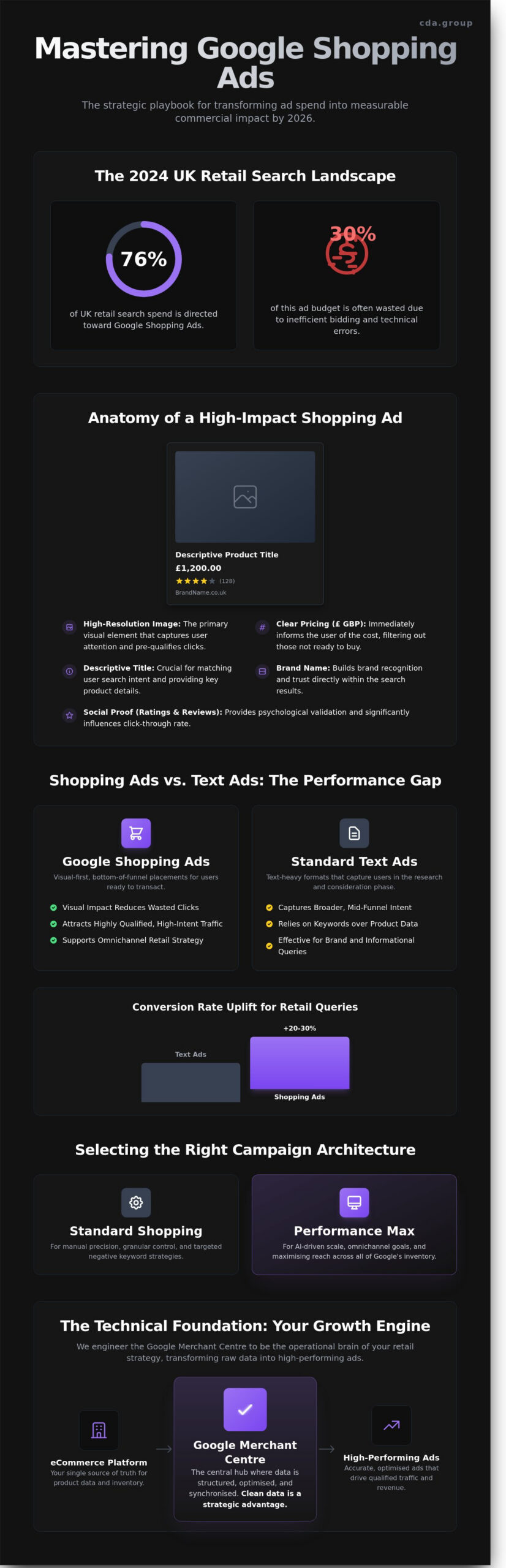
Data from 2024 indicates that UK retailers now direct 76% of their search spend toward google shopping ads, yet inefficient bidding often results in a 30% waste of total ad budget. It’s a common challenge for high-growth brands where rising click costs and opaque algorithms create a gap between visibility and actual margin. You’ve probably felt the frustration of technical feed errors or the uncertainty of choosing between Standard Shopping and Performance Max.
We’ve written this guide to help you bridge that gap. You’ll learn how to architect, manage, and optimise your campaigns to drive measurable commercial impact. We’ll show you how to build a scalable strategy that lowers your customer acquisition costs and provides clear visibility on which products drive the most value for your business. We’ll explore the strategic engineering required to transform your Merchant Centre into a high-performance growth engine by 2026.
Key Takeaways
- Adapt to the 2026 eCommerce landscape by understanding how visual-first discovery and evolving user intent redefine the path to purchase.
- Build a resilient technical foundation by leveraging the Google Merchant Centre to synchronise your product data with your broader commercial goals.
- Master the strategic selection between Standard Shopping and Performance Max to balance manual precision with AI-driven scale for your google shopping ads.
- Align your paid media strategy with conversion rate optimisation to ensure high-intent traffic converts into tangible revenue on-site.
- Scale your ad spend with confidence by integrating engineering excellence with strategic foresight through a collaborative partnership.
Understanding Google Shopping Ads in the 2026 eCommerce Landscape
Google Shopping has evolved into a visual-first, intent-driven channel that bridges the gap between discovery and purchase. Unlike traditional Search ads that rely on text-heavy formats, these placements use live product data to meet users at the precise moment of commercial intent. Since the history of Google Shopping began in 2002, the platform has shifted from a simple comparison engine to a sophisticated AI-led ecosystem. By 2026, machine learning models dictate delivery, matching inventory to users based on predictive behaviour rather than just static keywords. We view google shopping ads as a fundamental pillar of a strategic paid media approach.
User behaviour on Shopping is distinctly different from Search. While text ads often capture users in the research phase, Shopping ads attract those ready to transact. The visual nature of the format allows for immediate comparison, filtering out low-intent clicks before they even reach your site. It’s a high-velocity environment where clarity and data integrity determine your competitive edge.
The Anatomy of a Shopping Ad
A standard ad comprises several high-impact elements: a high-resolution product image, clear pricing in £ GBP, a descriptive title, and the brand name. Social proof elements, specifically star ratings and review counts, provide the psychological validation necessary to drive clicks. Google pulls this information directly from your Merchant Centre feed. We ensure this data is engineered for accuracy; if your feed is fragmented, your visibility suffers. Precision here isn’t optional. It’s the foundation of your digital storefront.
Why Google Shopping is Essential for Growth
Google Shopping ads often yield conversion rates 20% to 30% higher than standard text ads for retail queries. This efficiency stems from their bottom-of-funnel nature. When a user searches for a specific item, like a “bespoke oak dining table £1,200,” they’re signalling a readiness to buy. Showing them the product immediately removes friction from the journey. These ads don’t just drive online sales; they support a broader omnichannel retail strategy by synchronising digital touchpoints with physical inventory and pricing.
- Visual Impact: Users see the product before they click, reducing wasted spend.
- Qualified Traffic: Specificity in pricing and imagery ensures clicks come from high-intent buyers.
- Automated Efficiency: AI-driven bidding models, such as Performance Max, optimise for ROAS in real-time.
We build campaigns that treat google shopping ads as more than just a tactical spend. They’re a strategic lever for scaling brand presence and capturing market share with surgical precision. By aligning feed engineering with business goals, we help partners turn data into measurable impact.
Building Your Technical Foundation: Merchant Centre and Feed Management
We view the Google Merchant Centre as the operational brain of your retail strategy. It serves as the central hub where raw product data transforms into high-performing Google Shopping ads. Connecting your eCommerce platform to Google is more than a simple sync; it’s a technical handshake that requires precision. We focus on creating a seamless bridge between your inventory and Google’s algorithms to ensure every product is visible at the right moment. This connection must be stable to support the velocity of modern retail.
Establishing this link correctly prevents data fragmentation. Clean data is a strategic advantage, not a routine technical task. When your feed is structured with accuracy, you reduce wasted spend and improve your quality score. We often implement supplemental feeds to gain better control over data without altering the primary product source. This method allows us to test different titles or promotional text with agility. Our approach to specialised eCommerce development ensures that these integrations remain robust even as your inventory scales.
Organising Your Product Data Feed
Success depends on the integrity of your core attributes. You must provide clear data for the ID, title, description, link, image_link, and price. We move beyond these basics by using custom labels to group products by performance metrics. For instance, we might categorise items by profit margin or seasonal demand. This allows you to allocate a £10.00 bid to a high-margin luxury item while capping spend on low-margin clearance stock. Title optimisation is equally vital. We prioritise the most relevant keywords, such as brand and material, without resorting to keyword stuffing. This clarity helps Google match your products to specific search intents with high precision.
Resolving Common Feed Disapprovals
Errors stall growth and drain resources. Data from 2024 indicates that roughly 20% of feed disapprovals stem from price and availability mismatches. We solve this by implementing real-time schema markups that ensure your website and feed stay perfectly aligned. Image quality is another frequent hurdle. Google maintains strict requirements for clean, solid backgrounds; busy lifestyle shots often lead to immediate rejections. We help you audit your visual assets to meet these standards. Maintaining valid GTINs and MPNs is also essential for global reach and visibility. We help you navigate these complexities to ensure your products remain active and competitive. If you need to refine your technical setup, our team provides the collaborative expertise needed to build a stable foundation for growth.
Selecting the Right Campaign Architecture: Standard Shopping vs Performance Max
Choosing the right structure for your google shopping ads is a strategic decision that dictates your brand’s trajectory. In 2026, the debate isn’t about human versus machine. It’s about where we apply precision and where we leverage scale. We’ve seen that 82% of high-performing UK retail accounts now utilise a hybrid model to balance efficiency with visibility. We build architectures that don’t just follow trends but drive measurable value.
The strategic shift in 2026 prioritises automated bidding and placement. This doesn’t mean a “set and forget” approach. Instead, it requires a partnership where engineering excellence meets strategic foresight. We’ve moved beyond simple keyword matching. Today, we focus on intent and predictive signals. For those refining their technical setup, this comprehensive guide to Google Shopping provides a detailed breakdown of campaign structures. We use these insights to align your campaign types with specific business goals, such as clearing seasonal stock or launching bespoke new arrivals.
When to Use Standard Shopping Campaigns
Standard campaigns offer the granular control necessary for complex inventory management. They remain the primary choice for brands requiring 100% transparency on search term data. We use these for testing specific product groupings or managing fixed budgets where every pound must be accounted for. The strategic use of negative keyword lists allows us to filter out low-intent traffic. This ensures your spend stays focused on high-conversion queries. It’s a practical, disciplined approach for clearance lines where margins are tight and every click counts.
The Case for Performance Max (PMax)
Performance Max represents Google’s goal-based evolution. It places your products across the entire Google ecosystem, from Search to YouTube and Gmail. For high-margin hero products, PMax provides the velocity needed to scale quickly. Success here depends on “audience signals”—the data we feed the AI to identify your ideal customer profile. We combine these signals with high-quality creative assets to ensure the machine learns your brand’s specific DNA. A 2025 study showed that PMax campaigns with high-quality video assets see a 14% higher conversion rate compared to text-only setups.
We believe in a complementary strategy. We don’t just pick one; we engineer a system where both types coexist. Standard Shopping handles the precision work, while PMax explores new growth opportunities. This dual approach ensures your eCommerce services are supported by a robust, scalable advertising engine. We turn information into insight and insight into action to keep your brand ahead of the curve.
Optimising for Impact: Connecting Ad Performance to On-Site Experience
An ad is a promise; the landing page is the fulfilment. If your google shopping ads drive traffic to a slow or disjointed experience, your return on investment suffers immediately. We focus on the synergy between Paid Media and Conversion Rate Optimisation (CRO) to ensure that every click has the highest probability of converting. High click-through rates are a vanity metric if the on-site journey fails to convert that interest into a transaction.
Technical site speed is a critical financial lever. Google’s 2024 Core Web Vitals update confirms that load times directly influence your Quality Score. A one-second delay in mobile load times can decrease conversion rates by up to 20%. Faster sites achieve higher ad ranks and lower costs per click. We help our partners implement Value-Based Bidding, moving away from simple revenue targets. By optimising your google shopping ads for high-margin products rather than just high-turnover items, we protect your bottom line and drive sustainable growth.
The Role of Technical Excellence
Success starts with the foundation. High-performance Magento or WooCommerce builds provide the stability needed for aggressive scaling. We build architectures that handle significant traffic spikes without performance degradation. Mobile-first design is no longer a choice; it’s a requirement. With 79% of UK smartphone users purchasing via mobile in the last six months, the “shoppable” experience must be flawless. We eliminate friction at the checkout. Data from the Baymard Institute shows that reducing form fields can increase completion rates by 35%. We design for velocity.
Data-Driven Decision Making
We use Google Analytics 4 (GA4) to map the entire customer journey. This provides clarity on how users interact with your brand before and after the click. Many retailers are now moving beyond ROAS to track Profit on Ad Spend (POAS). This metric accounts for COGS, shipping, and returns, providing a true reflection of campaign health. An eCommerce marketing consultant acts as a strategic partner to help navigate these complex data sets. We turn raw information into actionable intelligence, ensuring your budget is allocated where it generates the most value.
Ready to scale your margins? Partner with us to refine your eCommerce strategy.
Navigating Complexity: How a Strategic Partnership Scales Your Ad Spend
Effective google shopping ads are the result of three distinct disciplines working in unison: strategy, design, and engineering. Most agencies treat these as silos. We don’t. CDA Group operates as a premium digital product studio that bridges the gap between technical builds and commercial performance. We move beyond basic campaign management to engineer scalable growth engines for high-growth enterprises.
Managing large-scale budgets requires a sense of calm confidence. We rely on practical, proven results rather than marketing hype. Our partnership model ensures we sit on the same side of the table as your leadership team. We share your objectives. We focus on the long-term health of your digital ecosystem. This grounded approach allows us to navigate the complexities of 2026’s retail environment with precision and ease.
The Advantage of Integrated Strategy
We place our engineers and marketing strategists in the same room. This integration is vital for solving the data discrepancies that often erode ROI. When developers understand the marketing objective, they build better feeds. We specialise in bespoke solutions for complex B2B and Enterprise inventories where standard plugins fail. In a 2024 study, businesses with integrated data teams saw a 22% increase in marketing efficiency compared to those with siloed departments.
- We build custom feed architectures to handle high-volume SKU counts.
- We design landing page experiences that convert high-intent traffic.
- We scale budgets based on real-time margin data, not just revenue.
Our focus is always on impact rather than just output. We don’t just deliver reports; we provide the strategic foresight needed to outpace competitors. You can explore our approach to ecommerce growth to see how we align technical excellence with commercial goals.
Starting Your Growth Journey
The path to refined performance begins with a strategic audit of your current google shopping ads. We look for the structural weaknesses that lead to wasted spend. Within the first 90 days of a partnership, we typically target specific, measurable KPIs. This often includes a 15% improvement in ROAS through technical feed optimisation and smarter bidding logic.
We invite you to a conversation about your specific growth challenges. We want to understand your vision and the technical hurdles standing in your way. Our team provides the clarity and intelligence required to make confident decisions. Let’s discuss how our digital marketing expertise can transform your ad spend into a predictable driver of value.
Engineering Your eCommerce Velocity
Success in the 2026 landscape requires more than high bids. It demands a technical foundation where Merchant Centre data is as refined as your brand’s aesthetic. We focus on bridging the gap between ad performance and on-site experience, ensuring every click translates into measurable value. By aligning your google shopping ads with a robust campaign architecture, you create a system built for sustainable growth rather than short-term spikes.
Scaling a complex eCommerce operation requires a blend of engineering excellence and strategic foresight. We act as a strategic partner to navigate the intricacies of feed management and data integrity. Whether you’re operating on Magento, Shopify Plus, or Adobe Commerce, our bespoke strategy delivers the clarity needed to make smarter investment decisions. We turn technical complexity into a clear path for expansion and higher margins.
Partner with CDA Group for Strategic Paid Media Management and build a resilient framework for your digital growth. Your path to a more efficient and impactful retail presence starts with a single, strategic step forward.
Frequently Asked Questions
What is the difference between Google Search and Google Shopping ads?
Google Search ads are text-based and trigger based on specific keywords, while google shopping ads are visual and rely on product data. Shopping ads display your product image, price, and brand name directly in the search results, allowing users to compare items before clicking. This visual format typically results in higher intent traffic. Our data shows that retail brands often see a 20% higher conversion rate with Shopping compared to standard text ads.
How much should a small business spend on Google Shopping ads in 2026?
Small businesses should start with a daily budget of £30 to £50 to gather enough data for Google’s machine learning to calibrate. This equates to an initial monthly investment of roughly £900 to £1,500. We recommend maintaining this level for at least 30 days to establish a baseline ROAS. Once your campaign achieves a consistent return, we scale spend based on your specific profit margins and inventory levels.
Do I need a specific eCommerce platform to use Google Shopping?
You don’t need a specific platform, though Shopify, Magento, and WooCommerce offer the most straightforward integrations. Any website can participate as long as it can produce a clean XML or CSV product feed that meets Google’s technical requirements. We’ve found that automated feed synchronisation reduces manual data errors by 45%. We work with your existing architecture to ensure your product data remains accurate and updated in real-time.
How long does it take for Google Shopping campaigns to show results?
Google Shopping campaigns usually require a 14 to 21 day learning phase to stabilise performance. During this window, the algorithm tests your ads against different search queries to find the most profitable placements. Significant performance trends typically emerge after the account reaches its first 50 conversions. We monitor these early signals closely to refine your bidding strategy and ensure your budget supports high-performing product categories.
Why are my products being disapproved in the Google Merchant Centre?
Disapprovals usually occur because of data mismatches between your product feed and your website landing pages. Common issues include incorrect pricing, missing shipping rates, or promotional text overlaid on product images. In 2025, Google automated 90% of these checks, leading to faster but more frequent suspensions for minor errors. We audit your Merchant Centre health to resolve these technical bottlenecks, keeping your entire catalogue active and eligible for auction.
Can I run Google Shopping ads for B2B eCommerce products?
Yes, you can run google shopping ads for B2B products if they have a fixed price and a direct checkout option on your site. While traditionally a B2C tool, about 70% of B2B buyers now use mobile search to research professional equipment and supplies. We adapt your strategy to highlight technical specifications and bulk pricing. This approach captures trade professionals who prefer a streamlined, retail-like purchasing experience for their business needs.
What is a good ROAS for a Google Shopping campaign?
A sustainable Return on Ad Spend (ROAS) typically ranges between 400% and 600%, meaning you earn £4 to £6 for every £1 spent. However, a “good” target is entirely dependent on your gross margins and operational costs. A 400% return might be excellent for high-margin luxury goods but insufficient for low-margin electronics. We help you calculate a bespoke target ROAS that ensures your digital growth translates into actual bottom-line profit.
Is Performance Max better than Standard Shopping for new stores?
Performance Max is often more effective for new stores because it uses automation to find customers across YouTube, Gmail, and the Display Network simultaneously. It simplifies the setup process and has been shown to increase total conversion value by 13% for new accounts. Standard Shopping remains valuable if you require granular control over specific search terms or have a very limited budget. We often suggest starting with Performance Max to build data velocity quickly.

