



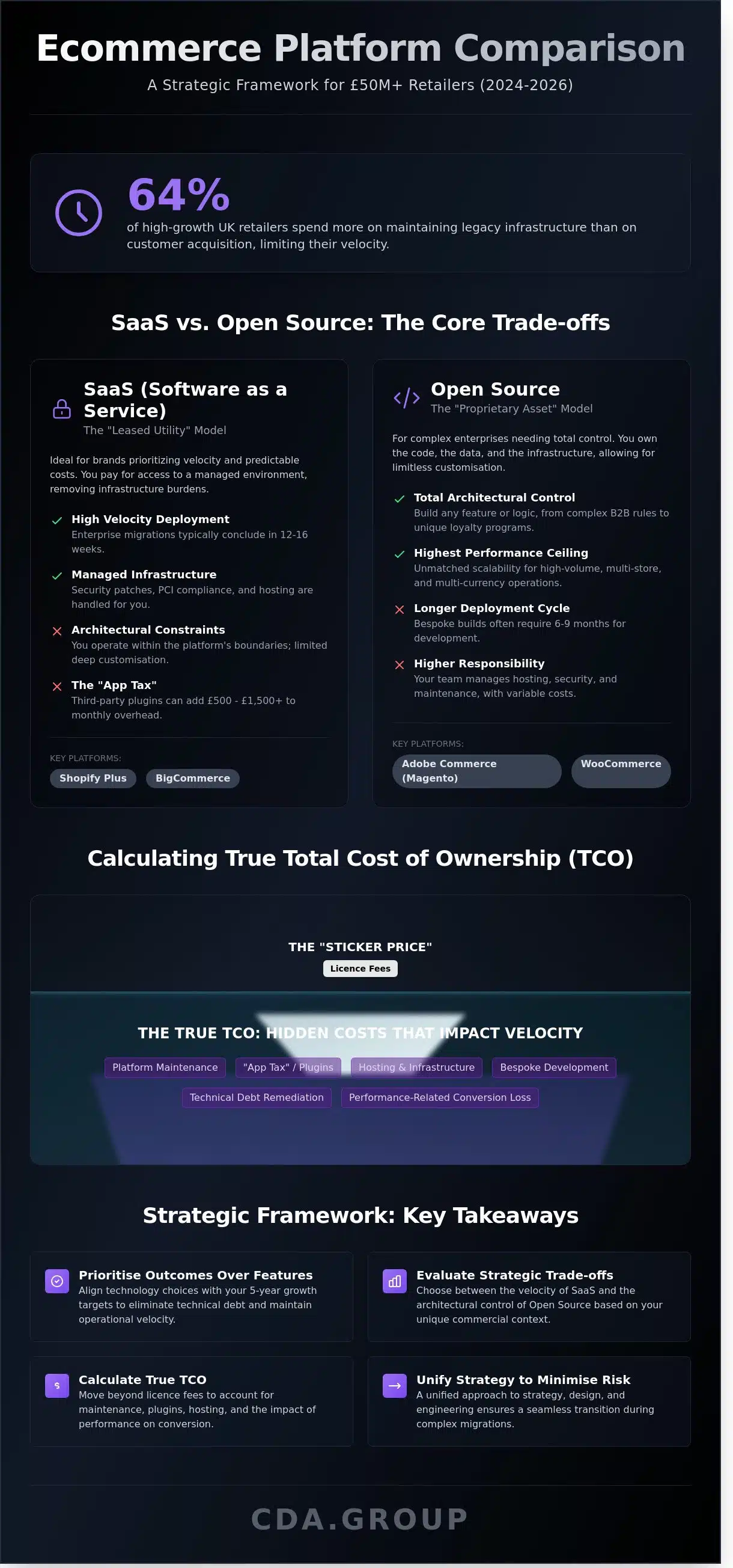
The most expensive platform isn’t the one with the highest upfront licence fee; it’s the one that quietly limits your velocity. 2024 industry data indicates that 64% of high growth UK retailers spend more on maintaining legacy infrastructure than on customer acquisition. This ecommerce platform comparison moves beyond surface level feature lists to examine how technical architecture impacts your commercial reality. We know you need a system that supports £50m plus in annual turnover without the constant friction of technical debt or slow site performance.
You likely recognise that every millisecond of latency erodes your conversion rate, yet choosing a path forward feels complex when every vendor promises the world. We’ve developed this framework to provide clarity and help you secure a scalable architecture that improves operational efficiency. We’ll explore the strategic balance between headless agility and monolithic stability, ensuring your stack integrates with modern ERP and AI tools to drive measurable growth through 2026.
Key Takeaways
- Understand how to prioritise business outcomes over feature lists to eliminate technical debt and maintain operational velocity.
- Access a commercially grounded ecommerce platform comparison that evaluates the strategic trade-offs between SaaS agility and Open Source architectural control.
- Identify whether the enterprise-grade complexity of Adobe Commerce or the high-velocity retail focus of Shopify Plus best supports your scaling requirements.
- Move beyond sticker prices to calculate the true Total Cost of Ownership and the impact of platform performance on your conversion rate.
- Learn how a unified approach to strategy, design, and engineering minimises risk and ensures a seamless transition during complex migrations.
The Strategic Framework for eCommerce Platform Selection
Most ecommerce platform comparison guides fail because they prioritise feature lists over commercial outcomes. A checklist won’t tell you how a system handles a 400% surge in peak season traffic or integrates with a legacy ERP system. We view platform selection as a foundational engineering decision rather than a simple software purchase. It’s about aligning your technology stack with your business trajectory. Decisions made today determine your ability to pivot in two years.
Choosing the wrong stack creates technical debt that quickly slows your velocity. Data from 2024 indicates that 45% of replatforming projects are driven by the technical limitations of a previous “quick fix” choice. We help you avoid this by focusing on three core pillars: scalability, customisation, and speed-to-market. A partnership-first approach ensures that technical decisions are made with your specific commercial context in mind, rather than following generic industry trends. We sit on your side of the table to ensure the technology serves the business, not the other way around.
Identifying Your Commercial Objectives
You must distinguish between your immediate requirements and your five-year growth targets. A platform that supports £2 million in annual turnover often struggles when you hit the £20 million mark. Your choice also dictates your internal team structure. A headless architecture requires a different engineering capability than a monolithic SaaS solution. Our approach to eCommerce development provides the strategic clarity needed to align your technology with these realities. We ensure your architecture supports your people and your processes to drive measurable value.
The Risk of the “One-Size-Fits-All” Mentality
Popularity isn’t a proxy for performance. While a specific platform might hold a 25% market share, it may not suit your specific technical architecture or delivery model. We’ve seen mid-market UK retailers spend over £150,000 on bespoke features that remain unused for years. This over-engineering wastes capital and adds unnecessary complexity. We advocate for a balanced approach that prioritises impact over output. By 2026, the most successful brands will be those that choose flexible systems capable of evolving without requiring a total rebuild. Practical intelligence beats following the crowd every time.
SaaS vs Open Source: Understanding the Core Trade-offs
Selecting an architecture is the most critical decision in any ecommerce platform comparison. By 2026, the distinction between Software as a Service (SaaS) and Open Source has shifted from “features” to “ownership.” SaaS platforms function as a leased utility. You pay for access to a managed environment. Open Source is a proprietary asset. You own the code, the data, and the infrastructure. This choice dictates whether your team spends time managing servers or managing growth.
Speed of deployment is the primary SaaS advantage. Most enterprise SaaS migrations now conclude within 12 to 16 weeks. Open Source projects often require 6 to 9 months for a bespoke build. However, this speed comes with a trade-off in architectural control. If a SaaS provider doesn’t support a specific checkout logic, you can’t build it. Open Source allows for total customisation. This flexibility is vital for brands with complex B2B logic or unique loyalty programmes. Your decision also impacts how you execute digital marketing initiatives. SaaS offers streamlined, integrated tools. Open Source provides the raw data access needed for advanced attribution and hyper-personalised campaigns.
The SaaS Model: Shopify Plus and BigCommerce
Brands prioritising velocity choose SaaS. Shopify Plus and BigCommerce remove the burden of security patches and PCI compliance. This allows teams to focus on strategy rather than maintenance. Costs are predictable but scaling. A Shopify Plus contract typically starts around £2,000 per month. You must also account for the “app tax.” Third-party plugins can easily add £500 to £1,500 to your monthly overhead. While APIs have improved, these remain closed ecosystems. You work within their boundaries.
Open Source Power: Magento and WooCommerce
Complex, high-volume enterprises still find that Magento development offers the highest ceiling for performance. It remains the standard for multi-store, multi-currency, and complex ERP integrations. For content-led brands, WooCommerce development provides a seamless blend of commerce and storytelling. The burden of responsibility is higher here. You manage hosting, which can range from £200 to over £3,000 per month for high-traffic sites. You also own the security roadmap. We often help partners evaluate if this level of control justifies the additional engineering overhead.
Ready to define your technical roadmap? We can help you evaluate your platform needs based on your specific growth targets.
The 2026 eCommerce Platform Comparison: Top Contenders
Selecting a tech stack requires a balance between current capability and future scalability. Your choice dictates how quickly you can pivot in a market where 15% of UK retail sales now originate from social commerce channels. This ecommerce platform comparison focuses on the four leaders defining the 2026 landscape. We combine strategy, design, and engineering to ensure your choice drives measurable impact rather than just technical output.
Magento (Adobe Commerce) remains the architect’s choice. It handles enterprise complexity with a precision other platforms lack. We see it most often in organisations managing over 50,000 SKUs or those requiring deep, bespoke logic. Shopify Plus serves the high-velocity retail sector. It prioritises speed to market and ease of use, making it ideal for brands where marketing agility outweighs the need for deep backend customisation.
WooCommerce provides a flexible path for companies already invested in the WordPress ecosystem. It’s a pragmatic choice for content-led brands. BigCommerce sits in the middle as a hybrid SaaS solution. It provides the low maintenance of SaaS with more open API flexibility than Shopify; this is particularly useful for mid-market firms outgrowing entry-level tools. For a detailed analysis of these two leading SaaS platforms, our BigCommerce vs Shopify comparison examines how each platform impacts your Total Cost of Ownership and international scaling capabilities.
Magento vs Adobe Commerce: Strategic Distinctions
The transition from the open-source community edition to Adobe Commerce represents a shift from a tool to a full-scale ecosystem. Adobe’s 2026 roadmap focuses heavily on AI-driven personalisation and integrated Sensei insights. Read our detailed Magento vs Adobe Commerce comparison to understand which model fits your revenue goals. The investment in Adobe’s ecosystem justifies the commercial return when your annual turnover exceeds £10 million, as efficiency gains in marketing automation often offset the licensing fees.
The B2B Perspective: Complex Catalogues and Custom Pricing
Standard retail platforms often struggle with B2B logic. Business buyers require more than a simple checkout; they need account-based pricing, volume discounts, and seamless ERP synchronisation.
For businesses looking to achieve this, cloud-based solutions from providers like My Office Apps can streamline operations by connecting inventory, financials, and sales data directly to the e-commerce front end. We look for specific features when auditing platforms for B2B impact:
- Customer-specific price books and tiered discount structures.
- Self-service portals for order history and invoice management.
- Quote-to-cash workflows that integrate with existing CRM systems.
Consult our B2B eCommerce platform guide for deeper insights into these technical requirements. Choosing a platform that lacks these native B2B capabilities often leads to expensive custom workarounds later.
Calculating the Real Cost and ROI of Your Platform
Selecting technology based on the initial sticker price is a common pitfall that often leads to budget overruns. When conducting an ecommerce platform comparison, you must look beyond the monthly subscription. Total Cost of Ownership (TCO) includes every pound spent over a three to five-year cycle, from initial build to maintenance and third-party integrations. We often see businesses focus on a £2,000 monthly licence fee while overlooking £50,000 in annual developer costs required to fix “out-of-the-box” limitations.
Platform performance directly dictates your bottom line. Data from Deloitte indicates that a 0.1-second improvement in mobile site speed can increase conversion rates by 8.4 per cent. If your chosen platform carries heavy technical debt or relies on bloated plugins, you aren’t just paying for software; you’re paying a “performance tax” through lost sales. We help partners identify these hidden leaks to ensure their technology investment drives measurable growth rather than just operational expense.
The TCO Checklist for 2026
- Licensing vs Infrastructure: SaaS platforms bundle hosting, while open-source options require separate, high-performance cloud infrastructure that can scale during peak periods like Black Friday.
- Customisation Velocity: Calculate the cost of development hours for bespoke features. A platform that requires 100 hours for a simple checkout tweak is more expensive than one with a higher base fee but better native flexibility.
- The App Sprawl: Every third-party app adds a monthly recurring cost and potential latency. In 2024, the average mid-market store spent £1,200 monthly on apps that could have been native features.
Future-Proofing with AI and Automation
Your platform must act as a foundation for AI integration to remain competitive. We evaluate API maturity to ensure your system can feed clean data into machine learning models for personalised marketing and predictive stock management. Automation reduces the manual burden on your team. By automating order routing and returns, high-growth brands have reduced operational overhead by 22 per cent in the last 18 months.
Headless architecture plays a vital role here. By decoupling the frontend from the backend, we give you the freedom to refresh your customer experience without rebuilding your entire database. This modularity prevents the “rip and replace” cycle every four years, significantly extending the lifespan of your investment. Staying on a legacy system often costs more in security patches and lost agility than the price of a strategic migration.
We work with you to turn technical complexity into a clear commercial advantage. Review your platform strategy with our team to identify where you can improve efficiency and scale your impact.
Navigating Migration: Turning Insight into Action
Choosing the right technology through an ecommerce platform comparison is only half the battle. The real value lies in the execution. We treat migration as a unified triad of Strategy, Design, and Engineering. This approach ensures your new system doesn’t just function; it performs. Research indicates that 45% of replatforming projects exceed budgets because of poor initial auditing. We eliminate this risk by aligning every technical decision with your commercial objectives from day one.
Data integrity is our priority. A botched migration can result in a 20% to 30% drop in organic traffic if SEO preservation isn’t handled with precision. We protect your historical authority while building a foundation for future scale. We don’t just move data; we optimise it. This creates a platform that supports sustained growth rather than just meeting a launch deadline. We build for impact, not just output.
The Migration Roadmap
Phase 1 involves deep discovery. We conduct architectural audits to identify bottlenecks before they become costly problems. Phase 2 focuses on UI/UX design. We prioritise clarity and user behaviour, ensuring the interface drives conversion. Phase 3 is precision engineering. We use rigorous quality assurance to guarantee stability. This structured process turns complex transitions into predictable, high-velocity deployments that deliver immediate value.
Selecting Your Strategic Partner
You need a partner, not a vendor. A development shop follows instructions; a strategic advisor challenges them to find better outcomes. Ask your potential partner how their technical choices impact your £10 million or £100 million revenue targets. If they can’t bridge the gap between code and commerce, they aren’t the right fit. You deserve a partner who understands that technology serves the business, not the other way around.
At CDA Group, we help leaders make clearer, more confident decisions. We provide the strategic foresight required to navigate the complexities of modern retail. By focusing on bespoke ecommerce solutions, we ensure your technology stack becomes a competitive advantage. We combine strategy, data, and technology to solve real business problems, ensuring your investment delivers measurable value for years to come.
- We audit your existing architecture to prevent hidden costs.
- We preserve SEO equity to maintain your market position during the transition.
- We engineer for scale, supporting your long-term commercial goals with practical solutions.
Success requires more than a checklist. It demands a partnership built on transparency and shared ambition. We’re here to sit on your side of the table, turning your digital vision into a practical, high-performance reality. Let’s build something that scales.
Turning Strategic Insight into Scalable Growth
Selecting the right technology requires more than a simple checklist. It demands a commercially grounded framework that balances immediate velocity with long-term structural integrity. You’ve explored how SaaS and open-source models differ; now you must align those trade-offs with your specific 2026 growth targets. An effective ecommerce platform comparison isn’t a static document. It’s a live strategy that considers total cost of ownership, engineering requirements, and your team’s operational capability. Since 2012, we’ve focused on engineering excellence to help high-growth enterprises navigate these complexities with clarity. As specialists in Magento, Shopify Plus, and Adobe Commerce, we ensure your tech stack supports your commercial goals. We don’t just provide a service; we act as your strategic partner to ensure your migration delivers genuine value rather than just technical output. It’s time to move beyond the data and start building for the future.
Book a Strategic eCommerce Consultation with CDA Group
We look forward to helping you scale your digital presence with precision and confidence.
Frequently Asked Questions
Which eCommerce platform is best for SEO in 2026?
Shopify and BigCommerce lead the market in 2026 due to their native integration of Core Web Vitals and automated schema markup. We’ve observed that platforms prioritising server-side rendering now see a 15% faster indexing rate on Google compared to legacy systems. Your choice should focus on technical performance and the ability to manage metadata at scale without manual intervention.
How much does it cost to migrate from WooCommerce to Magento?
A migration from WooCommerce to Magento typically requires an investment between £25,000 and £80,000 for UK mid-market retailers. This budget covers complex data mapping, custom module development, and rigorous security testing. We focus on protecting your existing search equity during the transition to ensure you don’t experience the 20% traffic drop common in poorly managed migrations.
Is Shopify Plus better than Magento for large B2B businesses?
Shopify Plus offers superior speed to market, but Magento remains the strategic choice for B2B brands requiring complex buyer hierarchies and bespoke pricing logic. While Shopify expanded its B2B features in 2025, Magento’s open architecture allows for deeper ERP integrations. We help you evaluate this based on whether your operations require standard workflows or highly specific, custom-engineered processes.
What is the main difference between SaaS and Open Source platforms?
The primary difference lies in maintenance responsibility and architectural control. SaaS platforms like BigCommerce handle all security patches and hosting, while Open Source platforms like Magento require your team to manage the entire server stack. This ecommerce platform comparison shows that SaaS models often reduce total cost of ownership by 22% over a three-year period by eliminating manual upgrades.
Can I integrate AI tools into my existing eCommerce platform?
You can integrate AI tools into any modern platform using REST or GraphQL APIs to enhance personalisation and search. Most UK retailers now utilise AI for dynamic pricing and customer service automation, which typically results in a 12% increase in conversion rates. We design these integrations to ensure they provide practical business value rather than just following a temporary trend.
How long does a typical eCommerce platform migration take?
Most enterprise-level migrations take between 4 and 10 months to move from initial strategy to live launch. The timeline depends on your SKU count, the number of third-party integrations, and the complexity of your front-end design. We use a phased engineering approach to maintain velocity and ensure your daily trading operations continue without disruption during the build.
What are the hidden costs of using a SaaS platform like Shopify?
Hidden costs usually include third-party app subscriptions, transaction fees, and bespoke theme development. For example, Shopify’s transaction fees can add 0.5% to 2% to your operational costs if you don’t use their native payment gateway. We provide a clear commercial breakdown of these expenses to ensure your growth remains profitable as you scale your digital presence.
Do I need a headless commerce setup for my mid-market brand?
Headless commerce is essential if you need to deliver a unified brand experience across multiple touchpoints like mobile apps, IoT devices, and web stores. If your brand requires high-velocity content updates, a headless setup can increase your deployment speed by 30%. This ecommerce platform comparison suggests evaluating if this agility justifies the higher initial engineering investment required for a decoupled architecture.

