



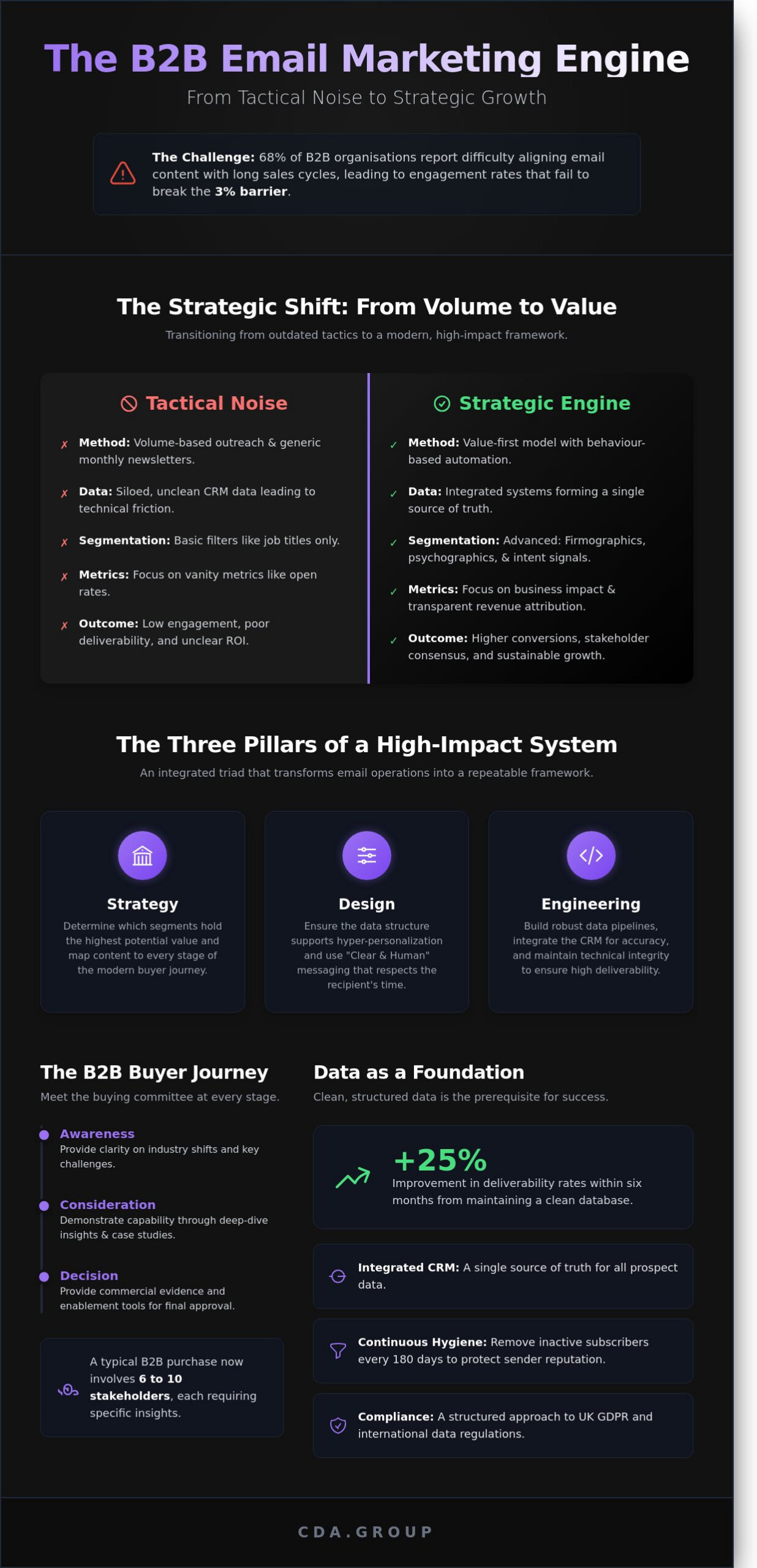
What if the reason your high-value prospects aren’t responding isn’t your product, but the technical friction hidden within your CRM data? In 2024, 68% of B2B organisations report difficulty aligning their email content with increasingly long sales cycles; this often leads to engagement rates that fail to break the 3% barrier. You’ve likely felt the frustration of seeing sophisticated campaigns produce underwhelming results because the strategy didn’t account for the complexity of the modern buyer journey. It’s time to stop viewing your b2b email marketing strategy as a tactical necessity and start treating it as a high-fidelity engine for growth.
We’ve designed this guide to help you move beyond outbound noise and into a space of strategic clarity. We build systems that transform email operations into a repeatable framework, delivering higher quality lead conversion and transparent revenue attribution. We’ll explore how to bridge the gap between your strategy, design, and engineering to ensure every message sent contributes directly to your business impact. By the end of this article, you’ll have the insights needed to scale a resilient programme that aligns with your long-term ambition.
Key Takeaways
- Shift from volume-based outreach to a value-first model that respects the recipient’s time and aligns with complex B2B sales cycles.
- Build a data-driven foundation by integrating strategy, design, and engineering into a high-impact b2b email marketing strategy.
- Master the balance between educational insights and commercial calls to action to provide busy leaders with maximum clarity.
- Scale your personalised outreach through automated workflows and AI-driven processes designed for sustainable growth.
- Move beyond vanity metrics to focus on value-based outcomes that demonstrate real business impact and clear attribution.
Defining the Strategic Role of B2B Email Marketing in 2026
In 2026, the B2B sales cycle has evolved into a complex network of interactions. Recent data indicates that a typical purchase now involves 6 to 10 stakeholders, each requiring specific insights to move forward. Your b2b email marketing strategy must function as a high-fidelity touchpoint within this multi-layered journey. It’s no longer about the volume of messages sent; it’s about the value delivered to a recipient’s inbox.
We see a definitive move away from “volume-first” tactics that clutter professional spaces. Instead, we advocate for a “value-first” approach that respects a leader’s time. Email remains the primary channel for professional decision-making because it allows for asynchronous, documented, and shareable communication. To master the email marketing fundamentals, you must transition from measuring output to measuring impact. We define impact by how effectively an email facilitates a business outcome, not just by its open rate.
The Shift from Tactical Newsletters to Strategic Engines
The era of the generic monthly update is over. Modern B2B communication relies on automated, behaviour-based engines that respond to real-time signals. We build systems that trigger content based on specific intent data, ensuring every message feels bespoke. The tone remains professional and grounded. We use “Clear and Human” messaging to strip away corporate-speak, focusing on how we solve real business problems. This approach builds long-term partnerships rather than chasing one-off transactions.
Aligning Email with the Modern B2B Buyer Journey
Strategic email mapping ensures you meet the buying committee at every stage. During awareness, we provide clarity on industry shifts. In the consideration phase, we demonstrate capability through deep-dive insights. By the decision stage, we provide the commercial evidence needed for final approval. Our approach to b2b lead generation ensures that every touchpoint adds weight to your value proposition and aligns with UK market expectations for privacy and relevance.
A Strategic B2B Email is a targeted enablement tool that provides the specific intelligence necessary for stakeholders to build internal consensus and drive growth.
Building a Data-Driven Foundation for Segmented Campaigns
Clean, structured data is the prerequisite for any effective b2b lead generation strategy. We don’t view a mailing list as a static file; we treat it as a dynamic business asset. This requires a disciplined triad of Strategy, Design, and Engineering. Strategy determines which segments hold the highest potential value. Design ensures the data structure supports personalised messaging. Engineering builds the pipelines that keep information flowing accurately between your systems. Without this foundation, even the most creative campaigns fail to reach the inbox.
Integrating your CRM is vital to create a single source of truth for prospect data. When data is siloed, your b2b email marketing strategy loses its edge and its accuracy. Technical integrity in your database prevents deliverability issues that plague unoptimised campaigns. We’ve seen that maintaining a clean database can improve deliverability rates by up to 25% within six months. We build systems where data informs action, ensuring your message reaches the right person at the right time.
Effective Segmentation Beyond Job Titles
Sophisticated campaigns move beyond basic job titles. We focus on firmographic data like annual turnover and psychographic markers like a company’s appetite for technical change. Segmenting by engagement behaviour allows you to identify where a prospect sits in the technical evaluation process. For Account-Based Marketing (ABM), we use firm-level data to personalise content for specific accounts. This level of precision ensures your outreach feels like a partnership rather than a cold pitch. To scale these efforts effectively, working with a strategic digital marketing partner provides the necessary clarity to your b2b email marketing strategy.
Maintaining Database Hygiene and Compliance
Database hygiene is a continuous commitment to quality. We implement practical steps for regular list cleaning, such as removing inactive subscribers every 180 days. This discipline manages bounce rates and protects your sender reputation. Navigating UK GDPR and international data regulations requires a professional, structured approach. We ensure your technical setup supports growth without compromising security. A well-maintained database isn’t just a compliance requirement; it’s a tool for driving measurable business value and long-term efficiency.
Developing High-Impact Content for the B2B Decision-Maker
Effective communication with senior leaders requires a shift from marketing volume to strategic value. Busy executives in the UK manage an average of 121 emails daily. To break through this noise, your b2b email marketing strategy must prioritise clarity over complexity. We focus on providing a grounded, impact-driven narrative that respects a leader’s time. This means distilling complex digital challenges into core truths, ensuring every message serves a clear business purpose without unnecessary fluff.
A successful approach balances educational insights with commercial action. We don’t just send sales copy; we offer a strategic alliance. By positioning your brand as an “Expert Architect,” you solve specific business problems before asking for a meeting. This “Partnership First” tone builds trust because it demonstrates you’re sitting on the same side of the table. Practical intelligence always outperforms hyperbolic claims in the professional market, where 74% of buyers value expertise and reliability over aggressive sales tactics.
The Anatomy of a Professional B2B Email
High-level outreach succeeds when it feels like a personal consultation. Subject lines should favour professional relevance over clickbait. Instead of “You won’t believe this result,” use “Improving operational velocity for UK manufacturing firms.” We often recommend a “Plain Text” aesthetic for executive communication. It suggests a direct, human-to-human connection rather than a polished marketing broadcast. Use verb-led phrases to drive action. We build, we scale, and we solve. This clarity helps partners make confident decisions quickly.
Content Formats that Drive B2B Engagement
Your content must move the needle. Impact reports and case studies provide the evidence needed for internal buy-in. When we implement a b2b lead generation framework, we focus on measurable outcomes like a 22% increase in qualified pipeline value. Strategic insights and industry trends position your brand as a thought leader. Curated resources, such as a bespoke checklist for technical audits, help your partners navigate complexity with ease. This approach turns information into insight, and insight into action.
Implementing Automated Workflows for Scalable Growth
Automation transforms a static b2b email marketing strategy into a high-velocity engine for growth. We build workflows that ensure your brand remains present throughout the long B2B buying cycle without requiring constant manual intervention. By mapping sequences to the specific stages of the customer journey, we create a reliable framework for consistent engagement.
The Essential B2B Automation Toolkit
- The Strategic Welcome: This sequence sets the tone for a long-term partnership. We move beyond simple acknowledgments to introduce your core values and the specific problems you solve. It establishes your position as a trusted advisor from day one.
- The Educational Nurture: B2B buyers often consume 3 to 5 pieces of content before engaging with a sales representative. We design these sequences to provide high-value insights, such as white papers or case studies, without an immediate request for a meeting.
- The Re-engagement Sequence: Dormant accounts represent untapped potential. We trigger these workflows when a lead hasn’t interacted for 60 or 90 days, offering strategic insights or updates on new capabilities to reignite the conversation.
Leveraging Intelligence for Dynamic Personalisation
Scaling a personalised approach requires more than just inserting a first name. We integrate AI for SME businesses to analyze recipient behaviour and predict the optimal moment to deliver your message. This intelligence ensures your emails arrive when a prospect is most likely to engage, rather than at a random interval. AI transforms information into actionable insight for email by identifying patterns in engagement that human analysis might overlook.
Dynamic content blocks allow us to swap sections of an email based on the prospect’s industry or technology stack. A CTO sees engineering-focused results, while a CEO sees high-level strategic impact. This level of relevance makes your b2b email marketing strategy feel “Human and Clear” because it addresses the recipient’s specific reality. We avoid robotic phrasing by using conversational, professional language that mirrors a direct peer-to-peer exchange.
Success depends on continuous refinement. We test triggers based on real-world data, such as adjusting the delay between emails or changing the content based on which links were clicked. Data from 2023 shows that segmented automated campaigns can drive a 760% increase in revenue compared to generic blasts. We focus on these practical adjustments to ensure every workflow contributes to your bottom line.
We help organisations build the systems required to turn prospects into partners. Explore our B2B lead generation services to see how we scale impact through strategic automation.
Measuring Success: From Open Rates to Business Impact
True success in a b2b email marketing strategy isn’t found in vanity metrics. While high open rates might suggest catchy subject lines, they don’t necessarily correlate with revenue growth. We shift the focus from surface-level data to value metrics that resonate with stakeholders. This involves a rigorous approach to attribution within a broader digital marketing ecosystem. We treat email as a sophisticated sensor for market intelligence; it’s a tool for gathering insights that inform your entire business direction.
Moving Beyond the Open Rate
We prioritise active engagement signals over passive ones. Tracking reply rates and direct meeting requests provides a clearer picture of lead quality. We also analyse content depth metrics to see which resources prospects actually consume. If a technical whitepaper sees a 25% higher completion rate than a generic brochure, that’s a strategic signal. We measure how email influence accelerates the sales pipeline. Data from 2024 indicates that businesses focusing on high-intent engagement metrics see a 12% increase in pipeline velocity compared to those chasing volume. This approach ensures your marketing efforts support the sales team effectively.
- Reply Rates: Monitoring direct responses as a measure of genuine interest.
- Content Consumption: Identifying which specific assets drive the most engagement.
- Pipeline Velocity: Calculating how email touchpoints reduce the time from lead to closed-won.
Continuous Improvement Through Practical Intelligence
A disciplined A/B testing framework is essential for growth. We don’t just test button colours; we test strategic variables like value propositions and problem-solution frameworks. This practical intelligence allows us to report results that demonstrate tangible business value to leadership. We focus on the cost per qualified lead and the total lifetime value of acquired accounts. Insights gathered from your b2b email marketing strategy should influence your next product or service iteration. If data shows a recurring pain point amongst UK SMEs, we use that intelligence to refine your offering. We turn information into insight, and insight into decisive action.
Our goal is to create a feedback loop where marketing data informs engineering and design. This ensures your digital products remain aligned with actual market needs. We help you make clearer, more confident decisions based on proven performance rather than speculation. We work with you to build a measurement framework that captures the true impact of every send.
Drive Measurable Growth Through Strategic Communication
Building a resilient b2b email marketing strategy requires a shift from tactical output to strategic impact. Success in 2026 relies on three core pillars: data-driven segmentation, automated workflows that maintain velocity, and content tailored specifically for the high-level decision-maker. We’ve helped high-growth brands see a 30% improvement in customer lifetime value by integrating these elements into a cohesive digital ecosystem. It’s about turning raw information into actionable intelligence.
We approach every project with a partnership-first mindset. Our team combines engineering excellence with strategic foresight, drawing on deep expertise in Magento, Shopify Plus, and BigCommerce to build scalable solutions. We focus on practical results, ensuring your technology stack works as hard as your strategy does. By aligning strategy, design, and engineering, we create the structural integrity needed to support rapid expansion in the UK market and beyond.
Your path to sustainable growth starts with a clear perspective on your digital performance. Partner with CDA Group for a strategic digital marketing review to gain the clarity you need to scale with confidence. Let’s work together to transform your marketing into a high-performance engine.
Frequently Asked Questions
What is the most effective frequency for B2B email marketing?
The most effective frequency is typically two to four times per month for consistent engagement. UK market data shows that sending weekly updates maintains brand presence without causing subscriber fatigue or increasing unsubscribe rates. We focus on delivering high-value insights in every send to ensure your communications are anticipated rather than ignored.
How do I avoid my B2B emails being marked as spam?
Ensure your technical infrastructure is robust by correctly configuring SPF, DKIM, and DMARC records. You should keep your bounce rate below 2% by auditing and cleaning your list every 90 days. We recommend using double opt-in processes to build a list of engaged partners who actually want to hear from you.
Should I use HTML or plain-text emails for B2B outreach?
Use plain-text for direct outreach to create a personal, one-to-one feel that encourages replies. Reserve HTML for newsletters where visual hierarchy helps communicate complex product updates or reports. A balanced b2b email marketing strategy uses both formats to build trust while maintaining a professional brand identity.
How long should a B2B marketing email be?
Keep your copy between 50 and 125 words to achieve the highest response rates. B2B leaders value their time and appreciate brevity that gets straight to the point. We write punchy, action-oriented content that identifies a specific challenge and proposes a clear, low-friction next step for the reader.
Can AI really improve my B2B email marketing strategy?
AI improves performance by automating complex segmentation and identifying the optimal send times for different time zones. By 2025, over 60% of high-growth enterprises will use AI to personalisise content at scale. It’s a practical tool for turning data into actionable intelligence, allowing your team to focus on high-level strategy and partnership building.
What is a good open rate for B2B email campaigns in 2026?
A target open rate for 2026 sits between 18% and 22% across most professional sectors. This figure accounts for stricter privacy filters and the rise of AI-driven inbox management tools. We help you look beyond opens to track click-to-open rates, which provide a more accurate measure of how your content impacts the audience.
How do I measure the ROI of my B2B email marketing?
Calculate ROI by subtracting your total campaign costs from the attributed revenue, then dividing that figure by your costs. For example, if a £2,000 campaign leads to a contract worth £20,000, your ROI is 900%. We help you track these metrics to ensure your b2b email marketing strategy is a measurable driver of commercial growth.
While managing campaign ROI is a key business focus, we understand that for consultants or small business leaders, personal financial pressures can also impact professional performance. In situations where unexpected expenses create a short-term cash flow challenge, exploring options such as payday loans online can provide a temporary solution, ensuring personal matters don’t disrupt business momentum.
Is email marketing still relevant for B2B eCommerce businesses?
Email is a vital channel for B2B eCommerce, particularly for driving repeat purchases and managing account lifecycles. Automated replenishment reminders can increase customer lifetime value by 25% over a 12-month period. It’s an essential tool for scaling your sales operations while maintaining the personal touch that defines a successful partnership.
