



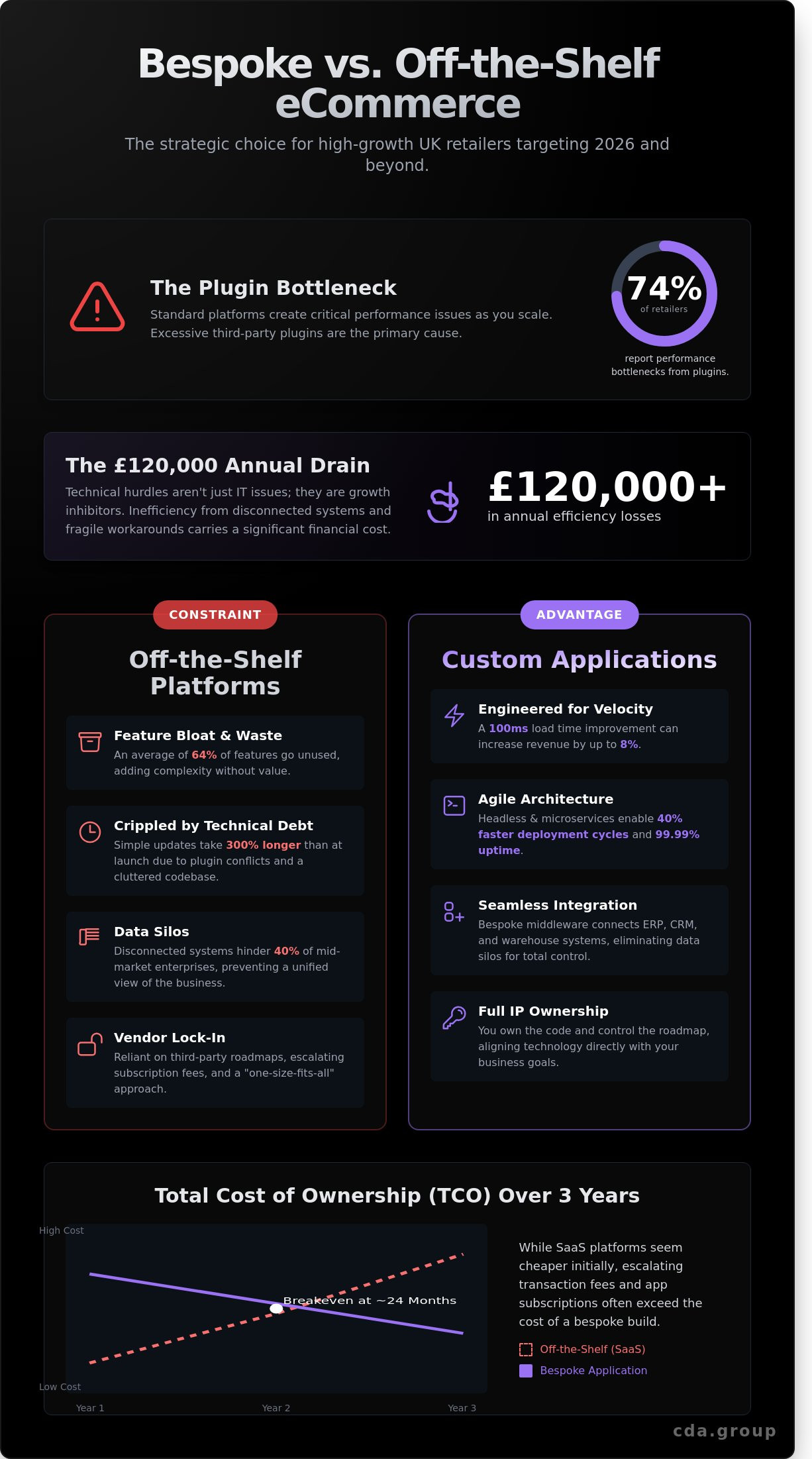
Your standard eCommerce platform is likely the primary barrier to your 2026 growth targets. While off-the-shelf solutions offer a quick start, 74% of high-growth UK retailers find that excessive third-party plugins eventually trigger critical performance bottlenecks. Investing in custom web application development ecommerce allows you to bypass these constraints by aligning your technology with your specific business logic. You’ve likely felt the friction of trying to sync B2B requirements with a standard retail interface or managing data across three or more disconnected systems. We understand that these technical hurdles aren’t just IT issues; they’re growth inhibitors that can cost a mid-market brand over £120,000 in annual efficiency losses.
This guide demonstrates how bespoke engineering replaces fragile workarounds with a high-velocity digital ecosystem. We’ll show you how to solve complex operational challenges and secure a clear ROI through engineering excellence and strategic foresight. We’ll explore the shift from fragmented tools to a unified architecture that scales with your ambition, ensuring your digital infrastructure becomes a competitive advantage rather than a constraint.
Key Takeaways
- Understand the shift toward headless and microservices architectures to bypass the limitations of standard platform extensions.
- Gain total command over the customer journey and backend efficiency through seamless integration with existing ERP and warehouse systems.
- Explore how custom web application development ecommerce creates the bespoke middleware needed to connect disparate data points and drive growth.
- Prioritise a strategy-led discovery phase to ensure your digital product is engineered for long-term scalability and commercial impact.
- Evaluate potential partners based on their strategic insight and ability to navigate the complexities of modern retail technology alongside your team.
Defining Custom Web Application Development in the 2026 eCommerce Landscape
By 2026, the distinction between a standard online shop and a high-performance retail engine has sharpened. Standard platforms often fail to meet the complex demands of high-growth UK enterprises. Custom web application development ecommerce provides a foundation built for scale. Unlike generic templates, custom software aligns exactly with your operational logic. We build systems that prioritise velocity over convenience. This approach moves beyond simple storefronts to create integrated digital products that drive measurable impact.
Modern retail architecture has shifted decisively toward Headless and microservices configurations. This decouples the front-end user experience from back-end business logic. It allows for 40% faster deployment cycles compared to monolithic structures. Microservices ensure that a failure in one module, such as a payment gateway, doesn’t crash the entire store. This structural integrity is vital for maintaining 99.99% uptime during peak trading periods. We design these systems to ensure your technology stack remains agile and responsive to market shifts.
Data integrity is no longer just a compliance requirement; it’s a competitive edge. In the current landscape, performance velocity is the primary driver of search engine visibility and user retention. A 100ms improvement in load time can increase retail revenue by up to 8% based on 2025 industry benchmarks. Custom builds eliminate the overhead of third-party subscriptions that eat into margins. You own the intellectual property. You control the roadmap. This reduces the reliance on external vendors and keeps your strategic goals at the forefront of every engineering decision.
Bespoke vs. Off-the-Shelf: A Strategic Comparison
Managing the total cost of ownership (TCO) requires a clear three-year horizon. While a SaaS platform may seem cheaper initially, escalating transaction fees and app subscriptions often exceed the cost of a bespoke build by month 24. Custom builds eliminate the feature bloat found in standard sites, where 64% of features typically go unused. We design unique user journeys that reflect your specific brand behaviour. This precision removes the friction that generic plugins often introduce to the checkout process.
The Impact of Technical Debt on eCommerce Growth
Technical debt is the cumulative cost of choosing easy shortcuts over scalable engineering.
You’ll know your plugin-heavy approach is failing when simple updates take 300% longer than they did at launch. Frequent site crashes during minor updates or slow page responses are clear indicators of structural weakness. Bespoke applications provide a cleaner, more maintainable codebase that facilitates rapid scaling. This engineering excellence ensures your team spends time on innovation and growth rather than constant bug fixes. We focus on building a sustainable capability that supports your long-term business strategy.
Strategic Advantages: Why Bespoke Solutions Outperform Generic Plugins
Off-the-shelf plugins often promise speed but deliver constraints. For high-growth retailers in the UK, the limitations of generic software become apparent when trying to scale beyond £10 million in annual recurring revenue. We build systems that remove these ceilings. By choosing custom web application development ecommerce, you gain absolute authority over every touchpoint. This control extends from the initial product discovery phase to the final, bespoke checkout flow. You’re no longer forced to adapt your business model to your software; the software adapts to you.
Generic platforms rely on a “one size fits all” logic that rarely aligns with complex business models. When deciding between purchasing an off-the-shelf solution or outsourcing the development, the primary factor is long-term agility. Bespoke applications allow for deep, seamless integration with your existing ERP, CRM, and legacy warehouse systems. This eliminates the data silos that typically hinder 40% of mid-market enterprises. We design infrastructure that scales independently of your core platform. This ensures your site remains performant during peak traffic events like Black Friday, where even a two-second delay can drop conversions by 7%.
Security is another critical differentiator. Standard plugins are frequent targets. Their vulnerabilities are public knowledge. Custom builds allow us to implement specific security protocols tailored to your unique risk profile and UK GDPR requirements. We focus on protecting your intellectual property and customer data through rigorous engineering standards. This avoids the bloat of third-party code that often introduces hidden backdoors. By aligning Strategy, Design, and Engineering, we create a fortified environment that protects your reputation and your bottom line.
Operational Efficiency and Workflow Automation
Manual data entry is a silent killer of profitability. We automate the flow between your storefront and back-office, reducing administrative overhead by up to 25% for our partners. Custom dashboards provide your logistics teams with real-time clarity, turning chaotic warehouse data into actionable insights. In retail environments where services supplement products, custom booking systems can be integrated directly into your workflow to manage appointments without friction. This level of automation ensures your team focuses on growth, not maintenance.
Superior UI/UX Design for Higher Conversion Rates
Conversion rates live or die by the quality of the interface. Custom applications allow for sophisticated, brand-aligned designs that generic templates cannot replicate. We reduce friction in the mobile shopping experience by building bespoke components that respond instantly to user intent. Engineering excellence directly influences customer trust. A site that feels sturdy and intuitive encourages higher average order values. Our approach to custom web application development ecommerce ensures your digital presence reflects your brand’s premium nature. Strategic UI/UX design for eCommerce forms the foundation of these high-converting interfaces, transforming complex interactions into seamless customer journeys. If you’re ready to move beyond the constraints of standard plugins, we can help you refine your digital strategy for maximum impact.
Core Use Cases: From Headless Architectures to AI-Driven Operations
Standard platforms provide a reliable foundation. They don’t provide a competitive edge. We build custom web application development ecommerce solutions that bridge the gap between generic features and specific business logic. Off-the-shelf software often forces your business to adapt to its limitations. We reverse that dynamic. We design technology that adapts to your unique operational flow, ensuring your digital architecture supports growth rather than hindering it.
Custom middleware acts as the central nervous system for high-growth UK retailers. It connects fragmented data points across legacy ERPs like Sage 200 and modern warehouse management systems. We design these connectors to ensure a single source of truth. This prevents the £12,000 annual loss the average UK SME faces due to manual data entry errors and inventory discrepancies. We create a seamless flow of information that allows your team to focus on strategy instead of spreadsheets.
Bespoke product configurators transform how customers interact with complex inventories. For items with thousands of permutations, a standard dropdown menu fails the user experience. We create visual, logic-heavy interfaces that guide users through customisation in real-time. These tools typically increase average order value by 22% by making premium upgrades intuitive and transparent. This is about more than aesthetics; it’s about reducing the cognitive load on the buyer.
We build internal tools to manage multi-channel inventory with precision. Selling across Amazon, eBay, and a direct storefront requires absolute synchronisation. Our custom applications provide 100% visibility across all channels, reducing overselling incidents by 40% within the first six months of deployment. We also implement advanced loyalty and subscription modules that go beyond basic points systems. We develop recurring revenue models that reflect your specific customer lifecycle, driving long-term retention through personalised incentives.
AI-Driven Operations and Personalisation
We integrate AI for SME businesses to turn historical data into predictive power. Our custom engines predict stock requirements with 90% accuracy, helping you avoid capital tie-up in slow-moving lines. We move beyond basic “customers also bought” logic. We build recommendation engines that analyse real-time intent and browsing velocity. We also facilitate natural language search and AI chatbots that resolve 65% of common queries without human intervention, allowing your support team to handle higher-value interactions.
B2B eCommerce and Complex Procurement Logic
B2B transactions require a level of nuance that retail-focused platforms lack. We develop custom portals for wholesale clients that handle tiered pricing and individual contract terms automatically. By integrating B2B lead generation tools directly into the web application, we help you capture and nurture prospects within a single ecosystem. Our applications manage complex UK tax logic, shipping rules for oversized goods, and individual credit limits. We ensure your digital storefront reflects the professional rigor of your offline sales process, turning complex procurement into a streamlined, self-service experience.
The Development Lifecycle: Navigating Complexity through Strategic Partnership
Engineering a high-performance platform requires more than just technical proficiency; it demands the mindset of an Expert Architect. We don’t begin with code. We begin with the structural integrity of your business logic. This phase ensures that every line of script serves a commercial purpose. By treating custom web application development ecommerce as a strategic investment rather than a tactical expense, we eliminate the friction that often plagues off-the-shelf solutions. We build systems that don’t just function but actually scale under the weight of high-volume UK retail peaks like Black Friday.
Our process moves rapidly from low-fidelity wireframes to high-fidelity, interactive prototypes. This transition allows for collaborative feedback loops where stakeholders can experience the user flow before a single back-end integration occurs. It’s a method that reduces mid-build pivots, which typically account for 35% of budget overruns in unmanaged projects. We maintain velocity through agile engineering, delivering functional modules in two-week sprints. This iterative approach ensures quality remains high while the project moves toward its launch date with clinical precision.
Rigorous Quality Assurance (QA) is non-negotiable in the eCommerce sector. A single broken checkout path or a delayed inventory sync can cost thousands in lost revenue. We employ automated testing suites alongside manual exploratory testing to verify every edge case. Whether it’s complex VAT calculations for B2B orders or intricate API handshakes with third-party logistics providers, our QA protocols ensure the platform is resilient from day one.
Discovery and Strategic Planning
Success starts by defining what “done” looks like through clear KPIs. We focus on tangible metrics like reducing checkout latency by 40% or increasing mobile conversion rates by 1.5%. By mapping the user journey, we identify the technical requirements needed to support your broader digital marketing strategies. This alignment ensures that when your marketing team drives traffic, the application is architected to convert that intent into measurable growth. Implementing strategic CRO techniques for eCommerce during the discovery phase ensures your custom application is optimised for conversion from the ground up.
Post-Launch Support and Continuous Evolution
A custom application is a living product, not a static asset. As we approach 2026, the threat landscape is evolving, with AI-driven automated attacks targeting API vulnerabilities. We provide proactive monitoring to ensure security patches and performance optimisations are applied in real-time. Our partnership-first approach means we stay on your side of the table, turning post-launch data into actionable insights that inform the next phase of your platform’s evolution. We don’t just hand over the keys; we ensure the engine keeps running at peak efficiency.
Ready to build a platform that drives measurable impact? Partner with our engineering team to start your discovery phase today.
Selecting the Right Partner for Your eCommerce Application Build
Choosing a partner for custom web application development ecommerce requires a shift in perspective. You aren’t just buying code; you’re investing in a commercial engine. Technical ability is the entry fee, but strategic insight determines the return on investment. A partner must understand how a bespoke API integration or a tailored checkout flow affects your bottom line. They should challenge your assumptions, not just execute a list of requirements.
Platform-specific expertise is non-negotiable. Whether your stack relies on Magento, Shopify Plus, or BigCommerce, your partner needs to understand the underlying architecture of these systems. This prevents “reinventing the wheel” and ensures that custom builds complement the core platform rather than fighting against it. Deep knowledge of Adobe Commerce, for instance, allows engineers to leverage existing frameworks while building high-performance extensions that scale under heavy traffic.
Local UK-based engineering teams offer a distinct collaborative advantage. Working in the same time zone eliminates the communication lags that often stall project momentum. High-velocity development depends on real-time feedback loops and a shared understanding of the UK retail environment. When your lead architect understands the nuances of SCA compliance or local delivery expectations, the project moves faster and with fewer errors. We believe that proximity fosters the kind of intellectual rigor needed for complex engineering tasks.
The CDA Group Approach to Custom Development
We focus on impact over output. A feature only has value if it moves a specific commercial metric. Our work with Magento 2 websites and Adobe Commerce centres on this principle of utility. We don’t just build storeheads; we engineer systems that turn complex data into clear business direction. For a recent enterprise client, we reduced technical debt by 35% while increasing site speed by 1.8 seconds. This directly resulted in a 14% lift in mobile conversion rates within the first quarter of deployment. We bridge the gap between heavy engineering and meaningful business results.
Next Steps for Your eCommerce Transformation
Prepare your internal team by defining clear ownership before the project begins. Appoint a product owner who understands both the technical requirements and the commercial goals of the business. This ensures that decisions are made with speed and clarity. When you structure your request for proposal (RFP), move beyond a simple list of features. Focus on the business problems you need to solve and the outcomes you expect to achieve. A strong RFP should include:
- Current technical constraints and legacy system data.
- Specific performance benchmarks and KPIs.
- Integration requirements for ERP, CRM, or PIM systems.
- Expected traffic volumes and scalability needs for peak periods like Black Friday.
Success in custom web application development ecommerce relies on a foundation of trust and shared ambition. We invite you to book a strategy session with our team to gain clarity on your technical roadmap and identify the high-impact opportunities within your digital estate.
Architecting Your Next Phase of Growth
The 2026 eCommerce landscape demands more than off-the-shelf stability. It requires a shift from standard plugins to bespoke systems that scale with your ambitions. By prioritising headless architectures and AI-integrated operations, you move beyond simple transactions to create meaningful business value. Success in this complex environment isn’t about finding a vendor; it’s about securing a strategic alliance that understands the nuances of your specific commercial goals.
Since 2012, CDA Group has operated as an independent UK agency focused on high-fidelity engineering. We don’t just build tools; we design end-to-end solutions that drive measurable impact. Whether you’re navigating Magento, Adobe Commerce, or Shopify Plus, our team bridges the gap between technical complexity and commercial clarity. Investing in custom web application development ecommerce ensures your infrastructure supports your velocity rather than hindering it. We provide the strategic foresight and technical rigour needed to turn your digital roadmap into a high-performing reality.
Partner with CDA Group for your next custom eCommerce application build to start scaling with confidence.
Frequently Asked Questions
What is the difference between a custom web application and an eCommerce platform?
A custom web application is a bespoke solution built to handle unique business logic, whereas an eCommerce platform provides a standardised toolkit for general selling. Platforms often force you to adapt your operations to their technical constraints. We build custom applications to map directly to your specific workflows; this includes advanced B2B pricing tiers or complex inventory logic that standard SaaS tools cannot manage.
How much does custom web application development for eCommerce cost in 2026?
In 2026, custom web application development for eCommerce typically starts at £40,000 for targeted modules and can exceed £150,000 for enterprise systems. These figures reflect the rising costs of specialist engineering talent in the UK and the complexity of modern headless architectures. We focus on value over output, ensuring your investment scales with your revenue growth rather than becoming a sunk cost.
Will a custom application work with my existing Magento or Shopify store?
Custom applications integrate seamlessly with existing stores like Magento or Shopify through robust API connections. You don’t need to migrate your entire stack to see the benefits of bespoke engineering. We often design sidecar applications that handle specific tasks, like a custom product configurator or a loyalty portal, while your core platform manages the checkout and payment processing.
How long does it take to build a bespoke eCommerce web application?
Building a bespoke eCommerce web application generally takes between 12 and 36 weeks, depending on the scope of the strategy, design, and engineering phases. A Minimum Viable Product focusing on core functionality often launches within 14 weeks. This timeline ensures we maintain high velocity without compromising the structural integrity or security of the final product.
Do custom web applications require more maintenance than standard plugins?
Custom applications require proactive maintenance but avoid the update fatigue and conflicts common with third-party plugins. While a plugin might break during a platform update, a custom build gives you total control over the codebase. We recommend allocating 15% of the initial build cost annually for security patches and performance optimisations to ensure long-term stability.
Can a custom web application help with my eCommerce SEO strategy?
Custom web application development for eCommerce improves SEO by enabling superior site speed and clean, semantic code. Standard templates often carry bloated scripts that slow down page loads. By engineering a lightweight, high-performance application, we help you achieve Core Web Vitals scores above 90. This remains a critical ranking factor for Google and Bing in the UK market.
Is a custom build more secure than using third-party apps?
Bespoke builds are inherently more secure because they don’t share the public vulnerabilities found in widely used third-party apps and plugins. Hackers often target common vulnerabilities in popular plugins that affect 100,000 sites simultaneously. With a custom build, your attack surface is smaller. We implement enterprise-grade security protocols tailored specifically to your data architecture and compliance needs.
How do I know if my business is ready for a custom application build?
Your business is ready for a custom build when standard software limitations prevent you from hitting your growth targets. If you’re spending over £2,000 monthly on manual workarounds or losing 10% of conversions due to rigid checkout flows, it’s time to transition. We partner with you to identify these bottlenecks, ensuring that moving to a bespoke solution creates a clear, measurable impact on your bottom line.

