



The most popular platform choice for UK retailers often proves to be the most expensive architectural mistake by year three. While Shopify dominates market share, high-growth brands frequently discover that the bigcommerce vs shopify debate isn’t about features, but about commercial freedom. You’ve likely experienced the friction of a setup where 15 or more third-party apps are required to maintain basic functionality, or perhaps you’re watching transaction fees erode your margins by up to 2% on every sale. These aren’t just technical hurdles; they’re barriers to your velocity.
We’ve designed this guide to help you move beyond surface-level feature lists and focus on strategic alignment. We’ll analyse how each platform impacts your Total Cost of Ownership and your ability to scale internationally without hitting a technical ceiling by 2026. This analysis provides the clarity you need to choose an architecture that supports long-term growth and delivers measurable business impact. Our goal is to ensure you’re equipped to make a decision that prioritises practical results over platform hype.
Key Takeaways
- Align your digital architecture with long-term commercial goals by understanding the core philosophical differences between the market’s leading SaaS platforms.
- Assess the total cost of ownership beyond subscription fees, accounting for transaction costs and the cumulative impact of third-party app dependencies on your bottom line.
- Navigate the bigcommerce vs shopify debate through the lens of technical integrity, focusing on how API performance and SKU management affect growth velocity.
- Drive conversion by selecting a checkout experience that balances frictionless mobile payments with the bespoke functional requirements of a high-growth brand.
- Apply a practical framework to determine which ecosystem best supports your specific trajectory, whether prioritising marketing agility or complex multi-channel requirements.
Defining the Strategic Architecture: BigCommerce and Shopify in 2026
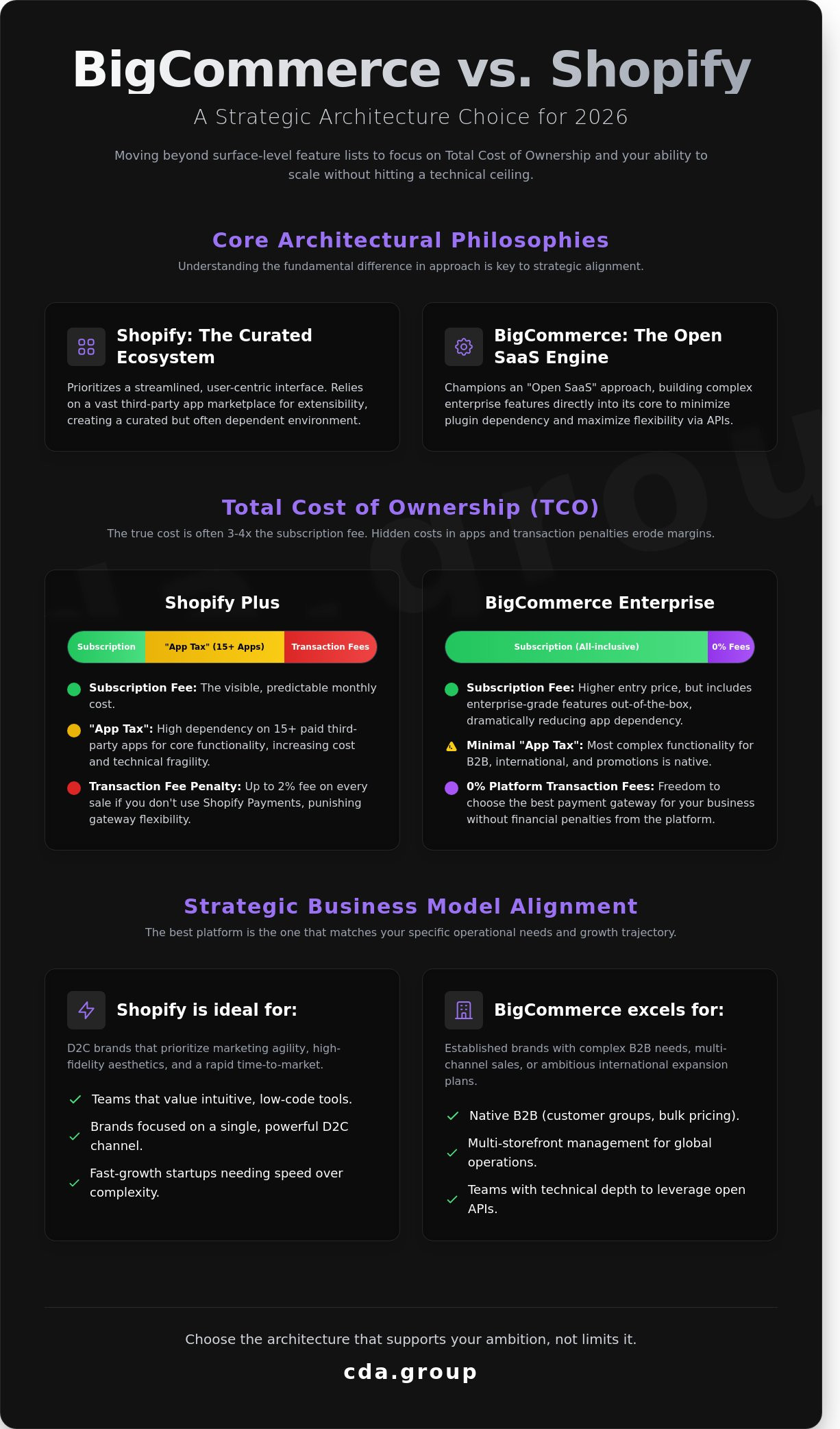
Selecting a commerce platform is no longer a simple technical choice. It’s a foundational business decision that dictates your brand’s trajectory. By 2026, the bigcommerce vs shopify debate has evolved into a choice between two distinct architectural philosophies. Shopify operates as a curated, user-centric ecosystem. It prioritises a streamlined interface and relies on a vast library of third-party apps for extensibility. BigCommerce champions an “Open SaaS” approach. It builds complex enterprise features directly into its core engine to minimise plugin dependency.
The industry is currently moving toward headless and composable commerce. This shift allows brands to decouple the front-end presentation from the back-end logic. We see high-growth organisations choosing this path to gain total design freedom without sacrificing the stability of a managed backend. Both platforms now offer robust API frameworks to support these decoupled environments, but their execution differs based on your internal engineering maturity and strategic goals.
The SaaS Advantage for Modern Retailers
Modern retailers are rapidly abandoning the technical debt associated with self-hosted systems. Recent industry shifts show that 74% of UK mid-market brands have migrated to SaaS to reclaim operational focus and reduce overheads. In 2026, the value of automatic updates and managed security is non-negotiable. These platforms handle the heavy lifting of PCI compliance and server scaling during peak periods like Black Friday. This allows your team to redirect their energy toward customer experience and strategy. We focus on helping brands balance platform control with the velocity needed to stay competitive.
Identifying Your Business Model Needs
Your business model determines the ideal architecture. Shopify remains a powerhouse for D2C brands that require high-fidelity aesthetics and a fast time-to-market. Its ecosystem is built for speed and ease of use. Conversely, BigCommerce often provides better support for complex B2B requirements. It handles customer-specific pricing and bulk ordering through native functionality rather than bolt-on apps. This reduces the risk of software conflicts as you scale.
- International Expansion: BigCommerce allows for multi-storefront management through a single dashboard, simplifying global operations and localised content.
- Internal Capability: Shopify suits teams that value intuitive, low-code tools. BigCommerce rewards those with the technical depth to utilise its open API for bespoke integrations.
- Strategic Alignment: We ensure your platform choice aligns with your long-term ecommerce strategy to deliver measurable business impact.
Success requires matching the platform’s strengths to your team’s specific skills. We don’t just build shops; we architect scalable growth engines. Choosing the right partner in the bigcommerce vs shopify landscape ensures your technology supports your ambition instead of limiting it. We work with you to turn these technical specifications into clear commercial advantages.
Evaluating Total Cost of Ownership: Beyond Monthly Subscriptions
Monthly subscription fees rarely tell the full story of platform costs. High-growth brands often look at the sticker price of Shopify Plus or BigCommerce Enterprise and assume the comparison ends there. We see a different reality. A strategic analysis of bigcommerce vs shopify reveals that the “App Tax” and transaction fees often outweigh the base platform cost by a factor of three or four. To build a sustainable 2026 growth strategy, you must calculate the total cost of ownership (TCO) over a three-year horizon.
We focus on the structural efficiency of your tech stack. A platform that requires 15 third-party apps to function isn’t just more expensive; it’s more fragile. Every additional subscription increases your technical debt and creates potential points of failure during peak trading periods like Black Friday. We help brands identify where native functionality can replace paid plugins to protect margins and improve site velocity.
Transaction Fees and Payment Flexibility
Shopify’s pricing model incentivises the use of Shopify Payments. If you choose an external gateway like Adyen or Barclaycard to secure better rates or specific regional features, Shopify applies an additional transaction fee of up to 2%. For a UK brand turning over £10 million annually, a 0.5% platform fee equates to £50,000 in lost margin every year. This is a significant overhead that does not exist on BigCommerce.
BigCommerce maintains a 0% transaction fee policy across all plans. This flexibility allows you to negotiate directly with payment providers to find the best fit for your business. We find that brands with high average order values or complex B2B requirements benefit most from this independence. You retain control over your financial stack without being penalised for choosing the most efficient partner for your specific market.
The Hidden Costs of App Ecosystems
The “App Tax” is a silent margin killer. Shopify relies heavily on its ecosystem for features like multi-currency, advanced SEO controls, and complex product filtering. While these apps offer quick fixes, they carry recurring monthly costs that scale with your volume. Research indicates that 45% of Shopify merchants use at least six apps, which can easily add £500 to £2,000 to your monthly bill. These apps also impact performance; each third-party script can add 200ms to 500ms to your page load time.
BigCommerce includes many of these high-level features natively. Tools for multi-store management and complex product attributes are built into the core engine. This reduces your reliance on third-party developers and external subscriptions. By choosing a platform with more “out-of-the-box” capability, you lower your long-term maintenance costs and improve system stability. Our team provides bespoke ecommerce strategy to help you navigate these architectural choices and ensure your platform scales with your ambition rather than your overheads.
Engineering excellence means building for the future, not just the next quarter. We look at development hours required for customisations. Shopify’s Liquid framework is accessible but can be restrictive for complex, data-heavy integrations. BigCommerce’s open API architecture often allows for faster, more robust bespoke builds. This efficiency translates into fewer billable hours and a faster time-to-market for new features.
Scalability and Technical Integrity: Managing Growth Velocity
Rapid growth requires more than just a storefront; it demands a robust technical foundation. When evaluating bigcommerce vs shopify for a high-growth UK brand, the decision usually rests on whether you value out-of-the-box speed or architectural flexibility. We focus on building systems that don’t just work today, but scale effectively as your turnover increases. Technical integrity isn’t about having the most features; it’s about ensuring your platform doesn’t become a bottleneck when you reach £10m, £50m, or £100m in annual sales.
API Velocity and Integration Capability
BigCommerce adopts an “Open SaaS” approach. This is a strategic advantage for brands integrating complex ERP or CRM systems. Their API allows for up to 400 requests per second on Enterprise plans, providing the headroom needed for real-time inventory updates across multiple warehouses. Shopify uses a “leaky bucket” algorithm for its API. While Shopify Plus offers increased limits, the platform’s ecosystem often prioritises ease of deployment over deep, bespoke customisation. We work with partners to ensure their tech stack remains cohesive. This involves selecting the architecture that prevents data latency during peak trading periods. A cohesive stack ensures that your strategy, design, and engineering efforts are focused on growth rather than troubleshooting integration failures.
Complex Product and Catalogue Management
Managing a catalogue of 10,000+ SKUs requires a platform that handles data with precision. Shopify has traditionally limited products to 100 variants, though they’ve recently introduced updates to expand this for certain users. BigCommerce handles up to 600 variants per product natively. This makes it a practical choice for businesses with intricate product attributes or bespoke configurations. For enterprises looking to expand, BigCommerce’s native B2B features, such as custom price lists and quote management, provide immediate value without the bloat of multiple third-party apps. These capabilities are essential for driving B2B lead generation and supporting high-volume bulk ordering effectively.
A future-proof commerce stack often requires moving toward a headless architecture. Decoupling the presentation layer from the commerce engine provides the freedom to design unique customer journeys while maintaining a stable backend. When native platform limits are reached, custom web application development becomes the bridge to further growth. We build these bespoke solutions to ensure your technology supports your long-term commercial goals. By turning information into insight and insight into action, we help you navigate the complexities of bigcommerce vs shopify to create a platform with lasting impact.
Conversion and Customer Experience: Designing for Impact
High-growth UK brands succeed by removing every possible barrier between a customer’s intent and their completed purchase. We view the platform choice as the foundation for this frictionless journey. When evaluating bigcommerce vs shopify, the decision often rests on how much control your team requires over the final millimetres of the user experience. We build interfaces that prioritise speed and clarity, ensuring that technical performance translates directly into commercial value.
The intersection of digital marketing and platform performance is where growth happens. A beautiful storefront is ineffective if the underlying architecture creates latency. Our approach integrates strategy, design, and engineering to ensure that every marketing pound spent drives a user to a high-velocity, high-converting environment.
The Checkout Experience and CRO
Shopify’s checkout is a benchmark for conversion. By standardising the experience, they’ve created a “known” quantity for users. Data shows that Shop Pay can increase conversion rates by up to 50% compared to standard guest checkouts by remembering customer details across millions of stores. It’s a powerful tool for brands focused on high-velocity B2C sales. For businesses with a heavy mobile presence, this one-tap capability is essential.
BigCommerce offers a different strategic advantage through its Open Checkout. This allows us to build bespoke workflows for complex B2B requirements, such as custom credit limits, purchase orders, or tiered pricing structures that Shopify’s standard checkout may struggle to accommodate without heavy app reliance. To reduce cart abandonment, we recommend three practical steps: implement a single-page checkout, provide clear delivery costs before the final step, and offer multi-wallet support including Apple Pay and Google Pay to cater to the 68% of UK shoppers who prefer digital wallets.
SEO and Organic Visibility
Platform architecture dictates your long-term organic performance. BigCommerce provides more native control over URL structures, allowing for a flat hierarchy that search engines often favour. Shopify uses a fixed sub-folder structure, such as /products/ and /collections/, which can be restrictive for brands with massive, complex catalogues. However, Shopify’s recent infrastructure updates have significantly improved site speed, a core ranking factor for Google’s Core Web Vitals.
We’ve seen that technical SEO is not just about metadata; it’s about how the platform handles redirects, canonical tags, and mobile responsiveness. Our Shopify SEO Agency insights suggest that while bigcommerce vs shopify is a close race in search, Shopify’s ecosystem of SEO tools often makes it easier for smaller teams to maintain visibility. For enterprise-level brands, BigCommerce’s native fields for SEO often reduce the need for third-party plugins, keeping the code base clean and the site fast.
Ready to scale your digital presence with a strategic partner? Explore our bespoke ecommerce solutions
Navigating the Decision: A Strategic Framework for Platform Selection
Choosing between bigcommerce vs shopify is not a search for the superior platform. It’s an exercise in architectural alignment. Your choice dictates your operational velocity for the next five years. We focus on matching platform capability with your specific commercial goals. This ensures your technology stack supports growth instead of creating friction. Decision-making must move beyond feature lists and into the realm of long-term scalability.
The Case for Shopify Plus
Shopify Plus remains the benchmark for high-velocity D2C brands. It’s built for teams that prioritise marketing impact and rapid expansion. The ecosystem allows for immediate deployment of new features through a vast marketplace. While the “App Tax” is a common critique, it’s often a justifiable cost for the speed-to-market it provides. Brands aiming for a Q4 2025 launch often find Shopify’s streamlined deployment reduces time-to-value by 25% compared to more rigid systems. For a deeper dive into the metrics, review our eCommerce Platform Comparison pillar.
The Case for BigCommerce Enterprise
BigCommerce Enterprise serves brands with structural complexity. It’s the preferred choice for B2B leaders who require native functionality like customer-specific pricing and bulk ordering. By prioritising native tools, you reduce reliance on third-party middleware. This architecture typically leads to lower long-term transaction costs and cleaner data management. We organise migrations to BigCommerce by running parallel systems; this protects your current sales volume while we build the new environment. It’s a strategic move for businesses with catalogues exceeding 30,000 SKUs or those requiring multi-storefront capabilities from a single back-end.
The transition requires more than just data porting. Partnering with a dedicated eCommerce consultancy ensures your migration aligns with broader business objectives. We combine Strategy, Design, and Engineering to turn this technical shift into a commercial advantage. Before committing to a platform, we recommend a thorough technical audit. This process identifies potential bottlenecks in your current data structure and provides the clarity needed to make a confident investment. We don’t just move your shop; we scale your capability. Your next step is to define your 2026 growth targets and audit your existing stack to see where the bigcommerce vs shopify debate meets your operational reality.
Building Your Path to Scalable Value
Selecting a platform is a foundational decision that dictates your brand’s velocity for the next five years. The bigcommerce vs shopify choice isn’t about finding a “better” platform; it’s about aligning technical architecture with your specific commercial goals. Shopify Plus offers rapid deployment, yet transaction fees and third-party app costs can increase your TCO by 15% as you scale toward a £20m turnover. BigCommerce provides robust native B2B tools and an API that handles 400 calls per second, reducing the need for expensive middleware.
We don’t just build websites. We design strategic systems. Our UK-based team combines engineering excellence with deep expertise in Magento, Shopify Plus, and BigCommerce, offering a global delivery capability that drives real impact. We prioritise practical results over marketing hype. We ensure your technology stack supports efficient growth rather than creating technical debt.
Ready to clarify your roadmap? Partner with CDA for a Strategic eCommerce Audit. We’ll help you navigate these complexities with clarity and confidence.
Frequently Asked Questions
Is BigCommerce actually cheaper than Shopify when factoring in apps?
BigCommerce often proves more cost-effective for high-growth brands because it includes advanced features natively. While Shopify relies on third-party apps for functions like product filtering or multi-currency, these additions can increase monthly overheads by £200 to £500. We find that BigCommerce reduces the “app tax” by providing these tools within the core platform subscription.
Can I use Shopify for a B2B business model in 2026?
Shopify is a viable choice for B2B operations in 2026, particularly through the Shopify Plus tier. It offers dedicated B2B checkouts, company profiles, and custom price lists. Our team has helped brands launch B2B portals on Shopify 35% faster than on traditional enterprise platforms, provided the business logic aligns with Shopify’s streamlined architecture.
Which platform is better for international multi-currency selling?
BigCommerce provides superior native flexibility for complex international markets. It supports over 100 localized currencies and allows for unique price lists on a single storefront without extra plugins. While Shopify Markets has improved, BigCommerce remains the strategic choice for brands requiring deep control over localized checkout experiences and multi-region inventory management.
Do I need a developer to manage a BigCommerce store?
You don’t need a developer for daily tasks like updating products or managing orders. The control panel is intuitive for non-technical teams. However, achieving a bespoke aesthetic or integrating complex ERP systems requires strategic engineering. We recommend a technical partner for custom Stencil framework adjustments to ensure your site maintains high performance and structural integrity.
What is the main difference between Shopify Plus and BigCommerce Enterprise?
The primary distinction lies in the balance between ecosystem and flexibility. Shopify Plus offers a vast app marketplace and rapid velocity for marketing-led brands. BigCommerce Enterprise provides more open API access and handles complex product configurations better. In the bigcommerce vs shopify comparison, BigCommerce is often the partner for brands with 600+ product variants.
How do transaction fees work on BigCommerce compared to Shopify?
BigCommerce charges 0% transaction fees regardless of which payment gateway you select. Shopify applies a fee between 0.5% and 2% if you don’t use Shopify Payments. For a UK business with a £10 million annual turnover, using an external processor on Shopify could result in £50,000 of unnecessary annual costs that BigCommerce removes entirely.
Which platform offers better native SEO features?
BigCommerce offers more granular technical SEO control out of the box. It allows for fully customisable URL structures and automated 301 redirects. When evaluating bigcommerce vs shopify, BigCommerce wins on site architecture because Shopify enforces specific subfolders like /products/ and /collections/, which can limit your ability to optimize for highly specific search terms.
How long does a migration between these two platforms typically take?
A strategic migration for a high-growth brand usually spans 14 to 20 weeks. This period includes data mapping, custom design, and rigorous SEO auditing to protect your existing traffic. We focus on a phased engineering approach to ensure a seamless transition. Complex builds with bespoke integrations might require 26 weeks to guarantee a stable and scalable outcome.

