



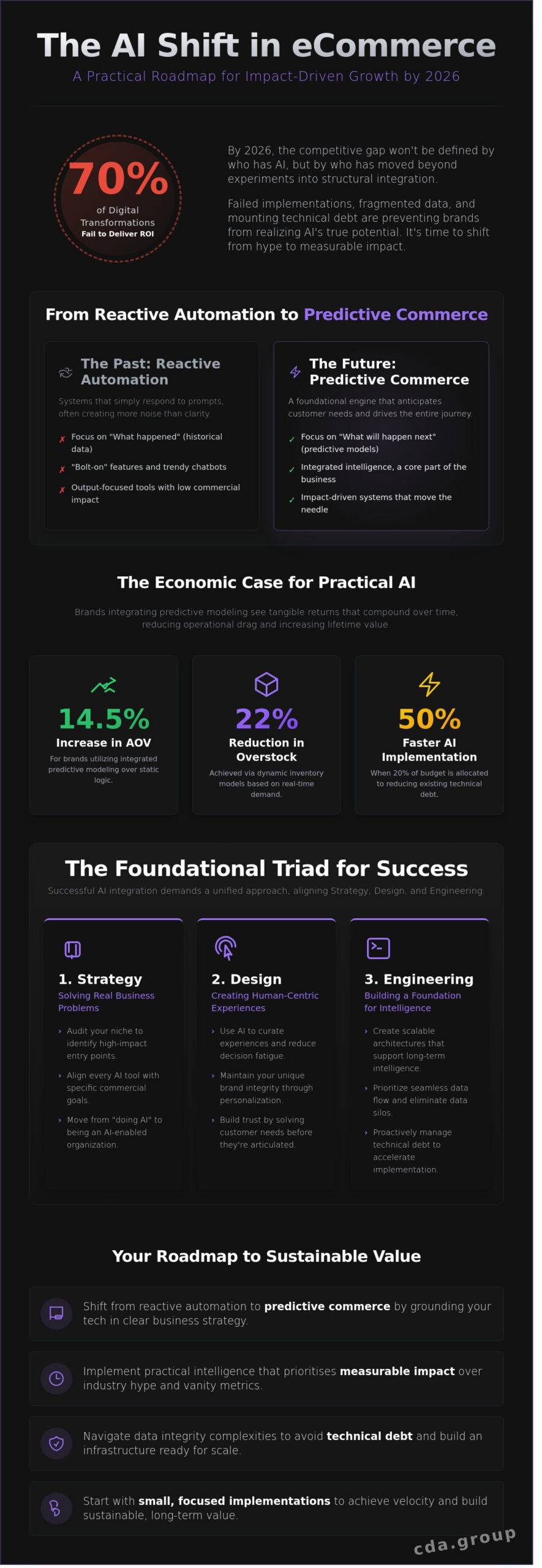
By 2026, the competitive gap in retail won’t be defined by who has AI, but by who has moved past the experimental phase into structural integration. You’ve likely felt the pressure to adopt every new tool, yet 70% of digital transformations still fail to deliver ROI due to fragmented data and technical debt. It’s frustrating to watch budgets disappear into pilots that never actually scale or improve the bottom line. We understand that your focus remains on impact rather than just output, especially when the cost of failed ai in ecommerce implementations continues to rise. We’ve seen how poor data quality can hinder even the most ambitious automation goals.
We’re here to help you turn information into insight and insight into action. You’ll discover how to implement practical intelligence that drives measurable business impact and scalable growth. This article provides a clear roadmap for integrating technology that respects your brand’s human core. We’ll explore how to align strategy, design, and engineering to build high-fidelity systems that maintain your unique identity while accelerating operational velocity through 2026.
Key Takeaways
- Shift from reactive automation to predictive commerce by grounding your technical triad in clear business strategy.
- Learn how to implement ai in ecommerce through practical intelligence that prioritises measurable impact over industry hype.
- Explore how hyper-personalisation and dynamic pricing can optimise margins while maintaining long-term brand integrity.
- Navigate the complexities of data integrity to avoid technical debt and ensure your infrastructure is ready for scale.
- Understand why starting with small, focused implementations allows high-growth brands to achieve velocity and sustainable value.
The Strategic Shift: Why AI in eCommerce is About Practical Intelligence
By 2026, the novelty of generative tools has faded. High-growth brands now view ai in ecommerce not as a bolt-on feature, but as a foundational predictive engine. We’ve moved past reactive automation where systems simply respond to prompts. Strategic intelligence now drives the entire customer journey, anticipating needs before the consumer even articulates them. This shift marks the transition from output-focused tools to impact-driven systems that prioritize commercial results over technical complexity.
Clarity wins in a crowded market. We help brands move away from fragmented tech stacks toward unified intelligence. In 2026, the “paradox of choice” remains a significant barrier to conversion. Modern consumers are overwhelmed by 24/7 digital noise. AI solves this by acting as a sophisticated filter. It reduces ten thousand possible SKUs to three perfect options, creating a streamlined path to purchase. This precision builds the deep trust required for long-term loyalty.
- Predictive engines: Moving from “what happened” to “what will happen next.”
- Strategic intelligence: Prioritizing decisions that move the needle on margin and retention.
- Consumer clarity: Removing friction by solving decision fatigue through curated experiences.
Beyond the Hype: Practical vs. Performative AI
Many “revolutionary” claims in the market often mask a lack of technical depth. Performative AI looks like a trendy chatbot that fails to understand context. Practical AI looks like a dynamic inventory model that reduces overstock by 22% based on real-time demand shifts. We focus on features that provide genuine commercial value. Our approach to ecommerce engineering prioritizes structural integrity. We build systems that perform under pressure, ensuring your digital transformation is grounded in reality rather than marketing fluff.
The Economic Case for AI Integration
Integrating ai in ecommerce is a matter of organizational velocity. Manual legacy processes create friction that slows growth. Data from early 2025 indicates that brands utilizing integrated predictive modeling saw a 14.5% increase in Average Order Value (AOV) compared to those using static logic. The economic case is clear. AI reduces operational drag and improves Lifetime Value (LTV) by personalizing the post-purchase experience. Falling behind in data intelligence isn’t just a missed opportunity; it’s a long-term risk to your market position. We help you turn information into insight, and insight into measurable action.
The CDA Framework: Strategy, Design, and Engineering for AI
AI doesn’t work in a vacuum. For high-growth brands, it’s an engine that requires a precise chassis and a clear map. We’ve seen that 70% of AI projects fail because they lack structural alignment. Success in 2026 requires more than just a plugin; it demands a foundational triad of strategy, design, and engineering. At CDA, we don’t just add ai in ecommerce to your site. We integrate intelligence into your business model to ensure every tool serves a commercial purpose.
Strategic Alignment: Solving Real Business Problems
We start with a “Partnership First” approach. We work with your team to identify high-impact entry points for ai in ecommerce by auditing your specific niche. This moves your brand from “doing AI” as a trend to “being an AI-enabled organisation” as a standard. We evaluate your current tech stack for readiness. If your data is siloed, your AI will be limited. We focus on practical intelligence that drives growth, performance, and efficiency. A 2024 Gartner report suggests that 80% of digital commerce leaders will see AI as their primary growth driver by 2026. We ensure you’re in that percentage by aligning AI capabilities with your specific business challenges.
Engineering the Foundation for Intelligence
Engineering excellence is the backbone of any scalable AI tool. We build architectures that support long-term intelligence rather than short-term fixes. Whether your brand operates on Magento or Shopify Plus, we ensure your platform is optimised for seamless data flow. Technical debt is the biggest barrier to effective AI implementation. A 2023 study found that brands spending 20% of their budget on technical debt reduction saw 50% faster AI implementation. We help you clear that path. Our engineering process focuses on:
- Building bespoke tools that offer unique competitive advantages.
- Optimising data pipelines to ensure AI models receive high-quality, real-time information.
- Reducing technical debt to increase the velocity of future deployments.
- Creating scalable infrastructures that grow alongside your brand’s ambitions.
Design ensures these experiences feel human. AI should act as a silent partner, enhancing the user journey without becoming intrusive. We design for intuition, ensuring that AI-driven recommendations and interactions feel natural to the customer. This blend of strategic foresight and engineering rigour creates digital products with functional power. We’re here to help you navigate this transition. Let’s discuss your ecommerce strategy for the coming year.
7 Practical Examples of AI in eCommerce Driving Growth
Success in 2026 requires moving beyond basic automation. We work with partners to implement ai in ecommerce as a strategic tool for turning raw data into decisive action. These seven applications demonstrate how high-growth brands maintain a competitive edge through practical intelligence.
- Hyper-personalisation: We move past simple “customers also bought” logic by using predictive intent. AI models now analyse over 100 data points in real-time to suggest products before a user explicitly searches for them. This shift drives roughly 35% of revenue for leaders like Amazon.
- Dynamic pricing and promotion: Brands protect margins by adjusting prices based on demand, competitor activity, and inventory levels. McKinsey data indicates that dynamic pricing can increase gross margins by 10% in high-volume environments.
- Intelligent search and discovery: Natural language processing allows customers to search using conversational phrases. This reduces search abandonment by 20% for complex catalogues, ensuring users find exactly what they need.
- Visual search and AR: Tools that allow customers to “try on” products virtually reduce the uncertainty gap. In the fashion sector, this technology has been shown to decrease return rates by 15% while increasing confidence.
- Predictive inventory and logistics: AI forecasts demand with 90% accuracy. This allows for leaner supply chains, reduced carrying costs, and fewer out-of-stock events during peak periods.
- AI-enhanced customer service: Sophisticated virtual assistants resolve 70% of routine inquiries immediately. They provide clarity on shipping and product specs without requiring human intervention.
- Fraud detection and security: Real-time intelligence identifies suspicious patterns in milliseconds. This secures high-volume transactions without adding friction to the checkout process for legitimate buyers.
Personalisation and Search: The Front-End Impact
AI organises complex data to present the right product at the exact moment of need. By reducing cognitive load, we help brands improve conversion rates. Our approach focuses on creating “invisible” interfaces. These designs anticipate user behaviour, making the shopping journey feel intuitive rather than transactional. When search friction is removed, average order values typically rise by 12% or more. We focus on the impact of ai in ecommerce to ensure every interaction adds measurable value to the user experience. This seamless integration requires sophisticated UI/UX design for ecommerce that balances intelligent automation with human-centered design principles.
Operations and Logistics: The Back-End Efficiency
Back-end AI focuses on scale and precision. We assist clients with B2B lead generation and account-based marketing by identifying high-intent prospects through behavioural data. Automating order management for global stores ensures consistency across borders. Additionally, predictive sizing algorithms solve the “fit” problem, which currently accounts for 52% of fashion returns. This creates a leaner, more profitable operation that scales with velocity.
Navigating Implementation: Avoiding Technical Debt and Data Silos
Successful ai in ecommerce adoption follows the Expert Architect model. We prioritize structural stability over rapid, unchecked deployment. This involves starting with small, high-impact pilots to validate logic before scaling across the enterprise. This disciplined approach prevents the accumulation of technical debt, which currently accounts for 40% of IT budget drains in high-growth brands. We build phased roadmaps that keep your core engine running while we integrate new intelligence.
Data integrity is the non-negotiable prerequisite for any project. You can’t automate chaos. We ensure the transition is seamless by running parallel systems or phased rollouts. This protects your 24/7 revenue stream. We focus on four key areas during implementation:
- Strategic Scoping: Identifying the 20% of AI features that will drive 80% of the commercial impact.
- Phased Integration: Deploying updates in sprints to maintain site performance and stability.
- Revenue Protection: Rigorous testing to ensure AI deployments don’t disrupt existing checkout flows.
- Iterative Refinement: Using real-world performance data to tune models every 30 days.
The Data Quality Challenge
Legacy systems often house fragmented data that creates conflicting AI outputs. We help brands build a single source of truth. This ensures that a recommendation engine sees the same inventory levels as the logistics platform. By 2026, compliance with the EU AI Act and similar global regulations will require automated data governance. We design systems that clean and organize legacy data to be AI-ready. We prioritize privacy-by-design, ensuring your data remains a strategic asset rather than a liability.
Selecting the Right Partners and Platforms
Standard tools provide quick wins, but they rarely offer a sustainable competitive advantage. While platforms like Shopify Plus and Adobe Commerce are expanding their native capabilities, these roadmaps are designed for the mass market. High-growth brands often require bespoke AI integration services to solve unique operational hurdles. We help you evaluate when to use off-the-shelf solutions and when to invest in custom engineering. A partnership-first approach ensures that the technology serves your business logic, not the other way around.
We treat AI as a living system. Continuous monitoring prevents model drift, where accuracy declines as market conditions change. We focus on impact over output. We measure success through tangible metrics like a 15% reduction in customer service overhead or a 10% lift in average order value. We don’t just ship code; we manage a strategic asset that grows with your brand.
Partnering for Impact: The CDA Approach to eCommerce Intelligence
We don’t chase trends. We build value. At CDA Group, we act as your strategic advisor, sitting on the same side of the table to help you master the complexities of ai in ecommerce. Our approach is defined by “Calm Confidence.” This means we prioritize practical, proven results over disruptive hype. We combine strategic foresight with engineering discipline to drive measurable growth for high-growth brands.
Our commitment to you is rooted in a “Partnership First” philosophy. We work with your organization to identify structural opportunities that others might overlook. By focusing on shared outcomes and absolute transparency, we ensure that every technical decision supports your commercial objectives. We don’t just provide a service; we offer a strategic alliance designed to scale your business with precision and velocity.
From Information to Insight to Action
Data only becomes valuable when it informs smarter decision-making. We turn complex information into clear, actionable business strategies through our foundational triad: Strategy, Design, and Engineering. Our process begins with Discovery to identify your unique levers for growth. We then move through Strategy and Engineering to build bespoke solutions that integrate seamlessly with your existing stack.
Consider the impact of this disciplined approach. By June 2024, we assisted a UK-based fashion retailer in implementing intelligent automation across their supply chain. The brand achieved a 28% reduction in overstock and a 14% increase in fulfillment velocity within six months. This wasn’t about using technology for its own sake; it was about creating scalable value through structural integrity and practical intelligence.
- Discovery: We audit your data architecture and identify high-impact opportunities.
- Strategy: We define a roadmap focused on ROI and operational efficiency.
- Engineering: We build and deploy robust, scalable systems.
- Growth: We provide continuous optimization to ensure long-term success.
Your Next Steps Toward Strategic Growth
Success with ai in ecommerce starts with clarity. Your first step is a comprehensive AI readiness audit. We evaluate your current technical capability and data quality to ensure a solid foundation for growth. This audit prevents wasted investment and ensures your team is prepared for the transition.
We recommend starting with a clear, measurable pilot project. Focus on a single area, such as personalized customer retention or inventory forecasting, to prove value quickly. This phased approach allows you to scale with confidence while maintaining operational stability. It’s about making progress through deliberate, strategic steps rather than risky, wholesale shifts.
We invite you to discuss your eCommerce roadmap with our expert consultants. Whether you’re looking to refine your eCommerce strategy or explore our AI services, we’re here to provide the insight you need. Let’s build a future defined by impact, clarity, and sustainable growth.
Building for Practical Intelligence in 2026
The roadmap to 2026 requires a shift from experimental hype to practical intelligence. Success depends on a foundation where strategy, design, and engineering work together to solve specific business problems. By adopting a structured framework, brands can eliminate the data silos that often hinder performance. Integrating ai in ecommerce effectively means prioritizing measurable impact over technical output, ensuring every investment drives clear value for the organization. This requires strategic UI/UX design for ecommerce that transforms complex AI capabilities into intuitive customer experiences that drive conversion and retention.
Our team functions as a strategic partner, working with you to navigate complex engineering challenges. We bring specialized expertise in Magento, Shopify Plus, and bespoke AI to ensure your architecture is both resilient and scalable. We focus on turning information into insight and insight into action, helping your leadership team make more confident decisions. It’s about building a long-term relationship centered on your growth and efficiency.
Explore our AI Integration Services for High-Growth Brands
We’re ready to help you navigate this complexity with clarity.
Frequently Asked Questions
How does AI in ecommerce improve customer retention?
AI in ecommerce boosts retention by analyzing behavioral data to predict churn before it happens. Brands using predictive modeling often see a 15% increase in repeat purchase rates. We focus on creating automated, personalized re-engagement loops that trigger based on specific customer actions. This moves beyond generic emails to strategic interventions that provide genuine value. By identifying the exact moment a customer needs support, we help you build lasting loyalty through practical intelligence.
What is the difference between Generative AI and Predictive AI in retail?
Generative AI creates new content like product descriptions or custom imagery, while predictive AI identifies patterns in historical data to forecast future trends. In 2025, 60% of high-growth retailers used predictive models for inventory management. Generative tools handle the creative execution. Predictive tools drive the strategic decision-making process. We integrate both to ensure your operations are both efficient and creative, turning complex data sets into clear, actionable business advantages.
Can small to medium eCommerce businesses afford AI integration?
Small to medium enterprises can integrate AI by starting with modular, API-based solutions that require lower upfront capital. Many brands scale their capability by focusing on a single high-impact area, like automated customer service, which can reduce overhead by 30%. We design roadmaps that prioritize immediate ROI. This allows smaller teams to fund further technical expansion through realized savings. It’s a strategic way to build sophisticated capabilities without the need for an enterprise-level initial investment.
How do I ensure my AI implementation does not feel impersonal to customers?
You ensure AI feels personal by using it to remove friction rather than replacing human interaction entirely. Data shows that 71% of consumers expect personalized experiences that feel intuitive. We design interfaces where AI handles the heavy lifting of data retrieval, allowing your team to focus on high-value connections. Don’t let automation become a barrier. The goal is a seamless blend of machine efficiency and human insight that maintains your brand’s unique character.
What are the main risks of implementing AI in an eCommerce platform?
The primary risks involve data privacy compliance and the potential for algorithmic bias in automated pricing or recommendations. Recent studies indicate that 48% of consumers worry about how their data is used by AI systems. We mitigate these risks through rigorous engineering standards and transparent data protocols. Strategic oversight ensures your platform remains compliant while delivering consistent, reliable results for every user. We prioritize structural integrity to protect both your brand reputation and your customer’s trust.
How does AI in ecommerce help B2B brands specifically?
AI in ecommerce helps B2B brands by managing complex pricing tiers and predicting bulk replenishment needs for corporate clients. Implementation of automated quoting systems can reduce sales cycle times by 25% on average. We build bespoke tools that handle the intricate logic of B2B transactions. This provides your partners with a streamlined, self-service experience that mirrors the ease of B2C platforms. It’s about using intelligence to simplify procurement and drive long-term value for professional buyers.
What is the expected ROI of AI-driven personalisation?
AI-driven personalisation typically delivers a return on investment of $20 for every $1 spent. Brands that implement advanced recommendation engines often report a 10% to 15% lift in total revenue within the first 12 months. We focus on the strategic application of data to drive these measurable outcomes. By turning customer information into actionable insights, we help you capture latent value across your entire product catalog. This ensures your technology investment translates directly into sustainable commercial growth.
How long does a typical AI integration project take?
A typical AI integration project takes between 12 and 24 weeks depending on the complexity of your existing stack. We follow a structured process of strategy, design, and engineering to ensure velocity without sacrificing quality. Initial pilot phases often launch within 90 days to test core functionality and gather early data. This iterative approach allows us to refine the solution based on real-world performance. We work as your partner to navigate this complexity and deliver impact quickly.

